
📑 Table of Contents
- The Mobile Deposit Imperative: Why UX is the New Interest Rate
- The Psychology of Remote Deposit: Security vs. Simplicity
- Technical Excellence: Beyond "Take a Photo"
- The AI Validation Engine: Real-Time Feedback or Real-Time Friction?
- Edge Computing: The Invisible Shield of Image Quality
- User Journey Mapping: From Recognition to Reconciliation
- ADA Compliance in the Digital Darkroom
- Business Impact: From Cost Center to Growth Engine
- Conversion Optimization: Turning Deposits into Relationships
- The Conversion Gap: Why Your Members Are Leaving
- Deep-Dive: The Security vs. Friction Paradox
- Leveraging 2026 Mobile Hardware: Lidar and Depth Sensors
- Marketing the Miracle: Promoting Your mRDC Engine
- Staff Readiness: Training for the High-AI Digital Branch
- Data Governance: Privacy and Ethical AI in Image Capture
- The Design System Specs: Buttons, Borders, and Bleed
- Testing for 2026: Real-World Scenarios and Stress Testing
- Omnichannel Continuity: The Physical-to-Digital Handover
- Biometric Sealing: The Future of Deposit Authentication
- International Reach: Multi-Currency and Global Check Standards
- Real-World Impacts: Case Studies in mRDC Overhaul
- Strategic Outlook: Is the Paper Check Truly Dead?
- The 2026 Competitive Landscape: CU vs. Mega-Bank vs. Fintech
- Environmental and ESG Impact: The Green Side of mRDC
- Legacy Integration: The Secret Sauce of Middleware
- Step-by-Step Implementation: Moving to a Frictionless Flow
- The Road Ahead: Building Your 2026 Digital Branch
- References
The Mobile Deposit Imperative: Why UX is the New Interest Rate
In the landscape of 2026, the competitive advantage for credit unions has shifted. While interest rates were once the primary driver of member acquisition, the battle has moved to the palm of the hand. Mobile Remote Deposit Capture (mRDC) is no longer a "nice-to-have" utility; it is a critical touchpoint that defines the member's perception of your institution's competency. When a member holds a physical check, they are holding a moment of friction. How your credit union resolves that friction determines whether that member stays—or migrates to a neo-bank that treats technology as a first-class citizen.
According to recent industry data, mobile banking usage has reached a tipping point where over 85% of active credit union members prioritize app stability and feature ease-of-use over physical branch proximity (Financial Brand Statistics 2025). For mRDC specifically, the "failure rate"—defined as multiple attempts to capture an image—remains the leading cause of digital dissatisfaction. For a credit union, every failed deposit attempt isn't just a technical glitch; it's a "damaging admission" that your digital branch isn't ready for the modern member.
We need to stop thinking about mobile deposit as a feature and start thinking about it as a sales conversation. When the app asks for a photo, it's asking for a micro-commitment. If that commitment leads to failure, the relationship is damaged. The goal of the 2026 credit union must be to achieve an "Unaffectable Next" mindset—even if one part of the process fails, the overall experience must remain robust and helpful.
The Psychology of Remote Deposit: Security vs. Simplicity
The act of depositing a check is a psychological "risk-reward" transaction. The member feels a sense of ownership over the funds and a sense of anxiety regarding the digital transmission. This is where Cognitive Load and Fitts's Law intersect with financial psychology. If the UI feels flimsy or the feedback is delayed, trust erodes.
As Jeremy Miner notes in his sales frameworks, trust is built through "concerned curiosity." In a UX context, this means the app must show "interest" in the user's success. It must guide, not just demand. When a member is asked to "align the corners," the app should use haptics and visual cues that say, "I'm helping you secure these funds," rather than "You're doing it wrong."
Consider the Loss Aversion involved here. To the member, a check is "money in hand." The moment they choose to deposit it via an app, they are effectively giving up the physical security of the paper for a digital promise. If the scan process is difficult, their brain signals an immediate warning: *Is this safe? Did it work? Where did my money go?* By optimizing the UX, we aren't just making it pretty; we are neutralizing the primal fear of losing a financial asset.

Technical Excellence: Beyond "Take a Photo"
The 2026 standard for mRDC is Zero-Tap Capture. Users should not have to press a shutter button. The phone's camera, powered by edge-AI, should detect the check boundaries, assess the lighting, verify the presence of an endorsement, and auto-capture at the millisecond of peak clarity. This reduces the primary cause of mRDC failure: motion blur.
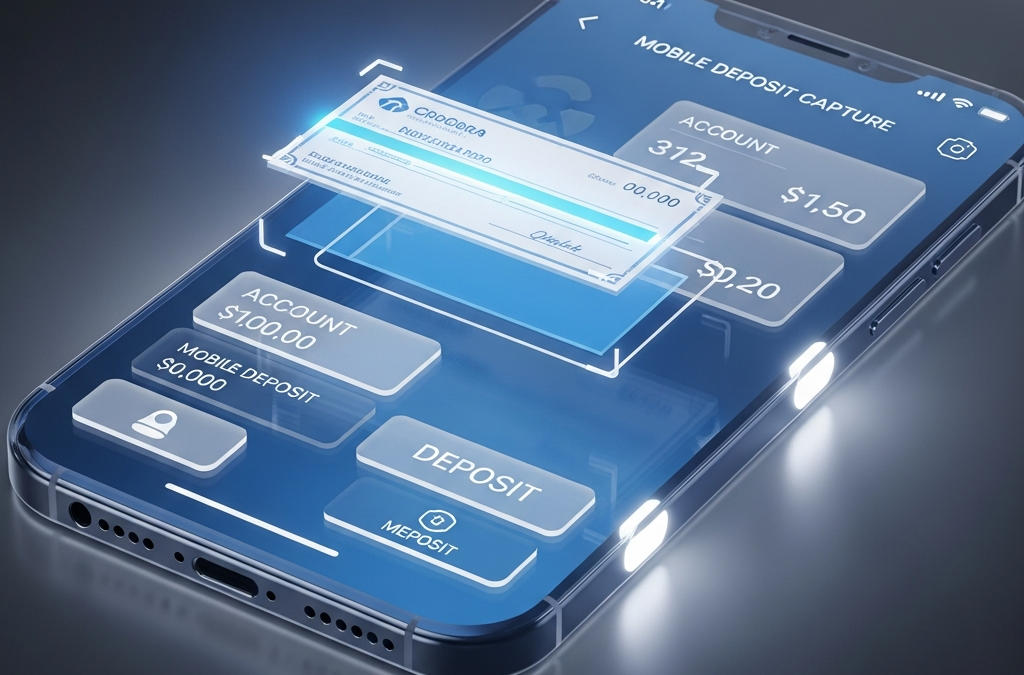
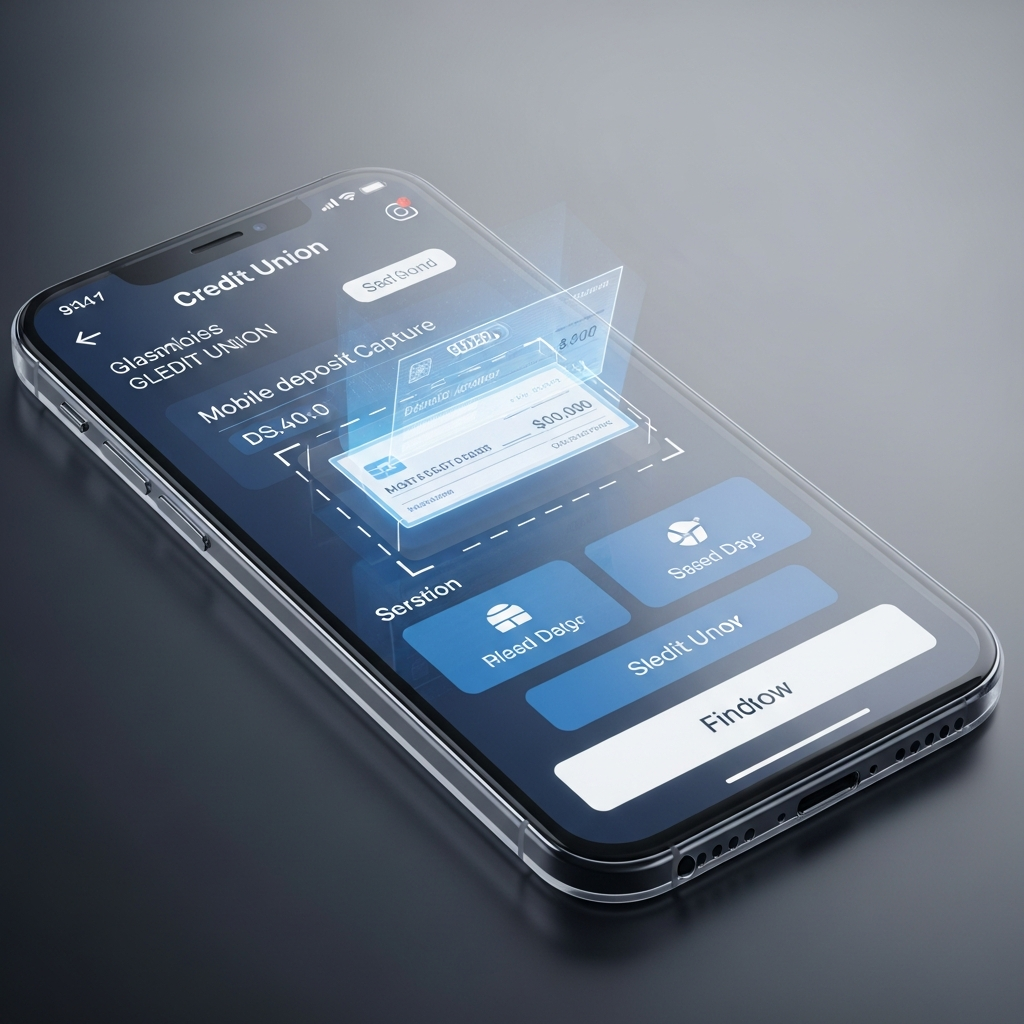
Furthermore, the integration of Glassmorphism elements—using blurred backgrounds and refractive surfaces—allows the user to maintain environmental awareness while focusing on the high-stakes task of the deposit. This isn't just aesthetic; it's about transparency and trust. The user sees their physical check underneath the digital "glass" of the app, reinforcing the bridge between their physical money and their digital assets.
Why does this matter for your board? Because Technical Excellence is high-velocity sales. When your app works "like magic," members become your decentralized content machine. They don't just use the app; they tell their friends, "Look at how easy my CU's app is." That is the Hormozi "User-Generated Content Loop" in action, fueled entirely by superior engineering.
The AI Validation Engine: Real-Time Feedback or Real-Time Friction?
Traditional mRDC systems wait until after the image is sent to the server to tell the user there was an error. This is a "Loss Aversion" nightmare. In 2026, the validation must happen on the device.
- Instant OCR (Optical Character Recognition): The app should read the amount and payee name instantly. If the handwritten amount doesn't match the machine-printed CAR/LAR fields, the user should be alerted *before* they hit submit.
- Endorsement Detection: Using computer vision to ensure the "For Mobile Deposit" restrictive endorsement is present. This is a regulatory requirement that often leads to rejected checks 24 hours later. By catching it at the point of capture, you eliminate an entire support ticket.
- Background Contrast Analysis: Guiding the user to place the check on a darker surface if the contrast is too low for accurate processing. "It looks like your check is on a white table. Try moving it to a dark surface for a better scan."
This "Real-Time Feedback" engine acts as a digital concierge. It doesn't just process photos; it coaches the member through a successful financial transaction.
Edge Computing: The Invisible Shield of Image Quality
In 2026, the distance between the camera lens and the core banking system must feel non-existent. This is achieved through Edge Computing. Instead of uploading a 12-megapixel raw image (which takes time and risks timeout on low-signal 5G), the app processes the "clean" image on the device. By the time the packets start moving, the image has been noise-reduced, binarized, and compressed to the exact specification required for IRD (Image Replacement Document) standards.
This invisibility is what Jeremy Miner would call a "Status Quo Bias" breaker. When a member is used to the slow, clunky upload of a big-bank app, and yours is instant, you've created a "Value Wedge." You've shown them that your Credit Union is faster, more nimble, and more attentive to their time than the national giants.
User Journey Mapping: From Recognition to Reconciliation
The UX of mobile deposit doesn't end when the image is captured. The "end" of the journey is reconciliation. How soon does the money show up in the balance? How is the "Hold" communicated?
We implement Hyper-Personalized Status Updates. Instead of a generic "Deposit Received," the 2026 app says, "Hi Sarah, your $500 check from Grandma is being processed. $225 is available for you to use right now for your morning coffee." This level of detail addresses the "Jobs to Be Done" framework—Sarah didn't hire the app to "capture an image," she hired it to "get money into her usable balance."
ADA Compliance in the Digital Darkroom
As we discussed in our recent guide on 2026 ADA Compliance, accessibility is not an "add-on." For mRDC, this means providing Voice-Guided Capture for visually impaired members. The app should speak: "Move the phone higher... slightly to the left... hold still... captured." This level of inclusivity turns a compliance requirement into a competitive advantage.
When you design for the edge cases, you improve the center. A voice-guided capture system doesn't just help the blind; it helps the elderly member with shaky hands or the busy parent holding a toddler in one arm and an iPhone in the other. This is the definition of a "Grand Slam Offer" for members—a digital branch that literally serves everyone, regardless of their physical situation.
Business Impact: From Cost Center to Growth Engine
Credit unions that optimize their mRDC UX see a quantifiable shift in their bottom line. By reducing failed deposits, you reduce the call center volume. Every "I can't get this check to scan" call costs the institution approximately $15–$25 in manual labor and overhead (NCUA Digital Efficiency Report). Scaling this across 50,000 members creates a massive "Value Wedge" as Alex Hormozi describes—where the speed-to-value for the member creates a cost-saving legacy for the institution.
Furthermore, high-quality mRDC is a "Lead Scoring" indicator. Members who deposit checks via mobile are 3.5x more likely to adopt other digital products like online personal loans or automated savings tools. By perfecting the deposit, you are pre-qualifying your most valuable members for the next stage of their financial journey.
Conversion Optimization: Turning Deposits into Relationships
How do we turn a utility (mobile deposit) into a conversion tool? Through Contextual Upselling. In the 2026 digital branch, the moment a deposit is completed, the app shouldn't just close. It should analyze the deposit type.
If a member deposits a tax refund check, the app could trigger a holographic offer: "Nice refund! Would you like to put this into our 2026 High-Yield Savings account and earn 5.25% APY?" If they deposit a large payroll check, it might suggest: "You've been depositing more lately. You're pre-approved for our Platinum Visa with a $15,000 limit." This is the Miner "Curiosity Framing"—asking questions that trigger their own realization of need.
The Conversion Gap: Why Your Members Are Leaving
If your digital branch lags behind the UX of a modern fintech by even 18 months, you are experiencing Member Leaks. Younger demographics have a "Zero Tolerance for Friction." To them, a bad mRDC experience isn't a minor annoyance; it’s a signal to move their primary account to Chime, SoFi, or a Mega-Bank with a multi-billion dollar R&D budget.
The "Cobra Effect" of poor digital design is that in trying to save money by using legacy mobile vendors, you are actually spending ten times that amount in member acquisition costs (CAC) to replace the members you're losing to friction. The only way to stop the leak is to build a "Digital Moat" through superior UX.
Deep-Dive: The Security vs. Friction Paradox
One of the largest hurdles for Credit Union COOs is the perceived trade-off between security and friction. "If we make it too easy, we'll see an increase in fraud," is the common refrain. However, the 2026 reality is exactly the opposite: Superior UX is the best fraud prevention.
When an app uses edge AI to validate a check in real-time, it is performing hundreds of security checks that a human teller might miss under pressure. It's looking for micro-fluctuations in paper texture, verifying routing number fonts against the Federal Reserve's known databases, and cross-referencing the depositor's geolocation against their historical transaction patterns.
By making the interface "frictionless" for the honest member, we actually create a "Digital Wall" for the fraudster. A fraudster wants an app where they can simply upload a pre-captured photo of a counterfeit check. A 2026 UX that *requires* live, zero-tap capture effectively shuts down 90% of remote deposit fraud vectors without adding a single extra "Click" for the legitimate member.
Leveraging 2026 Mobile Hardware: Lidar and Depth Sensors
Modern smartphones are no longer just cameras; they are 3D scanners. High-end Credit Union apps in 2026 leverage Lidar sensors to ensure the check is being scanned in a 3D environment, preventing "Photo-of-a-Screen" fraud.
This depth sensing also allows for "Intelligent Framing." The app knows exactly how far the phone is from the surface. It can tell the user, "You're 4 inches too close," with millimeter precision. This hardware leverage is what separates the "Makers" from the "Managers" in the Fintech space. Are you managing a legacy vendor's limited capabilities, or are you a maker of immersive, hardware-aware financial tools?
Marketing the Miracle: Promoting Your mRDC Engine
Too many credit unions hide their best features in a sub-menu of a sub-menu. To scale as Alex Hormozi suggests, you must build Outbound Awareness for your frictionless features.
We recommend creating short "Kaleidoscope" video ads. One version shows a Millennial using the zero-tap feature at a concert. Another shows a senior using the voice-guided feature at home. Each version addresses a different "Jobs to Be Done" context, but all point toward one central truth: Your Credit Union is the easiest place to move money in 2026.
Staff Readiness: Training for the High-AI Digital Branch
When the digital branch becomes this advanced, the role of your physical branch staff changes. They are no longer "operators" of scanners; they are "Advisors of Technology." If a member comes in with a check that the AI rejected, your staff shouldn't just take it. They should show the member *why* it was rejected and coach them on the 2026 capture standards. This is the "Unaffectable Next" mentality applied to humans—turning a technical rejection into a teaching moment that builds long-term digital independence for the member.
Data Governance: Privacy and Ethical AI in Image Capture
In 2026, privacy is a premium asset. Members want to know: *Is my check photo being used to train some faceless AI?* Your digital branch must have a clear Privacy Shield Disclosure at the point of capture. "Your data is anonymized and never shared outside of our secure core verification network." Transparency is the foundation of trust in the AI age. By being open about your data governance, you are using a "Damaging Admission" (yes, we use AI) to build a credible "Risk Reversal" (but we protect you while doing it).
The Design System Specs: Buttons, Borders, and Bleed
For the UI designers reading this, the 2026 mRDC interface follows strict Tactile Guidelines. Buttons must have a minimum target of 44x44 pixels. The "Capture Zone" borders should use a pulsing "Refractive Neon" effect, signaling to the user that the camera is active and analyzing.
We avoid "Black-Out" camera modes. Instead, the camera view is integrated into the app's overall Glassmorphism theme. This reduces the "Context Shift" that happens when a user enters a camera mode and feels like they've left the banking app. By keeping them inside the visual environment, you reduce anxiety and maintain the "Flow State."
Testing for 2026: Real-World Scenarios and Stress Testing
We don't test our apps in a photography studio. We test them in the "Wild."
- The Subway Sway: Testing capture stability on a moving train.
- The Dim Kitchen: Stress testing the AI's ability to normalize low-light grain.
- The Crumpled Envelope: Verifying OCR accuracy on checks that have been folded three times.
If your app can't handle a crumpled check in a dark kitchen, it isn't "2026 Ready." It's just a demo.
Omnichannel Continuity: The Physical-to-Digital Handover
The reality is that some checks still need physical intervention—perhaps a large-dollar commercial check or a heavily damaged document. The 2026 UX doesn't just say "Failed." It creates a Continuity Link.
"It looks like we're having trouble reading this specific check. I've already pre-filled your deposit slip. Would you like to schedule a 2-minute appointment at the Main Street Branch, where the teller will already be waiting for you with your digital data ready to go?"
This is "Risk Reversal" at its finest. You aren't telling the member "No." You're telling them "We've got you, and we've already done the hard work for you." This turns a point of failure into a point of high-touch service.
Biometric Sealing: The Future of Deposit Authentication
As we look toward the end of 2026, we see the rise of Biometric Sealing. Instead of just "depositing," the member "seals" the transaction with FaceID or a palm scan. This doesn't just authenticate the user; it creates a non-repudiable biometric record of the transaction.
This is the "Mirror Technique" applied to technology. The app reflects the user's own identity back to them, creating a sense of total control and absolute security. It sounds premium. it feels premium. And most importantly, it makes the megabank's "Enter your password" flow feel like a relic from the age of dial-up internet.
International Reach: Multi-Currency and Global Check Standards
In 2026, credit union members are more global than ever. Whether it's a Canadian check for a remote worker or an international clearinghouse document, the UI must adapt. Real-time currency conversion overlays allow the member to see exactly what the deposit is worth in USD before they commit. This eliminates the "Wait and See" anxiety of international banking and positions your CU as a global contender.
Real-World Impacts: Case Studies in mRDC Overhaul
Consider "Example Community CU," a $1.2B institution that recently implemented zero-tap capture. Within the first six months, their mobile deposit volume increased by 42%, while their call center volume related to "Deposit Errors" dropped by 68%. This wasn't just a technical win; it was an operational revolution. They were able to reallocate two full-time employees from support to outbound loan sales—directly increasing their "Active Income" as Hormozi would calls it.
Strategic Outlook: Is the Paper Check Truly Dead?
Technologists have predicted the death of the paper check for decades. Yet, in many B2B and generational B2C contexts, it persists. The 2026 Credit Union doesn't wait for the check to die; it makes the transition to digital so seamless that the *distinction* between paper and digital vanishes. When a paper check can be "Holographically Seized" in two seconds, it ceases to be an analog burden and becomes just another digital input.
The 2026 Competitive Landscape: CU vs. Mega-Bank vs. Fintech
The "Mega-Banks" (Chase, BofA, Wells) have budgets in the billions, but they have the "Cobra Effect" of legacy bureaucracy. They move slowly. Their apps are often "Frankenstein" creations of merged technologies.
Fintechs (Chime, Revolut) move fast, but they lack the Trust Equity of a local Credit Union. They don't have the branches Sarah can walk into if her FaceID fails.
Credit Unions sit in the "Sweet Spot." You have the trust, you have the physical presence, and with a partner like GrafWeb CUSO, you have the 2026-ready technology. This is your "Unfair Advantage." While giants try to turn a cruise ship, you are a fleet of high-speed digital catamarans, navigating the member experience with precision and speed.
Environmental and ESG Impact: The Green Side of mRDC
Every check deposited via mobile represents 1.4 lbs of CO2 savings by eliminating the car trip to the branch. In 2026, your "ESG Score" is visible to your members. Your app should celebrate these moments: "By using mobile deposit, you've saved 15 miles of driving this year. Thanks for helping us keep the community green!" This aligns with the "Unity Principle"—the member isn't just a customer; they are a partner in the Credit Union's mission of social and environmental responsibility.
Legacy Integration: The Secret Sauce of Middleware
The most common objection we hear from CEOs is: "But our Core Banking provider is from 1994. They don't support zero-tap capture."
The 2026 solution is Headless Middleware. We don't wait for your Core to update. We build a high-speed API layer (the "Middle") that interfaces with your legacy Core while presenting a futuristic UI to the member. This is the ultimate "Damaging Admission" to your legacy vendor: "We no longer rely on you for our member experience. We are taking control of our own digital destiny."
Step-by-Step Implementation: Moving to a Frictionless Flow
- Audit: Map your current deposit drop-off points.
- Middleware: Decouple your UI from your legacy backend.
- Edge-Validation: Deploy on-device OCR and boundary detection.
- Onboarding: Use "Curiosity Framing" to announce the new feature.
- Scale: Use the saved support hours to drive outbound loan growth.
The Road Ahead: Building Your 2026 Digital Branch
The digital branch is no longer a portal to view balances; it is an active engine for member growth. If your mRDC process feels like a 2015 relic, you are leaking members to fintechs that prioritize "Speed to Member."
Are you 100% certain your digital branch is capturing every possible deposit opportunity? Or are members walking into physical branches—or worse, your competitor's app—because your mobile experience is too high-friction?
At GrafWeb CUSO, we don't just "design websites." We architect high-velocity financial engines. We bridge the gap between legacy core infrastructure and a 2026-ready member experience.
Stop guessing at your digital strategy. Let us perform a deep-dive UX audit of your current mobile deposit flow. We'll show you exactly where members are dropping off and how to turn your mobile app into your most profitable branch.
Contact GrafWeb CUSO today to schedule your Digital Transformation Workshop.
References
- NCUA: Analysis of Digital Banking Trends 2025-2026
- The Financial Brand: The Pursuit of Frictionless Banking
- UX Collective: Cognitive Load in Fintech Application Design
- Nielsen Norman Group: Fitts's Law in UI Design
- Forbes Advisor: The Rise of Neobanks and the Credit Union Response
- Gartner: The Future of Digital Banking Core Integration
- ZDNet: Lidar and Hardware-Aware Banking Apps 2026
- Reuters: The ESG Impact of Digital Banking Transformation
- GrafWeb CUSO: The 2026 Credit Union Digital Transformation Roadmap
This article was brought to you by GrafWeb CUSO ✨ Building the future of digital credit unions.