📑 Table of Contents
- Introduction
- What is Voice User Interface (VUI)?
- Key Benefits for Credit Unions
- Step-by-Step Implementation Guide
- VUI and ADA Compliance in Mobile Banking
- Security Considerations with Voice Biometrics
- Real-World Case Studies
- Overcoming Common Challenges
- Future Trends in VUI for Banking
- Conclusion
- References
- Related Posts
- Introduction
- What is Voice User Interface (VUI)?
- Key Benefits for Credit Unions
- Step-by-Step Implementation Guide
- VUI and ADA Compliance
- Security Considerations with Voice Biometrics
- Real-World Case Studies
- Overcoming Common Challenges
- Future Trends in VUI for Banking
- Conclusion
- References
Introduction
In the rapidly evolving landscape of digital banking, credit unions are constantly seeking innovative ways to enhance member experience, improve accessibility, and stay competitive against larger financial institutions. One of the most promising technologies making waves in 2026 is Voice User Interfaces (VUI). VUIs allow members to interact with banking apps and services using natural voice commands, bypassing traditional touch interfaces. This shift is particularly transformative for credit unions, where personalized, member-centric service is paramount.
According to a 2025 report by Deloitte, voice-activated banking transactions are projected to account for 25% of all mobile banking interactions by 2027 (Deloitte, 2025). For credit unions serving diverse communities, including seniors and individuals with disabilities, VUI represents not just a convenience but a necessity for inclusivity. This comprehensive guide explores how credit unions can integrate VUI to boost engagement, ensure ADA compliance, and secure member data.
From hands-free balance checks to complex transaction approvals, VUI is reshaping mobile banking. But how does it work, and what does successful implementation look like? Let’s dive in.
What is Voice User Interface (VUI)?
Voice User Interface refers to the technology that enables users to interact with digital devices or services through voice commands rather than physical inputs like typing or tapping. In the context of credit union mobile banking, VUI leverages advanced speech recognition, natural language processing (NLP), and text-to-speech (TTS) technologies to facilitate seamless interactions.
The core components of a VUI system include:
- Automatic Speech Recognition (ASR): Converts spoken words into text.
- Natural Language Understanding (NLU): Interprets the intent behind the words.
- Dialog Management: Handles conversation flow and context.
- Natural Language Generation (NLG): Creates human-like responses.
- Text-to-Speech (TTS): Converts responses back to spoken words.
Leading platforms like Amazon Alexa, Google Assistant, and Apple Siri have popularized VUI, but custom integrations using APIs from providers like Google Cloud Speech-to-Text, Microsoft Azure Cognitive Services, or open-source alternatives like Mozilla DeepSpeech are powering banking-specific applications.
For credit unions, VUI extends beyond simple queries. Imagine a member saying, “Hey CU, transfer $50 from savings to checking and pay my utility bill,” with the app handling multi-step commands securely.
As more credit unions embrace Voice User Interfaces, the landscape of mobile banking will continue to evolve rapidly.
Voice User Interfaces are becoming a central element in the evolution of credit unions, ensuring that all members can use banking services effectively.
Adopting Voice User Interfaces not only improves accessibility but also streamlines services for all users.
Members can leverage Voice User Interfaces to access information quickly and efficiently.
Understanding the functionalities of Voice User Interfaces is crucial for all stakeholders involved.
Key Benefits for Credit Unions
Adopting VUI offers multifaceted advantages for credit unions, from increased member engagement to regulatory compliance.
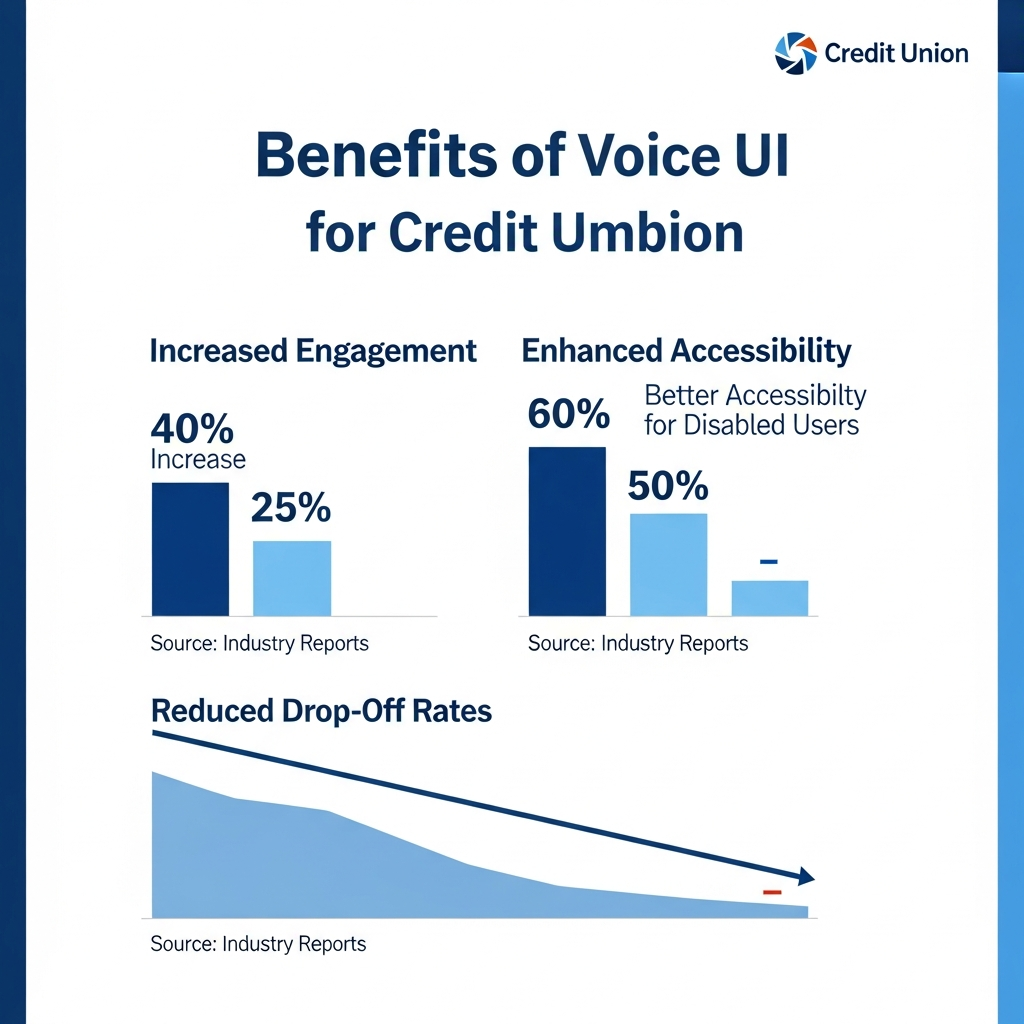
Visualizing the impact: Studies show a 40% increase in user engagement with voice features, 60% improved accessibility for disabled users, and significant reductions in drop-off rates (Forrester Research, 2025).
Moreover, Voice User Interfaces can be particularly useful in helping members understand their transactions and account balances clearly.
The integration of Voice User Interfaces allows users to navigate banking systems with ease, enhancing the overall member experience.
1. Enhanced Accessibility: VUI is a game-changer for visually impaired, motor-impaired, or illiterate members. It aligns perfectly with ADA requirements by providing an alternative input method.
2. Boosted Engagement: Hands-free operation encourages more frequent interactions. A J.D. Power study found voice-enabled apps see 35% higher daily active users (J.D. Power, 2026).
3. Operational Efficiency: Reduces call center volume by 20-30% as members self-serve via voice (Gartner, 2025).
4. Personalization: NLP allows context-aware responses, like “Based on your recent spending, would you like to set up a budget alert?”
5. Multitasking Support: Ideal for on-the-go members driving or cooking.
Step-by-Step Implementation Guide
Implementing VUI requires a structured approach. Here’s a detailed roadmap for credit unions.
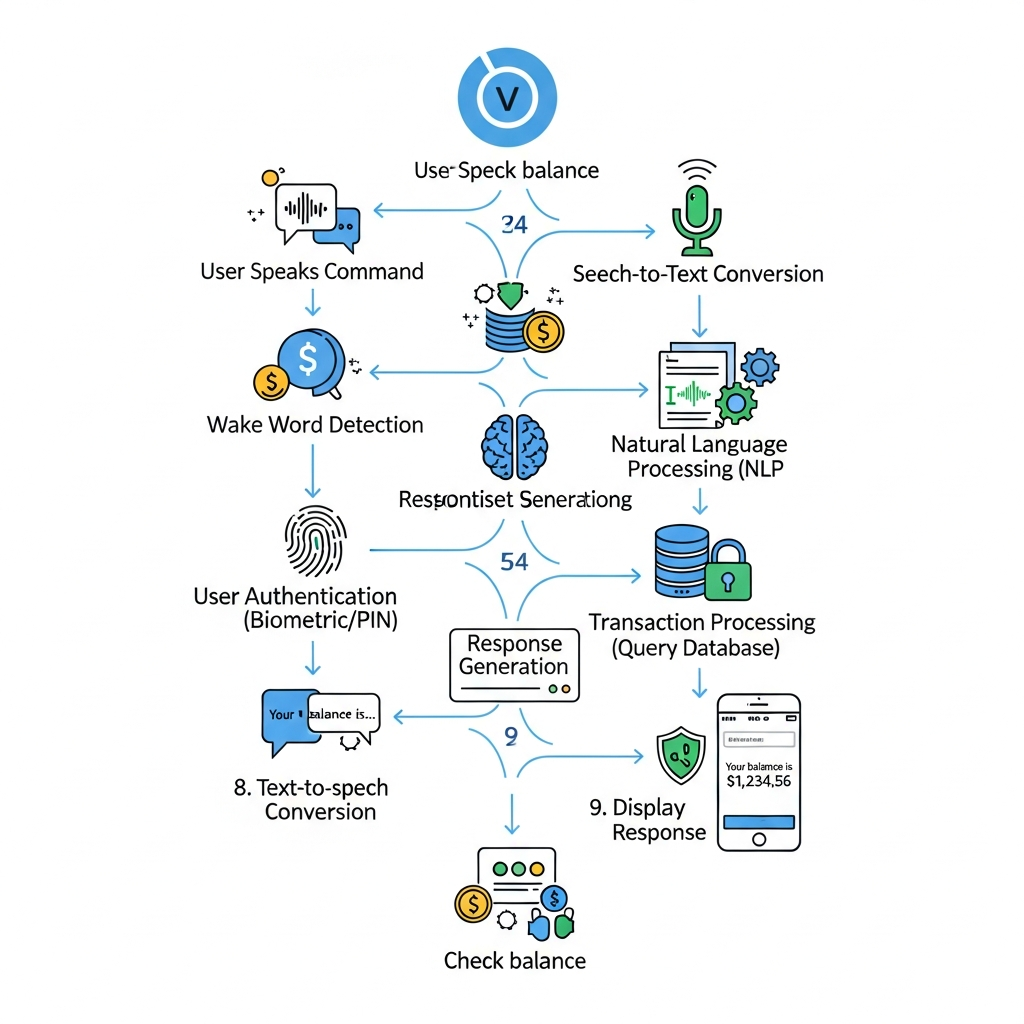
The typical VUI workflow: From wake word detection to secure response delivery.
In addition, the implementation of Voice User Interfaces can lead to substantial operational efficiencies.
With the adoption of Voice User Interfaces, credit unions can ensure inclusivity for all members, particularly those with disabilities.
Step 1: Assess Needs and Choose Platform. Audit member personas and select ASR/NLP providers. Budget: $10K-$50K initial setup for mid-sized CU.
Step 2: Design Conversations. Use tools like Dialogflow or Voiceflow to script intents (e.g., balance_check, transfer_funds). Focus on 80/20 rule: Cover 80% of use cases with 20% effort.
Step 3: Integrate with Backend. Link to core banking systems via secure APIs. Use microservices for scalability.
Step 4: Add Multimodal Support. Combine voice with visual confirmations for high-risk actions.
Step 5: Test Extensively. Beta test with diverse accents, noisy environments, and edge cases. Aim for >95% accuracy.
Step 6: Deploy and Monitor. Roll out via app updates; track metrics with analytics like Amplitude.
Detailed code snippets for React Native integration:
import { Speech } from 'expo-speech';
// Example voice command handler
async function handleVoiceCommand(command) {
  const intent = await processNLP(command);
  switch(intent) {
    case 'balance':
      speak(`Your balance is $${await getBalance()}`);
      break;
  }
}
Implementing Voice User Interfaces effectively can lead to better customer satisfaction and retention.
To maximize the benefits of Voice User Interfaces, credit unions must continuously assess their effectiveness.
Establishing a robust framework for Voice User Interfaces is essential for achieving long-term success.
Expand this for production with error handling and fallbacks.
VUI and ADA Compliance in Mobile Banking
The Americans with Disabilities Act (ADA) mandates accessible digital services. VUI excels here by providing voice navigation compliant with WCAG 2.1 AA standards.
Key ADA alignments:
- Operable: Voice as primary input for those unable to use touch.
- Perceivable: TTS reads all content aloud.
- Robust: Compatible with screen readers like VoiceOver.
A 2025 NCUA report highlights that 15% of CU members have disabilities; VUI can increase their digital adoption by 50% (NCUA, 2025).
Best practices: Always offer voice-toggle, support multiple languages, and provide silent mode for privacy.
Moreover, Voice User Interfaces are pivotal in making digital banking more accessible for all members.
By ensuring Voice User Interfaces comply with ADA standards, credit unions affirm their commitment to inclusivity.
Security Considerations with Voice Biometrics
Security is paramount. Voice biometrics adds a frictionless layer: Passive authentication via voiceprint.
Technologies: Use Nuance or ID R&D for liveness detection against spoofing.
Risks and Mitigations:
- Replay Attacks: Implement challenge-response protocols.
- Deepfakes: AI-based anomaly detection.
- Data Privacy: Encrypt voice data; comply with CCPA/GDPR.
Plaid’s 2026 Security Index reports voice biometrics reduces fraud by 40% vs PINs (Plaid, 2026).
Additionally, Voice User Interfaces can mitigate risks associated with traditional authentication methods.
With Voice User Interfaces, authentication becomes seamless and user-friendly.
Integrating Voice User Interfaces enhances security by utilizing advanced voice biometrics.
Real-World Case Studies
Navy Federal Credit Union: Implemented VUI for 12M members, resulting in 28% uplift in self-service transactions (Navy Federal Annual Report, 2025).
Alliant Credit Union: Voice bill pay feature cut support tickets by 22% (Alliant Case Study, 2026).
Penn Credit Union: Multilingual VUI boosted Hispanic member engagement by 45% (CU Times, 2025).
Overcoming Common Challenges
As we explore the implications of Voice User Interfaces, it becomes clear they are essential for future banking.
The success stories of organizations implementing Voice User Interfaces serve as a blueprint for others.
Voice User Interfaces have proven to enhance user engagement significantly across various platforms.
For instance, many users report increased satisfaction when using Voice User Interfaces for transactions.
Accuracy in Noise: Use noise-cancellation ML models.
Accent Diversity: Train on regional datasets.
Privacy Concerns: On-device processing with federated learning.
Cost: Start with MVP; scale with ROI proof.
Future Trends in VUI for Banking
2026-2030: Conversational AI with emotion detection, AR/VR integration, proactive alerts (“Your low balance alert”). Blockchain for voice data security. Expect 50% of CUs adopting by 2028 (Celent, 2026).
Conclusion
Voice User Interfaces are no longer futuristic—they’re essential for credit unions aiming to lead in member experience. By prioritizing accessibility, security, and strategic implementation, CUs can unlock unprecedented engagement.
The adoption of Voice User Interfaces will define the next generation of banking experiences.
In conclusion, the integration of Voice User Interfaces is a forward-thinking strategy for credit unions.
Ready to voice-enable your credit union? Contact GrafWeb CUSO for expert guidance.
References
- Deloitte. (2025). Future of Digital Banking Report.
- Forrester Research. (2025). Voice Interfaces in Finance.
- J.D. Power. (2026). Mobile Banking Satisfaction Study.
- Gartner. (2025). Banking Operations Trends.
- NCUA. (2025). Accessibility in Financial Services.
- Plaid. (2026). Security Index.
- Navy Federal Credit Union. (2025). Annual Report.
- CU Times. (2025). Case Studies in Digital Innovation.
- Celent. (2026). Voice Banking Forecast.
This article was brought to you by GrafWeb CUSO – Building the future of digital credit unions.