
📑 Table of Contents
- Introduction: Beyond Functionality
- The Psychology of Trust in Digital Banking
- Visceral Design: The First 50 Milliseconds
- Behavioral UX: Designing for Financial Intention
- Reflective Design: Building Long-Term Member Loyalty
- AI and Empathy: Humanizing Automation
- Neuromarketing Frameworks for Credit Unions
- The Strategic Gap: Bridging Current State to Financial Future
- UX Laws Applied to 2026 Fintech Interfaces
- Accessibility and Inclusivity: Emotional Design for All
- The Architecture of Security and Peace of Mind
- Implementing Emotional Architecture: A Step-by-Step Guide
- Mobile vs. Desktop: Consistency in Emotional Tone
- Measuring the ROI of Emotion: Key Performance Indicators
- Hypothetical Case Studies: Emotional Design in Action
- Future Outlook: Towards Cognitive-First Banking
- Executive Summary: The Boardroom Pitch
- References
Introduction: Beyond Functionality
In the hyper-competitive landscape of 2026, a credit union website that simply "works" is already obsolete. While big-box banks compete on raw, feature-thin convenience, credit unions have a unique and powerful competitive advantage: the human connection. However, as more members shift their primary relationship to digital-only channels, that fundamental connection must be translated into code, pixels, and interactions. We call this strategic approach Emotional Architecture.
Emotional architecture is the sophisticated practice of designing digital interfaces that trigger specific neuro-chemical responses—trust, security, belonging, and empowerment. It recognizes that financial decisions are rarely purely rational; they are deeply rooted in the limbic system, the part of the brain responsible for our emotions and value judgments. To survive and thrive amidst the "fintech-ification" of the industry, credit unions must build digital branches that don't just process transactions, but foster genuine, long-term relationships.
Every single interaction in a digital branch—from the way a form field behaves to the micro-animations of a "success" icon—sends a powerful message to the member. Is this institution professional? Are they looking out for me during a crisis? Can I trust them with my life savings when I'm under pressure? Emotional architecture provides the framework to answer "yes" to all these questions through design alone. For instance, according to recent studies in Credit Union UX Design, user experience is fundamentally about how a person feels when interacting with a system, including their emotions, perceptions, and responses. By focusing on these elements, we move from a utility-based model to an engagement-based model where the member feels truly seen and heard. This is the difference between being a vendor and being a partner. It is about emotional resonance over functional adequacy.
The Psychology of Trust in Digital Banking
Trust is the fundamental currency of any financial institution. In a physical branch, trust is built through the firmness of a handshake, the cleanliness of the lobby, the localized knowledge of the staff, and the eye contact of a teller. Digitally, trust must be synthesized through consistency, transparency, and "Cognitive Ease."
According to research on financial UX design, users feel empowered and believe their feedback matters when they see social mechanisms and positive feedback loops. This is not just a "nice-to-have" design feature; it is a physiological requirement for the brain to move from a state of "threat" (financial anxiety) to a state of "collaboration" (financial planning). When the brain is stressed about money, it seeks safety and simplicity. If your website is confusing, you are inadvertently increasing that stress.
When a member logs into their dashboard, their brain is subconsciously scanning for patterns of reliability. If the interface is cluttered, uses inconsistent terminology, or has slow loading times, it triggers a "System 2" cognitive load. System 2 is tiring, analytical, and prone to skepticism. In contrast, "System 1" thinking—intuitive, fast, and effortless—is the goal of emotional architecture. This is achieved by adhering strictly to Jakob’s Law: users spend most of their time on other sites, and they want your site to work the same way. By providing a familiar but elevated experience, you leverage existing mental models to build immediate rapport. Trust is the result of predictability over time. As Jeremy Miner advocates in his sales heuristics, "curiosity pacing" avoids overwhelming the prospect. Similarly, a well-paced UI avoids "information dumping," keeping the member calm and in control of their financial journey. This builds what we call "Perceived Reliability"—the member's belief that if the small things (the UI) are handled well, the big things (their money) are too.
Visceral Design: The First 50 Milliseconds
Don Norman’s theory of emotional design identifies three levels: visceral, behavioral, and reflective. The visceral level is the pre-conscious, immediate reaction to an interface. It happens in the first 50 milliseconds of a page load—before a user has even read a single word of copy. For credit unions, this means the aesthetic quality of the website is directly and inextricably correlated with perceived security.
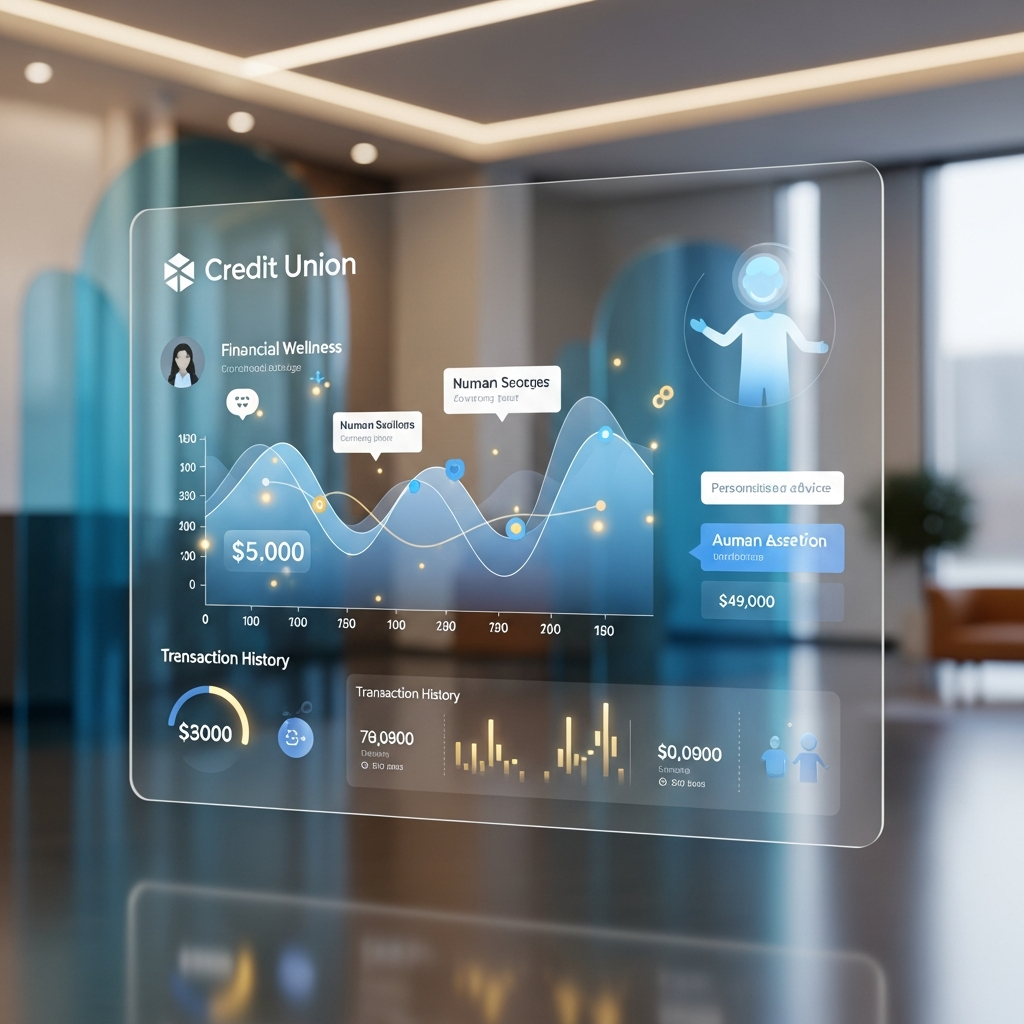
If a website looks dated, clunky, or "cheap," the member's brain subconsciously flags it as "unsafe." In contrast, high-end 3D renders, soft glowing UI components, and human-centric data visualizations—hallmarks of 2026 aesthetics—signal that the institution is modern, capable, and protective. This is the visual equivalent of a well-maintained, high-security vault in a physical branch. As Jeremy Miner notes in his sales frameworks, "vocal pacing" and "tone" are critical; in design, your visual "tone" is your color palette, typography, and whitespace. A "concerned curiosity" tone in sales has a visual equivalent: a design that is clean and professional but uses warm, inviting colors and approachable imagery to show that the credit union genuinely cares about the member’s wellbeing.
Consider the use of "Glassmorphism" or "Neumorphism" strategically. These aren't just aesthetic trends; they provide depth and tactile feedback that helps ground the digital experience in a physical sense of reality. This tactile quality reduces the "flatness" of digital banking, making the financial products feel more tangible and real. When a member can "feel" the depth of the interface, they are more likely to engage with the complex data behind it, leading to better financial decisions. Visceral design is your first "Damaging Admission" in visual form: you aren't the largest bank, but you are the most attentive one. This is visible in every pixel of a high-end credit union site. The first impression is the only impression that matters for long-term trust acquisition.
Behavioral UX: Designing for Financial Intention
Behavioral design is about the pleasure and effectiveness of use. It focuses on the "doing" part of the interaction. In 2026, this level of design translates directly to "Hyper-Personalization." A credit union member should not see a generic list of products. They should see a digital branch that recognizes their current life stage and anticipates their next move. Using personalized greetings and insights into spending habits makes members feel valued rather than just being another account number on a spreadsheet.
We leverage Hick's Law (the time it takes to make a decision increases with the number of choices) and Fitts's Law (the time to acquire a target is a function of the distance to and size of the target) to ensure that the most important actions—the "Tertiary Actions" that lead to long-term wealth building—are the easiest to perform. By reducing cognitive load, we allow the member to focus on their goals rather than the interface. For example, if a member frequently logs in to check their savings progress toward a home purchase, that progress bar should be the central focal point of their dashboard, not a hidden sub-menu. This is what we call "Anticipatory UI"—where the interface predicts the member's most likely intention based on behavioral history. This eliminates the "skill gap" that Alex Hormozi describes as a barrier to making more money; we provide the digital skills for them automatically.
Furthermore, behavioral UX in 2026 involves the masterly use of Micro-interactions. These are the tiny feedback loops that occur when a user performs a task—like the subtle "ping" when a mobile deposit is successful, the smooth transition of a toggle switch, or the gentle glowing outline when a field is selected. These interactions provide "Dopamine Micro-hits" that reinforce positive financial behaviors. When saving money or paying a bill feels as satisfying as playing a well-designed mobile game, the credit union has successfully used emotional architecture to improve its members' lives and financial habits. It’s "gamification" without the gimmicks; it is the positive reinforcement of financial health. It turns the chore of banking into the journey of prosperity.
Reflective Design: Building Long-Term Member Loyalty
The reflective level is the highest level of emotional design. It is where meaning, brand identity, and self-image reside. This is where a member decides, "This is MY credit union." It is built through storytelling and the alignment of deep-seated values. When a digital branch highlights local community impact, non-profit partnerships, or member success stories, it triggers the reflective level of emotional design.
As marketing expert Alex Hormozi suggests, "transform member success stories into viral content." By bringing these stories into the heart of the digital branch, the credit union reinforces its mission-driven nature. This creates a "Strategic Gap" between the member's current financial aspirations and their desired future state, with the credit union positioned as the only trusted path to bridge it. Reflective design is about the long-term relationship. It’s what happens after the transaction is over. Does the member feel proud to belong to this credit union? Does the digital experience reflect the cooperative principles that differentiate credit unions from for-profit banks?
One way to achieve this is through "Collective Community Visualization." Imagine a section of the digital branch that shows the real-time collective impact of the credit union’s members—e.g., total local loans funded this month, total member savings achieved, or number of community projects supported. This fosters a powerful sense of "Social Identity," making the member feel part of an elite, mission-oriented group. This is a powerful driver of retention that generic fintechs can never replicate because they lack the localized, people-first foundation of the credit union movement. This is the ultimate "FOMO" play from Jeremy Miner: you aren't just missing out on a loan, you are missing out on being part of a community success story. You are missing out on belonging.

AI and Empathy: Humanizing Automation
The greatest architectural challenge of 2026 is maintaining human empathy through AI. We no longer use AI just for basic chatbots; we use it for "Empathetic Automation." This means AI that can detect financial stress in a member's interaction pattern and proactively offer support, a debt-consolidation tool, or a sympathetic "call with an advisor" option, rather than a generic, tone-deaf promotional offer.
When implementing these tools, we front-load what Alex Hormozi calls "Damaging Admissions." We explicitly admit that AI isn't a replacement for human staff, but a powerful tool to free up those staff for complex, high-touch interactions. This builds immediate credibility with members who may be skeptical of technology. As noted in UX psychology trends, interfaces should display choices and familiar patterns rather than forcing users to remember details, reducing the "Recognition vs. Recall" fatigue. An empathetic AI doesn't just answer questions; it understands the emotional *why* behind them.
For example, if a member asks the AI about "late payment fee policies," a standard bot would simply provide the fee amount. An empathetic AI, recognizing the potential stress behind the query, might respond: "I can certainly find that for you. I also see you've been a loyal member with us for 5 years with a great history—would you like me to see if we can offer a one-time relief waiver while we discuss a new automatic payment setup to avoid this in the future?" This is how technology builds, rather than destroys, the unique credit union bond. It turns a potential negative interaction into a loyalty-building moment of grace. This is the visual and technical embodiment of "concerned curiosity." It is sales through service.
Neuromarketing Frameworks for Credit Unions
To truly master emotional architecture, we must look at the scientific neuromarketing frameworks that drive decision-making. One such framework is the **Scarcity and Urgency** principle, but applied ethically for the member's benefit. In the credit union context, this means highlighting the "Scarcity of Time" for financial planning. Use visualizations that show the "Cost of Waiting" to start an IRA or the "Estimated Lifetime Savings" of a limited-time refinance rate. This isn't about manipulating members; it's about using psychological triggers to help them overcome inertia and reach their goals.
Another powerful framework is the Von Restorff Effect, which states that when multiple similar objects are present, the one that differs from the rest is most likely to be remembered. In a sea of blue and white, overly-corporate banking apps, how does your credit union stand out? We use "Strategic Focal Points" to draw attention to the most beneficial member actions. This might be a brightly colored, high-contrast "Begin My Financial Wellness Journey" button that sits in contrast to the more mundane account balance view. By making the "good" behavior the most visually distinct and easiest to find, we psychologically guide the member toward better financial health. This is the design implementation of "Digital Omnipresence"—being the most relevant thing in their field of vision at the right moment. This is how you win the war for attention.
The Strategic Gap: Bridging Current State to Financial Future
Building on Jeremy Miner's "Gap" concept, the digital branch should be an active participant in defining a member's financial future. Every time a member interacts with the site, they should be subtly and ethically reminded of the "Gap" between where they are now and where they truly want to be. Are they 100% satisfied with their current home, or are they looking for a better space for their growing family? Are they 100% happy with their retirement plan? By asking these questions through UI prompts, personalized "lifestyle" content, and interactive calculators, we trigger a "Gap-solving" mindset.
The digital branch then provides the "Bridge"—the specific credit union products and services that fill that gap. This is the difference between a website that is a "vending machine" for loans and a website that is a "trusted consultant" for life goals. The "Bridge" must be frictionless. If you've identified a gap in a member's retirement savings, the path to opening an IRA must be a two-click, seamless process, not a mountain of digital paperwork. This is where "Effortless Execution" meets "Emotional Strategy." The interface should make the member feel smarter and more capable with every interaction. As Hormozi advocates for "Calculated Risks," we enable the member to take their next financial risk safely and with full data-driven support. The Gap is the motivation; the Architecture is the solution.
UX Laws Applied to 2026 Fintech Interfaces
We cannot discuss architecture without the underlying laws that govern human behavior. In 2026, the following laws are paramount for any successful credit union digital strategy:
- The Doherty Threshold: Productivity and trust soar when a computer and its users interact at a pace (<400ms) that ensures that neither has to wait on the other. For a credit union, this means high-performance hosting and optimized code are non-negotiable. A lagging app is an emotional drain that destroys the perception of security instantly. In the user's mind, "if the app is slow, my transaction might fail." Speed is an emotional signal of competence.
- Miller's Law: The average person can only keep 7 (plus or minus 2) items in their working memory. Most banking apps fail this spectacularly by presenting 50 different options on the home screen. We use "Progressive Disclosure" to hide advanced or infrequent features until they are needed, keeping the interface clean, calm, and manageable. This is the UI equivalent of Miner's "vocal pacing." It respects the member's limited bandwidth.
- The Peak-End Rule: People judge an experience largely based on how they felt at its peak (the most intense point) and at its end. For credit unions, the "Peak" might be the excitement of an instant loan approval, and the "End" is the confirmation screen or follow-up email. We design these moments with extra care, using celebratory visuals, supportive language, and clear "Next Steps" to leave a lasting, positive reflective impression. We curate the memory of the session.
- The Law of Common Region: Elements tend to be perceived as groups if they share an area with a clearly defined boundary. We use this to separate "Living/Spending/Daily" (checking) from "Growing/Saving/Planning" (savings/investments/loans), helping members mentally categorize their money and reduce the "monolithic balance" stress that leads to overspending. Boundaries create mental safety.
Accessibility and Inclusivity: Emotional Design for All
Emotional architecture must be inclusive. If a member with vision impairment or cognitive disability cannot use your digital branch, the emotional impact is one of exclusion and frustration. This is the opposite of the credit union mission. True emotional architecture integrates UX best practices like high-contrast modes, voice-guided navigation, and simple, plain-language financial education.
When a member finds that your site is specifically designed for their unique needs, the reflective bond is unbreakable. They aren't just a customer; they are a member of an institution that values their humanity enough to accommodate their limitations. This is a powerful "Mirror Technique" from Jeremy Miner: mirroring the member's specific needs back to them in the form of accessible design. Whether it is ensuring screen-reader compatibility or providing "Easy Read" versions of complex loan documents, accessibility is an emotional statement of value. It communicates that everyone is welcome in this cooperative. Inclusivity is the "authentic personal branding" of the credit union movement in the digital space.
The Architecture of Security and Peace of Mind
In 2026, cyber threats are at an all-time high. A digital branch must not only be secure; it must *feel* secure. This is the Architecture of Peace of Mind. We achieve this by being transparent about security processes. Instead of just a static lock icon, we use real-time security visualizations—showing the member that their data is encrypted and their identity is verified.
As Hormozi suggests addressing objections upfront, we address the "Security Objection" before the member even thinks of it. We use biometric transition screens that are smooth and authoritative. We provide instant notifications of unusual activity that aren't just a "Red Alert," but a helpful "Did you do this?" check that provides a clear path to resolution. Security should feel like a protective shield, not a restrictive hurdle. This balance of friction (for safety) and ease (for use) is the hallmark of advanced emotional architecture. You aren't just protecting data; you are protecting the member's peace of mind.
Implementing Emotional Architecture: A Step-by-Step Guide
To move your credit union into the era of Emotional Architecture, follow these four pillars of digital transformation:
Phase 1: The Visceral Audit
- Visual Benchmarking: Compare your current digital branch against the top 3 global fintech apps and the top 3 biggest commercial banks. Where is the "Aesthetic Gap"? Be brutally honest. If your site looks like it was built in 2018, your members are already looking at competitors. Aesthetics are the gateway to engagement.
- Perception Testing: Run "5-second tests" with non-members and members alike. Ask them: "Does this look safe? Does this look like a place that cares about my local community?" The visceral reaction is the most honest indicator of your brand's health. You cannot argue with a member's gut feeling.
- Color Theory Alignment: Ensure your palette isn't just "brand compliant" but "emotionally compliant." Use deeper blues for trust, vibrant greens for growth, and subtle golds for prestige and success. Avoid "anxiety-triggering" reds or aggressive purples. Every color carries a psychological baggage; pack carefully.
Phase 2: Behavioral Optimization
- Friction Mapping: Identify every single point in a loan application or account opening process where a member might "drop off" due to friction, slow loading, or confusion. Every "extra click" is a withdrawal from your trust account. Map the "pain points" as Jeremy Miner would map a prospect's objections.
- Anticipatory Prompts: Implement "Next Best Action" logic. If a member's car loan is 6 months from being paid off, begin showing them information on vehicle maintenance, trade-in values, or "gap" insurance—not just a generic "Apply for a new car loan" ad. Talk to them about their life, not your products.
- Responsive Feedback: Ensure every single button press has an immediate visual, auditory, or tactile response. Never leave a member wondering if the system received their command. Silence in UI is interpreted as failure. Feedback is the conversation of the interface.
Phase 3: Reflective Integration
- Storyteller Nodes: Integrate actual member testimonials and localized community impact data directly into the transaction flow. Let the member see that their choice of institution has a real-world positive impact. Make them the hero of the story.
- Value-Based Navigation: Instead of a navigation menu labeled "Products," try naming your main navigation "My Goals," "My Family," or "My Future." This shifts the psychological focus from the credit union's inventory to the member's life trajectory. This is the ultimate "Mindset shift."
- Long-term Dashboards: Create "Financial Journey" views that show a member's progress over years and decades, not just weeks and months. This reinforces the long-term, lifelong relationship that defines the credit union movement. Visualize the path from where they were to where they are going.
Mobile vs. Desktop: Consistency in Emotional Tone
Emotional architecture must be consistent across all devices. However, the *expression* of that tone changes based on the context of use. On mobile, the emotional goal is "Confidence and Convenience." The member is often on the go, making quick checks or fast transfers. The architecture must prioritize speed and one-handed usability to avoid frustration-driven churn.
On desktop, the emotional goal is "Stability and Insight." The member is often sitting down to handle more complex tasks—applying for a mortgage, planning retirement, or reviewing long-term data. Here, the architecture should provide more whitespace, deeper data visualizations, and more extensive educational content. Even while the visual assets remain a cohesive family, the "vocal pacing" of the desktop site is slower and more informative, while the mobile site is punchy and action-oriented. This is how you achieve "Aggressive Omnipresence" as described by Jeremy Miner: being everywhere the member is, in the exact way they need you to be.
Measuring the ROI of Emotion: Key Performance Indicators
How do you measure the success of an emotional strategy? Traditional metrics like conversion rates are only half the story. To measure Emotional Architecture, we track "Time-to-Trust" (how quickly a first-time visitor initiates a high-value action) and "Brand Affinity Score" (derived from sentiment analysis of member feedback).
We also look at "Friction Reduction Percentage"—the decrease in support tickets related to digital tasks. When a digital branch is architected for emotion, members don't just use it; they advocate for it. They share their "success screens" on social media. They mention the "ease of use" in reviews. As Alex Hormozi advocates for building a "High-Velocity Sales Operation," these digital signals become the fodder for your automated growth engine. Emotional ROI is the ultimate leading indicator of financial performance in 2026. Happy members are profitable members.
Hypothetical Case Studies: Emotional Design in Action
Case Study 1: The "Anxiety-Reducing" Mortgage Application
A mid-sized credit union in the Midwest implemented Emotional Architecture in their mortgage portal. Instead of a 20-page form, they used a "Conversation UI" that asked: "Tell us about your dream home." They used soft backgrounds of local neighborhoods and micro-animations that showed a progress bar as a "path home." The "Peak" was an immediate pre-approval notification with a congratulatory video from the local branch manager. Result: A 42% increase in completed applications and a measurable decrease in support calls regarding application status. The "Gap" wasn't a loan; it was a home.
Case Study 2: The "Empowerment" Dashboard for Gen Z
A suburban credit union redesigned its mobile dashboard using Miller's Law and Color Theory. It prioritized "Goals over Balances." They used high-contrast focal points for "Tertiary Actions" like starting a savings challenge. They integrated a "Community Impact Score" that showed how the member's deposits were helping local small businesses. Result: A 15% increase in member retention among the 18-25 demographic and a significant rise in members opening their second and third accounts within the first 6 months. They saw themselves in the data.
Future Outlook: Towards Cognitive-First Banking
As we look beyond 2026, the next frontier is **Cognitive-First Banking**. This is a stage where the digital branch understands the member's unique "Cognitive Style"—whether they are a visual learner who needs charts, a detail-oriented analyst who wants raw data, or a big-picture dreamer who responds to storytelling.
The interface will dynamically adjust its presentation style based on how the member interacts with their finances. This is the ultimate expression of the "human connection" in a digital world—an institution that adapts to the member, rather than forcing the member to adapt to the institution. This level of intimacy and personalization is the "Secret Sauce" that will allow credit unions to win against even the largest, most well-funded tech giants. The future is personal. The future is emotional.
Executive Summary: The Boardroom Pitch
The goal of Emotional Architecture is not just to make things look pretty. It is about building a digital branch that has a soul. It’s about creating a place where members feel understood, protected, and empowered to reach their most important life dreams. For credit unions, this isn't just a design choice or a marketing trend; it is a critical survival strategy for the digital age.
By investing in the emotional health and psychological integrity of your digital branch today, you are securing the loyalty, trust, and advocacy of your members for decades to come. Don't let your credit union be just another cold, generic commodity in a crowded app store. Build an experience that members can't imagine living their financial lives without. That is the true power, and the true future, of Emotional Architecture. This is how you take "Unaffectable Next" from a sales mindset to a digital reality: your next version is always unaffectably better than the last because it is rooted in deep member emotion. Your digital branch is your most valuable employee; architect it to care.
References
- How a Good UX Design Can Boost Customer Trust in Credit Unions
- Best Lessons From Top Brands for Financial Service UX Design
- Psychology in UX Design (2026): +25 Examples To Improve UI and the Experience
- Transforming Member Experience: The Credit Union Advantage with UX Research
- Are You Following These 5 UX Best Practices for Credit Union Websites?
- 6 UX Design Best Practices & Ideas For Credit Union Websites
- UX Best Practices for Credit Union Websites - PixelSpoke
This article was brought to you by GrafWeb CUSO – Building the future of digital credit unions.