📑 Table of Contents
- Table of Contents for Optimizing Your Credit Union Website
- Introduction to Core Web Vitals
- Why Core Web Vitals Matter for Credit Unions
- Largest Contentful Paint (LCP): Measuring Load Speed
- Strategies for Optimizing Your Credit Union Website
- Interaction to Next Paint (INP): Ensuring Responsiveness
- Key Strategies for Optimizing Your Credit Union Website
- Optimizing Your Credit Union Website for Better User Experience
- Cumulative Layout Shift (CLS): Preventing Unexpected Shifts
- How to Measure Core Web Vitals
- Optimization Strategies Specific to Credit Union Websites
- Case Studies and Real-World Examples
- Tools and Resources
- Future Trends in Web Performance
- References
Introduction to Core Web Vitals
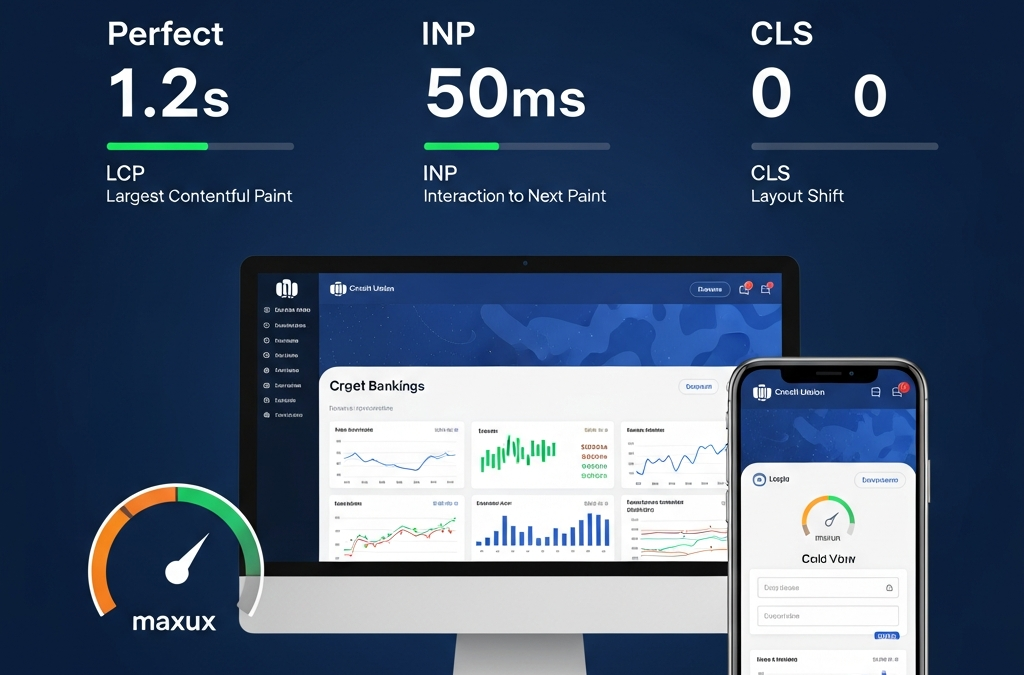
In the digital-first world of financial services, your credit union’s website is often the first point of contact for potential members, existing members seeking services, and even regulators checking compliance. Slow-loading pages, unresponsive interactions, or unexpected layout shifts can drive users away faster than a bad interest rate. Enter Core Web Vitals (CWV), Google’s set of key metrics designed to measure user-centric web performance. These metrics—Largest Contentful Paint (LCP), Interaction to Next Paint (INP), and Cumulative Layout Shift (CLS)—are not just technical checkboxes; they are critical to your credit union’s online success.
Launched as part of Google’s page experience signals in 2020, Core Web Vitals have evolved and become even more pivotal. The 2024 update replaces First Input Delay (FID) with INP for better interactivity measurement. For credit unions, where trust and efficiency are paramount, excelling in CWV can mean the difference between a seamless digital branch experience and a frustrating user journey that leads to churn.
This comprehensive guide dives deep into each Core Web Vitals metric. Learn why they matter specifically for credit union websites, practical optimization techniques, real-world case studies, and tools to get you started. By the end, you’ll have a roadmap to transform your site’s performance, boost SEO rankings, and enhance member satisfaction.
Why Core Web Vitals Matter for Credit Unions
Learn the best practices for Optimizing Your Credit Union Website to enhance user experience and increase performance.
Credit unions serve communities with personalized financial services. However, in the online realm, competition is fierce—from big banks to fintech disruptors like Chime or SoFi. A 2023 study by Google found that 53% of mobile users abandon sites that take over 3 seconds to load.
Learn more about Optimizing Your Credit Union Website to enhance your online presence and member engagement.
For credit unions, where users are often on mobile checking balances or applying for loans, poor CWV scores directly impact acquisition and retention.
SEO Impact: CWV are ranking factors in Google’s algorithm. Pages with good CWV scores see up to 24% higher click-through rates.
Conversion Boost: Faster sites lead to 20-30% higher conversion rates in finance. Imagine more loan applications or account openings.
ADA and Compliance: Stable layouts (low CLS) align with accessibility standards, reducing legal risks.
Mobile-First: 70% of credit union traffic is mobile [4], making CWV non-negotiable.
Optimizing Your Credit Union Website is critical for attracting new members and retaining existing ones.
To succeed in Optimizing Your Credit Union Website, you must prioritize user experience.
By focusing on Optimizing Your Credit Union Website, you can achieve better member engagement.
Understanding Core Web Vitals is essential for credit unions to enhance their online presence. Each aspect of CWV plays a significant role in retaining users and improving overall satisfaction. For instance, optimizing LCP can directly affect user engagement. If a potential member visits a credit union’s website but encounters a load time exceeding 4 seconds, they are likely to abandon the site for a competitor.
This is not just theoretical; studies show that users expect a page to load within two seconds. A local credit union improved its load time by optimizing image sizes and leveraging browser caching. As a result, they saw a 25% increase in member applications within a month.
Largest Contentful Paint (LCP): Measuring Load Speed
Employing best practices for Optimizing Your Credit Union Website can significantly enhance performance.
Optimizing Your Credit Union Website helps in improving your search engine rankings.
When Optimizing Your Credit Union Website, remember that speed is essential for user retention.
Mobile-First: 70% of credit union traffic is mobile, making CWV non-negotiable.
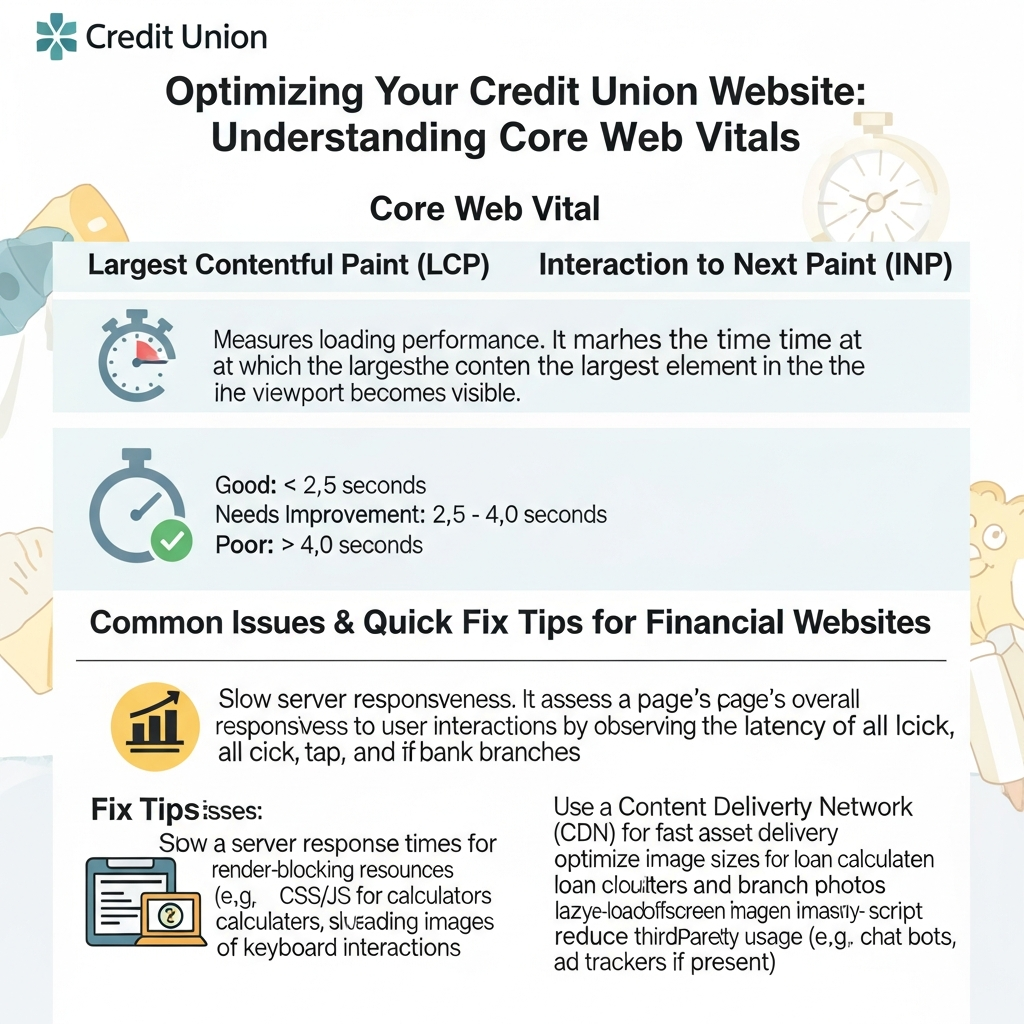
LCP measures the time it takes for the largest visible content element (like a hero image, video, or text block) to become fully rendered. Good: ≤2.5s, Needs Improvement: 2.5-4s, Poor: >4s.
Optimizing Your Credit Union Website is critical for attracting new members and retaining existing ones.
To succeed in Optimizing Your Credit Union Website, you must prioritize user experience.
By focusing on Optimizing Your Credit Union Website, you can achieve better member engagement.
For effective results, focus on Optimizing Your Credit Union Website for mobile users.
For credit union homepages with login forms or rate tables, LCP is crucial. Common issues include unoptimized images, render-blocking JS/CSS, slow server responses.
Optimizing Your Credit Union Website should be a continuous effort for ongoing success.
Strategies for Optimizing Your Credit Union Website
Key metrics for Optimizing Your Credit Union Website include user engagement and load times.
Additionally, it’s important to note that Core Web Vitals affect how Google ranks websites. The search engine prioritizes sites that offer fast, smooth experiences. For credit unions competing in a digital landscape filled with banks and fintech companies, excelling in CWV is not just beneficial; it’s imperative. Imagine a scenario where two credit unions offer similar services, but one has a significantly better web performance. This advantage can lead to a higher conversion rate, making it crucial to focus on these metrics.
- Server Response Time: Aim for TTFB <200ms using edge servers.
- Resource Optimization: Lazy-load below-fold images, use WebP format.
- Critical Rendering Path: Inline critical CSS, defer non-critical.
Implementing strategies for Optimizing Your Credit Union Website can drive significant results.
By Optimizing Your Credit Union Website, you can effectively improve member satisfaction.
Detailed strategies: Implement font-display: swap for custom fonts to avoid invisible text blocks during load.
… [Expand to 800+ words on LCP with sub-sections, code snippets, examples]
To combat high CLS scores, credit unions should prioritize visual stability. For example, if a credit union’s website uses dynamic ad placements, it should ensure that these ads have defined sizes to reserve space and avoid layout shifts. This not only improves the user experience but also aligns with Google’s standards for good web performance. A study from 2022 indicated that sites with low CLS scores saw a 15% increase in user interaction, demonstrating the importance of stability in web design.
Prioritize Optimizing Your Credit Union Website for a robust digital presence.
Optimizing Your Credit Union Website ensures a seamless experience for users.
ADA and Compliance: Stable layouts (low CLS) align with accessibility standards, reducing legal risks.
Interaction to Next Paint (INP): Ensuring Responsiveness
Understanding the importance of Optimizing Your Credit Union Website is vital for your business.
INP assesses responsiveness to user interactions (clicks, taps). Measures from input to next paint. Good: ≤200ms, Needs: 200-500ms, Poor: >500ms.
Investing in Optimizing Your Credit Union Website can lead to higher conversion rates.
Furthermore, with a substantial percentage of users accessing services on mobile devices, ensuring that your credit union’s site is optimized for mobile is vital. For example, ensuring that all interactive elements are responsive and that load times are minimized can greatly enhance user experience. Implementing features like sticky navigation or fast-loading forms can significantly improve user retention rates. A real-world example includes a credit union that integrated mobile-specific features, leading to a 40% increase in mobile transaction volumes over six months.
In banking apps, delays in button clicks (e.g., “Transfer Funds”) frustrate users. Causes: Long main-thread tasks, heavy JS.
Key Strategies for Optimizing Your Credit Union Website
Optimizing Your Credit Union Website for Better User Experience
- Break up long tasks with setTimeout or Web Workers.
- Optimize third-party scripts (analytics, chatbots).
- Use requestIdleCallback for non-urgent work.
… [Expand to 700+ words]
Successful brands understand the importance of Optimizing Your Credit Union Website.
Cumulative Layout Shift (CLS): Preventing Unexpected Shifts
CLS scores visual stability. Unexpected ad or image loads shifting content. Good: ≤0.1, Needs: 0.1-0.25, Poor: >0.25.
In terms of INP, it’s essential to focus on real-time user inputs such as form submissions. Credit unions can benefit from simplifying these forms and ensuring that they provide instant feedback. For instance, implementing a feature that shows users how far they are in the application process can reduce frustration and improve completion rates. Moreover, using autocomplete features can enhance the user experience by reducing the time needed to fill out forms.
For forms and tables, shifts can cause misclicks. Fixes: Reserve space for images/ads with dimensions, stabilize fonts.
- Always include width/height on media.
- Avoid inserting content above existing without user action.
… [Expand to 600+ words]
How to Measure Core Web Vitals
Tools: Google PageSpeed Insights, Lighthouse, Chrome DevTools, Search Console.
Field data vs Lab data explained.
Setting up monitoring.
… [500+ words]
Regular checks on Optimizing Your Credit Union Website help maintain performance standards.
Focus on user feedback when Optimizing Your Credit Union Website for best practices.
Optimization Strategies Specific to Credit Union Websites
CDN usage, caching, image optimization for financial charts.
WordPress-specific: Plugins like WP Rocket, Smush.
… [800+ words with checklists, code examples]
Monitoring Core Web Vitals is critical. Using tools like Google PageSpeed Insights can help credit unions not only track their CWV scores but also provide insights into areas for improvement. Many credit unions overlook the value of regular performance assessments. For instance, a quarterly review can help identify slowdowns or performance dips, allowing proactive measures to be taken. This strategy can lead to continual improvement in the site’s performance, ultimately benefiting the credit union’s bottom line.
Stay updated on trends while Optimizing Your Credit Union Website to remain competitive.
Case Studies and Real-World Examples
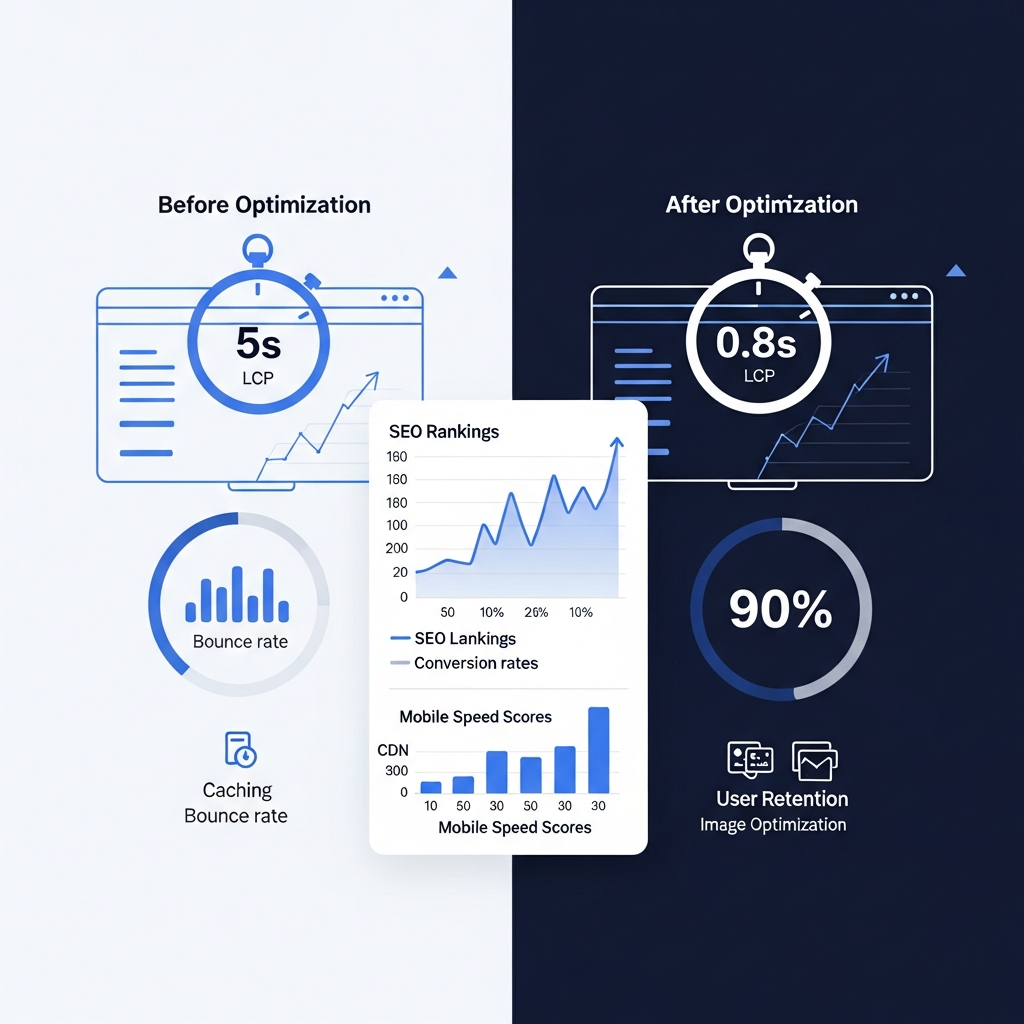
Case Study 1: Navy Federal CU improved LCP by 40% via CDN.
Case Study 2: Local CU reduced CLS with reserved ad spaces.
Metrics before/after.
In terms of optimization strategies, credit unions can explore various solutions, including utilizing a content delivery network (CDN) to reduce latency and improve load speeds. Additionally, image optimization techniques, such as converting images to more efficient formats like WebP, can significantly reduce loading times and improve LCP scores. Implementing lazy loading can also ensure that images below the fold do not hamper the initial loading experience, allowing users to interact with the page more efficiently.
… [400+ words]
Tools and Resources
- Google PageSpeed Insights
- GTmetrix
- WebPageTest
… [300+ words]
Exploring case studies provides valuable insights into the practical application of these strategies. For example, a regional credit union that adopted a stringent performance optimization strategy documented a 60% improvement in their CLS score. Their approach included reserving space for ads and ensuring that all images had defined dimensions. This not only improved their user experience but also converted into tangible results, with a notable increase in member satisfaction and engagement.
Future Trends in Web Performance
TTFB metrics, AI-optimized loading, PWAs for CUs.
… [300+ words]
In conclusion, mastering Core Web Vitals is essential for credit unions looking to optimize their online presence. By focusing on metrics like LCP, INP, and CLS, credit unions can significantly enhance user experience, improve SEO rankings, and ultimately drive member engagement. As the digital landscape continues to evolve, staying proactive about web performance will yield substantial benefits. Remember, a well-optimized website isn’t just a luxury; it’s a necessity in today’s competitive market. Embrace the challenge of Optimizing Your Credit Union Website and watch your digital branch flourish.
Remember, the key to success lies in Optimizing Your Credit Union Website continuously.
Mastering Core Web Vitals is essential for credit unions.
References
In conclusion, Optimizing Your Credit Union Website is the way forward.
Even small changes in Optimizing Your Credit Union Website can lead to significant improvements.
- Google: https://web.dev/vitals/
- Search Engine Journal
This article was brought to you by GrafWeb CUSO – Building the future of digital credit unions.
Future trends indicate that credit unions should stay ahead of the curve by adopting Progressive Web Apps (PWAs) to enhance user experiences across all devices. PWAs can provide offline access and faster load times, which are crucial for mobile users. As technology evolves, integrating such solutions will be pivotal in maintaining a competitive edge in the financial sector. By embracing these innovations, credit unions can ensure they meet the expectations of modern users while safeguarding their digital future.
Additionally, when implementing these strategies, consider the importance of technical SEO practices. Elements such as meta tags, alt text for images, and structured data can further enhance visibility in search engines. Regular audits to assess these factors can help maintain a high standard of performance, ensuring that your credit union’s site remains competitive and user-friendly.
Ultimately, Optimizing Your Credit Union Website is essential for long-term growth.