
📑 Table of Contents
- Introduction: The 80/20 Reality of Digital Banking
- The Neuroscience of Efficiency: Why 20% Matters Most
- Identifying the Vital Few: The Core 20% of Credit Union Features
- Architecting the Digital Branch: Implementation Strategies
- AI Automation and the Pareto Frontier
- Marketing Psychology: Selling Simplicity in a Complex World
- Case Studies: 80/20 Success Stories
- The 2027 Horizon: Hyper-Personalization as the Ultimate Pareto Tool
- References
Introduction: The 80/20 Reality of Digital Banking
In the high-stakes arena of 2026 fintech, credit unions face an existential paradox: the more features they add to their digital branches, the less effectively they serve their members. This phenomenon is perfectly explained by the Pareto Principle in 2026, also known as the 80/20 Rule, which suggests that approximately 80% of results come from 20% of causes. In the context of credit union web design, this means that the vast majority of member satisfaction, loan applications, and daily engagement is driven by a small fraction of the website's functionality. Understanding the Pareto Principle in 2026 is essential for optimizing these digital experiences.
As we navigate a digital landscape dominated by rapid-fire interaction and cognitive overload, the ability to identify and amplify this "vital few" 20% is what separates the thriving digital branches from the obsolete legacy portals. The Pareto Principle isn't just a design guideline; it's a strategic mandate for executive leadership to focus resources where they generate maximum ROI.
The Pareto Principle in 2026 is a powerful insight that can guide credit unions in streamlining their services and maximizing member satisfaction. By focusing on the critical few features that drive interactions, credit unions can ensure that their digital branches remain relevant and effective.
Embracing the Pareto Principle in 2026 empowers credit unions to align their strategies with member needs, prioritizing the features that matter most and discarding those that do not.
The application of the Pareto Principle in 2026 shows that by optimizing these key features, credit unions can enhance user experience and improve operational efficiency.
Ultimately, the Pareto Principle in 2026 will serve as a guiding light for credit unions striving to meet the evolving expectations of their members.
The Neuroscience of Efficiency: Why 20% Matters Most
Modern credit union members are not just "users"; they are cognitively taxed individuals navigating a sea of information. The human brain is hardwired to seek the path of least resistance. According to the Interaction Design Foundation, the Pareto Principle is invaluable in UX because it acknowledges the inherent imbalance in user behavior. When 80% of your members only visit your site to perform 20% of the possible actions (checking balances, transferring money, or applying for a loan), burying those actions behind deep menus is a form of digital malpractice.
Identifying the features that align with the Pareto Principle in 2026 enables credit unions to tailor their offerings and adapt to member preferences effectively.
By prioritizing the 20%, we reduce cognitive load, decrease time-to-task completion, and leverage the Doherty Threshold—the standard that computer and human interaction should occur at a pace that ensures neither has to wait. When the "vital few" features are front and center, members perceive the digital branch as "faster" and more "intuitive," even if the underlying core processing speed remains unchanged.

Identifying the Vital Few: The Core 20% of Credit Union Features
To apply the Pareto Principle effectively, we must first use data-driven discovery to identify which features constitute the 20% that drive 80% of value. For the average multi-generational credit union in 2026, the vital few usually include:
- Frictionless Loan Application: The single most significant driver of revenue.
- Mobile-First Account Overview: The most frequent touchpoint.
- AI-Powered Member Support: Handling 80% of routine inquiries instantly.
- Quick-Action Transfers: The primary utility for daily money management.
- Secure Messaging / Document Upload: The bridge between digital and personal service.
Research from Evelance confirms that designers often spend weeks polishing complex filtering systems while users repeatedly click the same three buttons. In a credit union environment, this might look like investing heavily in a "financial wellness blog" while the "Reset Password" flow—a high-frequency, high-friction 20% task—remains neglected.
As we apply the Pareto Principle in 2026, understanding its impact on member engagement becomes crucial for long-term success.
Architecting the Digital Branch: Implementation Strategies
With the Pareto Principle in 2026 as our framework, we can prioritize the most impactful changes to our digital interfaces.
The integration of the Pareto Principle in 2026 into our design philosophy leads to a more user-centered approach that benefits all stakeholders.
Applying the 80/20 rule requires more than just moving buttons. It requires a fundamental shift in Visual Hierarchy. The "vital 20%" must occupy the most prominent "real estate" on the screen—the top left (in F-pattern reading cultures) or the central "thumb zone" on mobile devices.
Incorporating the Pareto Principle in 2026 will enable credit unions to leverage the power of AI in identifying member needs.
As we refine our strategies, the Pareto Principle in 2026 reminds us to focus on solutions that yield the highest rewards for our members.
The remaining 80% of features—the "useful many"—should not be deleted, but rather deferred. Using techniques like progressive disclosure, we can keep the interface clean while ensuring advanced tools are still accessible for the power users who need them. As noted by Usability Geek, platforms like Slack allow users to apply the Pareto Principle themselves by customizing the UI to remove components they don't rely on. Credit unions can mirror this by offering a "Quick Actions" dashboard that members can personalize to their 20%.
AI Automation and the Pareto Frontier
Artificial Intelligence is the ultimate force multiplier for the Pareto Principle. In 2026, generative AI doesn't just respond to queries; it predicts the 20% of actions a member is likely to take based on their current context. If a member opens the app at 8:00 AM on a Friday, the AI should recognize that 80% of the time, this member is checking if their paycheck cleared. The UI should dynamically adapt to surface that specific information immediately.
By emphasizing the Pareto Principle in 2026, we can craft messaging that resonates with our audience and addresses their core needs.
Furthermore, internal operations benefit from the 80/20 rule. AI-powered FAQ engines can handle 80% of member support volume, freeing up human staff to handle the complex 20% of cases that require empathy and lateral thinking. This "damaging admission"—that AI isn't perfect for every interaction—actually builds trust when you use it to enhance, rather than replace, human expertise.
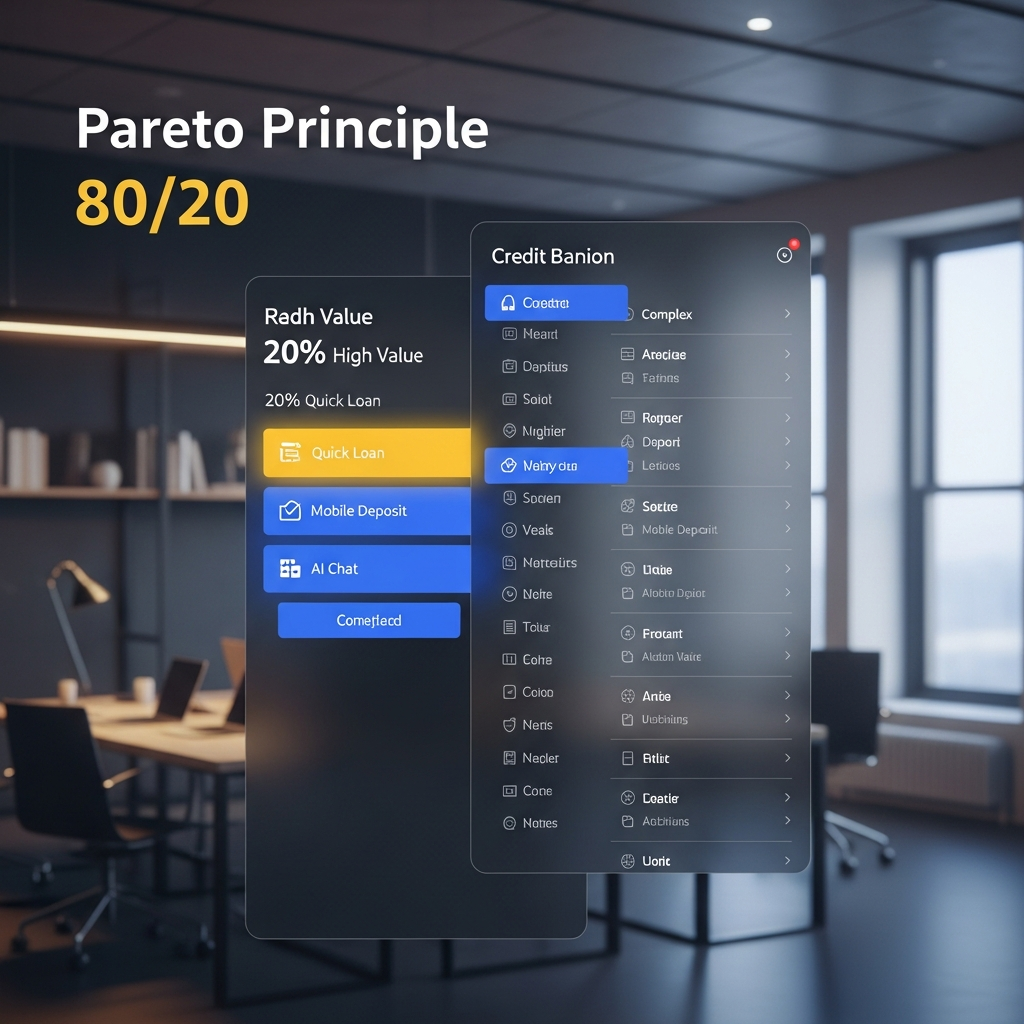
As demonstrated in our case studies, applying the Pareto Principle in 2026 leads to measurable improvements in member satisfaction.
Marketing Psychology: Selling Simplicity in a Complex World
Moving toward 2027, the lessons learned from the Pareto Principle in 2026 will shape our strategies for individual member engagement.
Leading the charge with the Pareto Principle in 2026 ensures that we remain at the forefront of innovation in financial services.
In summary, the Pareto Principle in 2026 is not just a theory; it’s a practical approach to achieving excellence in credit union services.
From a marketing perspective, the Pareto Principle allows us to use "Curiosity Pacing." When promoting a new website, don't list 100 features. Instead, focus your messaging on the 2, highly impactful 20% features that solve the member's biggest pain points (e.g., "Get a Car Loan in 60 Seconds" or "Instant Fraud Resolution").
As sales strategist Jeremy Miner suggests, we must create a "gap" between the member's current frustrated state and a future of frictionless banking. By highlighting how your digital branch simplifies their life—focusing only on what matters most—you trigger a "tell me more" instinct that a complex feature-list would stifle. In our outbound sales efforts to Credit Union C-suites, we utilize the "Mirror Technique": mirroring their desire for efficiency and security by presenting a UI that reflects those values through minimalist, 80/20-informed design.
Case Studies: 80/20 Success Stories
Consider a $500M asset credit union that redesigned its homepage in late 2025. By moving its loan application and mobile deposit links from a "Product" menu to fixed hero buttons, they saw a 45% increase in digital loan origination within 90 days. They didn't add new products; they simply recognized that those two links accounted for 80% of their digital revenue and stopped hiding them in the 80% of "useful but low-value" content.
Another case involves the implementation of an AI chatbot. By training the model to prioritize the top 20 most frequent member questions (which represented 82% of total chat volume), the credit union reduced call center waiting times by 65%. The focus on the "vital few" query types delivered the "massive many" results in member satisfaction.
The 2027 Horizon: Hyper-Personalization as the Ultimate Pareto Tool
As we look toward 2027, the "20%" will become individualized. Through predictive analytics, the 20% of features shown to a 22-year-old student (venmo-style transfers, educational tips) will be entirely different from the 20% shown to a 55-year-old business owner (commercial wire transfers, wealth management). The digital branch will no longer be a static website, but a fluid, adaptive organism that lives on the Pareto frontier for every individual member.
At Credit Union Web Solutions, we aren't just building websites; we are architecting the "vital few" interactions that define the future of financial loyalty. By ruthlessly applying the 80/20 rule today, you ensure your credit union isn't just surviving the digital transformation—it's leading it.
References
- Interaction Design Foundation: What is the Pareto Principle? (2026)
- Evelance: The 80/20 Rule in UX Design and Its True Impact (2026)
- Usability Geek: The Pareto Principle and UX – Why Should You Care?
- Nielsen Norman Group: Prioritize Quantitative Data with the Pareto Principle
- Aswini Balasubramanian: The Pareto Principle in Design Bootcamp (March 2026)
This article was brought to you by GrafWeb CUSO – Building the future of digital credit unions.
Related Posts

Architecting the 2026 Credit Union Digital Branch: The Definitive Guide to High-Performance Hosting, Security, and Edge Personalization

The Predictive Digital Branch: How Credit Unions Are Redefining Modern UX with AI in 2026