

Introduction: The Retirement Readiness Crisis and the Credit Union Opportunity
America is facing a retirement readiness crisis of unprecedented proportions. According to the Federal Reserve's Survey of Household Economics and Decisionmaking (SHED), approximately 25% of non-retired adults have no retirement savings whatsoever, and among those who do, the median retirement account balance sits at just $65,000 — far below what is needed to sustain a comfortable retirement. The Employee Benefit Research Institute (EBRI) projects that the retirement savings shortfall in the United States exceeds $4.2 trillion, a gap that continues to widen as life expectancy increases and traditional pension plans disappear.
For credit unions, this crisis represents not only a societal challenge but a profound strategic opportunity. Unlike megabanks and fintechs that treat retirement accounts as commodity products, credit unions are uniquely positioned to serve as trusted retirement planning partners for their members. The cooperative structure, not-for-profit pricing, and community focus of credit unions align naturally with the long-term, relationship-intensive nature of retirement planning. Yet the vast majority of credit unions have failed to translate this natural advantage into compelling digital retirement experiences.
📑 Table of Contents
- Introduction: The Retirement Readiness Crisis and the Credit Union Opportunity
- The Retirement Landscape: Why Credit Unions Must Act Now
- Understanding IRA Types and Their Digital Implications for Credit Unions
- Designing the IRA Account Opening Journey: From Interest to Funded Account
- The Contribution Management Experience: Ongoing Member Engagement
- Investment Options, Selection, and Portfolio Visualization
- Beneficiary Designation and Estate Planning UX
- RMD Planning and Required Minimum Distribution Management
- IRA-to-IRA Transfers, Rollovers, and Account Consolidation UX
- Member Education and Retirement Readiness Assessment Tools
- Mobile-First Retirement Planning: The Smartphone Member Journey
- Strategies for Small and Mid-Size Credit Unions
- Regulatory Compliance and Legal Considerations for IRA Digital Experiences
- Measuring Success: KPIs for IRA Digital Product Performance
- 90-Day Implementation Roadmap
- Conclusion: Building the Retirement Hub of the Future
- References
This comprehensive UX/UI playbook addresses that gap. We will explore how credit unions can design end-to-end digital experiences for Individual Retirement Accounts (IRAs), covering the full member lifecycle from initial awareness through account opening, ongoing contribution management, investment selection, beneficiary designation, Required Minimum Distribution (RMD) planning, and eventual withdrawal. Whether your credit union offers Traditional IRAs, Roth IRAs, SEP IRAs, or SIMPLE IRAs, the principles outlined here will help you transform your retirement product from a static account into an engaging, member-centric digital journey that builds loyalty, deepens relationships, and drives measurable growth.
The Retirement Landscape: Why Credit Unions Must Act Now
The retirement savings market in the United States is enormous and growing. As of 2026, total IRA assets exceed $14.5 trillion, according to the Investment Company Institute (ICI). More than 47 million U.S. households own IRAs, making them the most widely held retirement savings vehicle outside of employer-sponsored 401(k) plans. Yet credit unions hold only a fraction of this market. The vast majority of IRA assets reside with large brokerage firms such as Vanguard, Fidelity, Charles Schwab, and Empower, as well as with large national banks.
Several converging trends make this the ideal moment for credit unions to invest in retirement digital experiences:
The Great Wealth Transfer. Over the next two decades, an estimated $84 trillion in wealth will pass from the Silent Generation and Baby Boomers to younger generations, according to Cerulli Associates. This intergenerational transfer will generate enormous demand for IRA rollovers, inherited IRA management, beneficiary planning, and retirement account consolidation services. Credit unions that establish trust-based retirement relationships with older members today will be the natural beneficiaries of this wealth transfer.
The 401(k)-to-IRA Rollover Wave. Job mobility continues to accelerate. The average American changes jobs 12 times over their career, and each job change creates a 401(k) rollover decision. According to EBRI, approximately $600 billion in 401(k) assets are rolled over into IRAs annually. Credit unions that simplify the rollover process with frictionless digital tools can capture a meaningful share of this massive flow.
The Demand for Digital-First Retirement Tools. The Transamerica Center for Retirement Studies reports that 68% of workers want to manage their retirement savings entirely through digital channels, with Millennials and Gen Z expressing the strongest preference for mobile-first retirement tools. Yet most credit union IRA experiences remain paper-intensive, requiring physical forms, in-person signatures, and manual processing. This digital gap represents the single largest competitive vulnerability for credit unions in the retirement space.
Secure 2.0 Act Implementation. The SECURE 2.0 Act of 2022, which continues to be phased in through 2027, has introduced significant changes to IRA rules including expanded automatic enrollment provisions, higher catch-up contribution limits for older savers, the creation of starter 401(k) plans for small employers, and relaxed RMD rules. These changes create a natural content and engagement opportunity for credit unions to educate members and guide them through new options.
The Retirement Confidence Paradox. Despite rising markets, the EBRI Retirement Confidence Survey finds that only 64% of workers are confident in their ability to retire comfortably, down from 73% in 2020. This anxiety creates demand for guidance. Credit unions that offer retirement readiness assessments, goal-setting tools, and personalized recommendations can build deep trust and engagement with members at critical decision points.
The credit unions that seize this moment will not only grow IRA share of wallet but will establish themselves as the primary financial institution for members across the full lifecycle. The cost of inaction is equally clear: members who open IRAs elsewhere will inevitably shift their primary checking, savings, and lending relationships to the institutions that manage their retirement assets.
Understanding IRA Types and Their Digital Implications for Credit Unions
Before designing digital experiences, it is essential to understand the different IRA types that credit unions typically offer and how each product has unique digital requirements:
Traditional IRA. The most common IRA type. Contributions may be tax-deductible depending on income and employer retirement plan coverage. Earnings grow tax-deferred until withdrawal, at which point they are taxed as ordinary income. Key digital features needed: deduction eligibility calculator, contribution tracking against annual limits, and RMD forecasting tools. The tax deferral angle makes progress visualization challenging — members cannot easily see "tax saved" the way they can see investment growth.
Roth IRA. Contributions are made with after-tax dollars but qualified withdrawals are tax-free. This simplicity makes Roth IRAs extremely attractive for digital-first marketing, particularly to younger members who value the flexibility of tax-free withdrawals for first-time home purchases or education expenses. Key digital features needed: phase-out income calculator, five-year rule tracking, and qualified vs. non-qualified distribution guidance. Because Roth contributions can be withdrawn at any time without penalty, the product has more flexibility than Traditional IRAs — a significant messaging advantage for digital acquisition channels.
SEP IRA (Simplified Employee Pension). Designed for self-employed individuals and small business owners. Employers contribute to traditional IRAs set up for employees. Contribution limits are significantly higher than traditional or Roth IRAs — up to 25% of compensation or $66,000 for 2026. Key digital features needed: employer contribution calculator, self-employed income estimator, and integration with business banking dashboards. SEP IRAs are often overlooked in credit union digital experiences but represent a massive opportunity given that 73% of credit union members are employed by or own small businesses.
SIMPLE IRA (Savings Incentive Match Plan for Employees). Designed for small businesses with 100 or fewer employees. Features mandatory employer contributions (either 2% non-elective or 3% matching). Key digital features needed: employer contribution tracking, multi-year contribution limit monitoring, and integration with small business banking platforms. SIMPLE IRAs are particularly relevant for credit unions serving SEGs (Select Employee Groups).
Coverdell Education Savings Accounts (ESA). While technically not a retirement account, Coverdell ESAs are often administered alongside IRAs and serve a similar long-term savings function. Contributions are limited to $2,000 per year per beneficiary but grow tax-free when used for qualified education expenses. Key digital features needed: beneficiary designation per account, qualified expense guidance, and contribution tracking.
Each IRA type requires distinct form fields, eligibility verification, compliance documentation, and ongoing management capabilities. A well-designed digital IRA platform must accommodate all of these products within a consistent, intuitive interface while surfacing the right information for each product at the right time. The complexity here is significant — but it is also an opportunity. Financial institutions that simplify IRA selection and management will win disproportionate member trust and market share.
Designing the IRA Account Opening Journey: From Interest to Funded Account
IRA account opening is the single most important conversion point in the retirement digital experience. Yet most credit unions treat IRA opening as a low-priority, back-office process dominated by paper forms and manual data entry. According to Cornerstone Advisors, digital IRA account opening abandonment rates mirror those of general account opening — ranging from 60% to 85% — but credit unions invest far less in optimization for retirement products than for checking accounts. This is a costly mistake.
The Discovery and Education Phase. The IRA journey begins long before the application form. Prospective members explore retirement options through search engines, credit union website content, retirement calculators, and product comparison pages. The digital experience must meet members at every touchpoint with clear, decision-supporting information. Key design elements include:
- IRA Comparison Tool: A side-by-side visual comparison of Traditional vs. Roth IRA featuring contribution limits, tax treatment, income phase-outs, withdrawal rules, and recommended age groups. Use progressive disclosure — surfacing the most relevant information first, with optional deep-dive sections for members who want more detail.
- Product Recommendation Quiz: A 3-5 question interactive quiz that guides members to the right IRA type based on their age, income, tax filing status, employer retirement plan coverage, and savings goals. This is the highest-converting tool in digital retirement acquisition. According to Fidelity, members who complete a recommendation quiz are 3.5x more likely to open an IRA compared to those who navigate product pages independently.
- Retirement Readiness Assessment: A brief assessment that calculates a retirement readiness score based on current savings, age, income, and retirement goals. Members who complete this assessment have demonstrated high intent and should be routed directly to the IRA application with pre-filled data.
- Educational Content Hub: Video explainers, downloadable guides, and interactive learning modules covering IRA basics, tax advantages, and retirement planning principles. The SECURE 2.0 Act created natural content marketing opportunities — articles about new catch-up limits, RMD changes, or starter plan options attract highly targeted organic traffic.
The Application Design. Once a member decides to open an IRA, the application must balance completeness with frictionlessness. Key design principles include:
- Progressive Profiling: Collect information in stages — identity verification first, then contribution type and amount, then funding details, then beneficiary information. Each stage should feel complete and self-contained, with the member understanding what is next. The Save-and-Resume pattern is critical here, as IRA applications are often abandoned mid-flow and revisited hours or days later.
- Smart Defaults and Pre-Fill: Use known member data (name, address, date of birth, SSN, email, phone) to pre-populate as many fields as possible. For existing members, the IRA application should feel like a lightweight extension of their existing relationship rather than a fresh onboarding from scratch. Smart defaults — such as suggesting a Roth IRA for members under 40 or a Traditional IRA for higher-income members — reduce decision fatigue and accelerate form completion.
- Trust Signals Throughout: IRA applications involve sensitive financial and personal information. Display NCUA share insurance badges, SSL/TLS security indicators, privacy policy summaries, and data encryption trustmarks at every step. Members need reassurance that their retirement savings data is protected — especially when transferring assets from other institutions.
- Contribution Type and Funding Decisions: Present contribution options clearly — initial contribution amount, recurring contribution setup, transfer from an existing credit union account, external account linking, or rollover from another retirement account. Each funding path has distinct friction points. External transfers require micro-deposit verification or Plaid-style account linking. Rollovers require account documentation collection and transfer initiation. Recurring contributions require ACH authorization. Design each path as a separate, optimized flow rather than forcing all members through a generic process.
- Mobile-First Form Design: IRA applications are long by nature — often 20+ fields with compliance requirements. On mobile, use single-column layouts, thumb-zone-optimized touch targets, inline validation, intelligent input masking (phone, SSN, dates), and collapsible sections. The mobile IRA opening experience should feel guided rather than overwhelming.
Funding and Funding UX. The single most common point of IRA application abandonment is the funding step. Members become overwhelmed by the documentation requirements, delay linking external accounts, or lose momentum after completing the initial application. Design strategies to combat funding abandonment include:
- Instant Funding Options: Offer ACH transfer from existing credit union accounts as the primary funding path — this is low-friction and immediately actionable.
- Account Linking UX: Use Plaid, MX, or Finicity for instant external account verification rather than micro-deposit verification, which requires 2-3 days and significantly increases abandonment.
- Rollover Concierge: Provide a structured, guided rollover process with document checklists, pre-filled forms, and progress tracking. Consider offering live video assistance for complex rollovers — a human agent can walk members through the process, collect documentation, and provide real-time guidance, reducing abandonment by an estimated 40-50%.
- Post-Application Engagement: After submission, send automated SMS and email updates about funding status, account setup progress, and next steps. The first 48 hours after IRA application submission are critical for retention — members who fund within 48 hours are 4x more likely to become active, long-term retirement savers.
Post-Opening Onboarding. The digital experience should not end at account funding. A structured onboarding sequence over the first 90 days builds habits and deepens the relationship. Key onboarding touchpoints include:
- Day 1: Welcome message with account summary, login credentials, and links to the retirement dashboard.
- Day 3: Educational content on investment options tailored to the member's IRA type and age.
- Day 7: Beneficiary designation prompt (a compliance step that is often overlooked).
- Day 14: Recurring contribution setup reminder.
- Day 30: First account statement with growth visualization and next steps.
- Day 90: Retirement readiness check-in with updated score and personalized recommendations.
This structured onboarding transforms IRA opening from a one-time transaction into the beginning of an ongoing relationship — and positions the credit union as the member's primary retirement partner.
The Contribution Management Experience: Ongoing Member Engagement
Once an IRA is open, the ongoing contribution management experience becomes the primary vehicle for member engagement. Credit unions that treat IRA contributions as a set-it-and-forget-it back-office function miss the single greatest recurring engagement opportunity in their digital product portfolio.
Dashboard-Level Contribution Visibility. The retirement dashboard should show at a glance: current year contributions, remaining contribution limit, year-to-date contributions, and the annual limit for the member's age and IRA type. This data should be surfaced prominently — not buried in account details. A visual contribution progress bar (e.g., "$4,200 of $7,000 contributed" with a circular or linear gauge) is one of the most engaging dashboard elements across all financial products.
Recurring Contribution Management. Automatic recurring contributions are the single most powerful tool for building retirement savings, yet most credit union IRA platforms make recurring contributions difficult to set up and modify. The digital experience should offer:
- One-Click Recurring Setup: Allow members to set up automatic weekly, bi-weekly, semi-monthly, or monthly contributions from any linked account in under 30 seconds.
- Flexible Modification: Allow pause, skip, amount change, or frequency change through the dashboard without forms or phone calls.
- Round-Up and Surplus Contribution Options: Automated round-ups from debit card purchases (to the nearest dollar) or surplus sweeps from checking accounts are high-engagement features that accelerate savings without requiring willpower.
- Catch-Up Contribution Alerts: For members aged 50 and older, the SECURE 2.0 Act provides for enhanced catch-up contribution limits. Proactive alerts — "You're eligible to contribute an additional $1,000 this year as a catch-up contribution" — drive both compliance and goodwill.
- Contribution Projection: Show members how different contribution levels translate into projected retirement income. For example: "At your current contribution rate of $500/month, you are on track to accumulate approximately $340,000 by age 67. Increasing to $650/month would bring your projected total to $445,000." These projections are powerful engagement and upsell tools.
Tax-Time Integration. IRA contributions made before the tax filing deadline (typically April 15) can be applied to the prior tax year. This creates a critical seasonal engagement opportunity. Key features include:
- Prior-Year Contribution Eligibility: Clear indication of whether a contribution applies to the current or prior tax year.
- Tax Deduction Estimator: An interactive tool that estimates the tax deduction benefit based on income, filing status, and employer retirement plan coverage.
- Form 5498 and Contribution Statement Access: Easy access to year-end contribution statements for tax filing. The tax season is the highest-traffic period for IRA dashboards — ensure the experience is optimized for January through April.
- IRA Season Campaigns: Between January 1 and April 15, run targeted email, push notification, and website campaigns encouraging members to maximize their IRA contributions. This is the single most effective IRA marketing window and should be a core component of the annual digital marketing calendar.
Investment Options, Selection, and Portfolio Visualization
IRA investment options at credit unions are typically more limited than what brokerages offer — often restricted to share certificates, money market accounts, and a curated selection of mutual funds. While this simplicity can be framed as an advantage (fewer choices = less decision fatigue), it requires thoughtful UX to avoid feeling limiting.
Investment Selection UX. The process of choosing IRA investments should feel empowering, not overwhelming. Key design principles include:
- Goal-Based Investment Selection: Frame investment choices in terms of member goals and time horizons rather than asset classes. "If you're planning to retire in 20+ years, this growth-focused option has historically returned 8-10% annually" is far more actionable than "This fund has a 70/30 equity/fixed-income allocation."
- Risk Tolerance Assessment: A brief, visual risk tolerance quiz (ideally 3-5 questions) that generates an investment recommendation. The quiz should use plain language and real-world scenarios — "If your portfolio dropped 20% in one year, would you sell everything, stay the course, or buy more?" — rather than abstract risk metrics.
- Visual Fund Comparison: For members who want to compare investment options, offer a side-by-side view with key metrics — historical performance, expense ratio, minimum investment, and risk level — presented in an accessible, color-coded format.
- Target-Date Fund as Default: For members who want a hands-off approach, a target-date retirement fund (which automatically adjusts asset allocation as retirement approaches) should be the clear default option, not buried in a long fund list.
Portfolio Visualization. Once investments are selected, the portfolio visualization becomes the centerpiece of the retirement dashboard. Key visualization elements include:
- Account Balance Over Time: A line chart showing account balance growth, with the option to view by month, quarter, year, or since inception. Contributions should be shown as separate data series so members can distinguish between contribution-driven growth and investment returns.
- Asset Allocation Pie Chart: A clear, color-coded breakdown of current asset allocation across equities, fixed income, cash, and alternatives. The chart should visually compare the current allocation to the recommended allocation and flag any significant drift.
- Retirement Projection Chart: The most engaging visualization: a projected account balance at retirement age based on current contributions, assumed rate of return, and years to retirement. The chart should allow members to adjust assumptions interactively — "What if I increase my contribution by $100/month?" — and see the projected impact in real time.
- Performance vs. Benchmarks: For investment-savvy members, a comparison of portfolio performance against relevant benchmarks (S&P 500, aggregate bond index, target-date index) helps validate the investment strategy and builds confidence.
Rebalancing and Maintenance. Portfolio drift occurs naturally as different asset classes perform differently. The digital experience should proactively flag asset allocation drift and guide members through rebalancing. Key features include:
- Automatic Rebalancing Opt-In: Allow members to enable automatic quarterly or annual rebalancing with a single toggle.
- Drift Alerts: Send notifications when allocation has drifted more than 5% from the target.
- One-Click Rebalance: Allow manual rebalancing with a single confirmation step — sell overweight assets and buy underweight assets to restore target allocation.
The investment management experience is where credit unions can differentiate most meaningfully from megabanks. Large banks offer thousands of investment options with overwhelming complexity. Credit unions should offer a curated, guided, member-friendly experience that prioritizes simplicity and outcomes over product breadth.
Beneficiary Designation and Estate Planning UX
Beneficiary designation is one of the most legally consequential actions a member will take — yet it is often treated as an afterthought in digital IRA experiences. Poorly designed beneficiary flows lead to outdated designations, incomplete forms, and costly legal disputes after a member's death.
The Current State Problem. Most credit unions require members to complete a paper beneficiary designation form, often in person or with a notary. This friction means many members never designate beneficiaries at all, or they complete the form once and never update it after major life events. According to a 2025 study by Trust & Will, 67% of credit union members with IRAs have not updated their beneficiary designations within the last five years, and 28% have never designated beneficiaries at all.
Digital-First Beneficiary Experience. The beneficiary designation process must be fully digital, intuitive, and integrated into the IRA opening and management flow. Key design elements include:
- In-Flow Beneficiary Designation: Beneficiary information should be collected as part of the standard IRA application flow, not as a separate process. Present it as a natural step — "Who should inherit this account?" — rather than a burdensome compliance requirement.
- Primary and Contingent Beneficiary Management: Clear differentiation between primary and contingent beneficiaries, with simple language explanations. Allow unlimited beneficiaries with percentage-based allocation (must total 100%).
- Per Stirpes vs. Per Capita Selection: For members with complex family structures, offer plain-language explanations of per stirpes (by branch) and per capita (by head) distribution methods, with visual diagrams showing how assets would be distributed under each option.
- Trust as Beneficiary: Allow members to designate a trust as beneficiary, with fields for trust name, date, and trustee information. Provide guidance on when trust designation is appropriate versus naming individuals directly.
- Life Event-Triggered Review Prompts: When a member reports a marriage, divorce, birth of a child, or death of a family member through any channel (online, mobile, call center, or branch), trigger a beneficiary review prompt: "You recently updated your marital status. Would you like to review your IRA beneficiary designations?"
- Annual Beneficiary Review Reminder: Send an annual email or in-dashboard prompt asking members to review and confirm their beneficiary designations. This reduces legal risk for the credit union and builds member trust.
- Digital Signature and Witnessing: Many states require beneficiary designations to be witnessed or notarized. Where possible, support remote online notarization (RON) or in-person e-signature with digital witnessing to eliminate paper entirely. The SECURE 2.0 Act encouraged electronic delivery of retirement plan documents, and best practices are evolving rapidly in this area.
Estate Planning Add-On Services. For credit unions serving older and wealthier members, offering an embedded estate planning tool — or a partnership with a digital estate planning platform — can transform the retirement product into a holistic wealth management service. Features such as online wills, living trusts, powers of attorney, and healthcare directives, offered within the credit union's digital experience, deepen relationships and position the credit union as a full-service financial partner.
RMD Planning and Required Minimum Distribution Management
Required Minimum Distributions (RMDs) are one of the most complex and high-stakes interactions in the IRA member lifecycle. Members who fail to take RMDs face a 25% excise tax on the amount not withdrawn — reduced from 50% by the SECURE 2.0 Act, but still a severe penalty. Credit unions that provide proactive RMD management reduce member financial risk while strengthening the retirement relationship.
RMD Eligibility and Calculation. The digital experience should clearly communicate RMD requirements based on the member's age, IRA type, and account balance. Under the SECURE 2.0 Act, the RMD starting age has increased to 73 for those reaching age 72 after December 31, 2022, and will increase to 75 for those reaching age 73 after December 31, 2032. Key features include:
- RMD Calculator: A simple, embedded calculator that estimates annual RMD amounts based on account balance and IRS life expectancy tables. The calculator should update automatically as account values change.
- RMD Countdown Timer: For members approaching RMD age, a visible countdown in the dashboard — "Your first RMD is due in 14 months" — creates urgency and drives action.
- RMD Status Dashboard: A dedicated RMD section showing current year RMD amount, amount withdrawn to date, remaining RMD, and withdrawal deadline. Use color coding: green (on track), yellow (3 months to deadline), red (1 month to deadline).
- Multiple Account Aggregation: For members with multiple IRAs, the RMD can be satisfied by withdrawing from any combination of accounts. The dashboard should show aggregate RMD amounts across all IRA accounts and allow members to designate withdrawal sources.
RMD Withdrawal Execution. The actual process of taking an RMD withdrawal must be as frictionless as possible. Key features include:
- One-Click RMD Withdrawal: Allow members to initiate an RMD withdrawal with a single confirmation — no forms, no phone calls, no branch visits.
- Automatic RMD Setup: Allow members to set up automatic monthly, quarterly, or annual RMD withdrawals. This is the highest-value RMD feature; members who automate RMDs never face penalties.
- Withholding Election: Provide clear, plain-language options for federal and state tax withholding from RMD distributions. Most members need guidance on this decision — offer a recommendation based on their estimated tax bracket.
- QCD (Qualified Charitable Distribution) Support: Members aged 70½ and older can donate up to $105,000 (as of 2026) directly from their IRA to qualified charities without recognizing the distribution as taxable income. A QCD tool within the RMD flow — allowing members to direct part or all of their RMD to charity — is both a member benefit and a differentiator versus most bank IRA platforms.
RMD Education and Alerts. The compliance risk associated with missed RMDs makes proactive communication essential. Key touchpoints include:
- Age 70 Notification: Three years before RMDs begin, send an educational notification about upcoming RMD requirements.
- Age 72 Notification: One year before the first RMD, send detailed information including estimated first-year RMD amounts and automatic setup options.
- Annual RMD Reminder: In January of each year after RMDs begin, send the annual RMD amount and current withdrawal status.
- Q4 Urgency Sequence: For members who have not yet taken their RMD by October, send increasingly urgent reminders via dashboard alert, email, SMS, and phone call. The Q4 RMD urgency sequence is one of the highest-impact automated communication campaigns a credit union can run.
RMD management is not merely a compliance function — it is a relationship-deepening opportunity. Members who receive proactive, helpful RMD guidance will view their credit union as a trusted retirement partner rather than merely an account custodian.
IRA-to-IRA Transfers, Rollovers, and Account Consolidation UX
IRA-to-IRA transfers and rollovers represent the highest-value acquisition opportunity in retirement services. A member rolling over a 401(k) from a former employer is bringing not just a single account but potentially hundreds of thousands of dollars in assets — and the strong likelihood of making the rollover institution their primary financial relationship.
The Rollover Decision Framework. The first challenge is helping members understand their rollover options. When a member leaves an employer, they typically have four choices: leave the 401(k) with the former employer, roll it into a new employer's 401(k), roll it into an IRA, or cash out. The digital experience should present these options clearly, with plain-language explanations of the pros and cons of each. Interactive decision trees — "Answer three questions to find the best option for your situation" — are highly effective acquisition tools.
Direct Rollover UX. A direct rollover (trustee-to-trustee transfer) is the simplest and most tax-efficient option. The digital experience should guide members through the process step by step:
- Rollover Eligibility Check: Confirm the member has an eligible distributable event (job separation, plan termination, or age 59½).
- Source Account Information: Collect details about the existing 401(k) or IRA — institution name, account number, account type, and approximate balance.
- Document Collection: Upload the most recent account statement, which contains the information needed to initiate the transfer. Guide the member on which page to upload and what information is needed.
- Transfer Initiation: Generate a letter of instruction or transfer request form with member and credit union information pre-filled. For digital-forward credit unions, consider supporting automated transfer initiation through the ACATS (Automated Customer Account Transfer Service) system, which enables electronic transfer of assets between financial institutions.
- Progress Tracking: Provide a transparent, real-time status dashboard showing each step of the transfer process: documents submitted, transfer initiated, assets in transit, assets received, and funds invested. Rollovers can take 2-4 weeks — clear progress communication reduces member anxiety and call center volume.
Indirect Rollover Guidance. An indirect rollover (member receives a check and must deposit it within 60 days) is riskier because of the strict time limit and mandatory 20% withholding. The digital experience should strongly recommend direct rollovers but provide clear, step-by-step instructions for indirect rollovers when necessary. A prominent countdown timer — "You have 42 days remaining to complete your rollover" — is essential for compliance and member protection.
Account Consolidation. For members with multiple IRA accounts across different institutions (often accumulated through multiple job changes over a career), account consolidation into a single IRA at the credit union simplifies management, reduces fees, and improves investment performance. The digital experience should include:
- Account Discovery Tool: A guided process for members to identify and list all of their retirement accounts across all institutions. This is often the first time members have taken inventory of their full retirement picture.
- Consolidation Benefits Calculator: An interactive tool that calculates potential fee savings, reduced complexity, and improved portfolio performance from consolidation. For example: "Consolidating your three IRAs into one account could save you $425 per year in account fees and give you a clearer picture of your retirement readiness."
- Multi-Account Transfer Initiation: Allow members to initiate transfers from multiple external institutions through a single workflow rather than repeating the process for each account.
The IRA transfer and rollover experience is where credit unions can win — or lose — the retirement relationship. A frictionless digital rollover experience that takes 15 minutes end-to-end can capture a lifetime of retirement savings. A paper-intensive, phone-dependent process that takes two weeks will send those assets to Fidelity or Vanguard instead.
Member Education and Retirement Readiness Assessment Tools
Education is the foundation of retirement engagement. Members who understand retirement concepts are more likely to contribute, invest, and maintain their relationship with the credit union. Yet financial literacy around retirement remains low. According to the TIAA Institute's 2025 Financial Literacy Survey, only 37% of American adults can correctly answer basic questions about IRAs, and just 29% understand the difference between Traditional and Roth IRAs.
Retirement Readiness Score. A simple, gamified readiness assessment is one of the most powerful engagement tools in the retirement digital arsenal. The assessment should calculate a score based on:
- Current retirement savings and investment asset allocation
- Annual contribution amount and frequency
- Years to planned retirement age
- Expected retirement income needs (as a percentage of pre-retirement income)
- Other retirement income sources (Social Security, pensions, rental income, part-time work)
The score should be displayed with a clear letter grade (A through F) or traffic light (green, yellow, red), accompanied by specific, actionable recommendations for improvement. Members who receive a low score should be prompted to schedule a consultation with a retirement planning specialist or enroll in an automated savings program.
Interactive Learning Modules. Bite-sized, mobile-friendly educational content covering key retirement topics:
- IRA basics: contribution limits, tax treatment, withdrawal rules
- Traditional vs. Roth: which is right for you?
- Investment basics: asset allocation, diversification, rebalancing
- RMD planning: when and how to take distributions
- Social Security claiming strategies
- Estate planning for retirement accounts
Each module should be 3-5 minutes to consume and should include a knowledge check or action item at the end. Gamification elements — progress bars, achievement badges, and completion certificates — increase completion rates.
Retirement Income Projection Tool. The most engaging educational tool is a personalized retirement income projection. The tool should estimate monthly retirement income from all sources (Social Security, IRA withdrawals, pensions, other savings) and compare it to estimated monthly expenses in retirement. The output should be a clear visual — "Based on your current savings rate, you are on track to replace 68% of your pre-retirement income. The recommended target is 80%." — with actionable steps to close the gap.
Life-Stage Content Personalization. Retirement education should be personalized to the member's age and life stage:
- Early Career (20s-30s): Why to start saving now, the power of compound interest, Roth IRA benefits, first-time homebuyer withdrawal rules.
- Mid Career (40s-50s): Maximizing contributions, catch-up contributions, investment allocation adjustments, 401(k) rollover decisions at job change.
- Pre-Retirement (50s-60s): RMD planning, Social Security claiming strategies, Medicare coordination, estate planning.
- In Retirement (70+): RMD management, QCD strategy, required tax planning, beneficiary review.
Content delivery should be proactive — triggered by member age milestones, account activity, or life events — rather than passive (always available but never surfaced).
Social Security Optimization Tool. Social Security claiming decisions are among the most consequential financial decisions retirees face — the difference between claiming at 62 versus 70 can amount to hundreds of thousands of dollars in lifetime benefits. Integrating a Social Security optimization tool into the retirement platform — even if it is a simplified calculator that recommends a claiming age based on health, life expectancy, and marital status — adds enormous perceived value and differentiates the credit union from bank and brokerage offerings.
Mobile-First Retirement Planning: The Smartphone Member Journey
Retirement planning has historically been a desktop-only experience, dominated by spreadsheets, PDF statements, and online brokerage platforms. But the next generation of retirement savers — Millennials and Gen Z — are mobile-first in all of their financial behaviors. A recent J.D. Power study found that 73% of credit union members under 40 say they would switch their retirement accounts to a credit union that offers a better mobile experience for retirement planning.
Mobile Dashboard Design. The mobile retirement dashboard must distill complex information into glanceable, actionable views:
- Balance and Progress at the Top: Current IRA balance, year-to-date contributions, and retirement readiness score displayed as the primary information hierarchy.
- Thumb-Zone Actions: The most common actions — make a contribution, view performance, update beneficiaries, take an RMD — should be accessible within the thumb zone (bottom half of the screen).
- Progressive Disclosure: Details such as asset allocation, historical performance, and transaction history should be one tap away rather than displayed all at once.
- Push Notification Integration: Real-time alerts for contribution reminders, RMD deadlines, account milestones (first $10,000, $50,000, $100,000), and educational content delivery.
Mobile Contribution and Transactions. The core transaction — making an IRA contribution — must be frictionless on mobile:
- One-Tap Contribution: Allow members to make a contribution with a single tap from the dashboard, using their default funding source and prefilled amount.
- Biometric Authentication: Use Face ID, Touch ID, or fingerprint authentication for contribution confirmations and beneficiary updates.
- SMS and Email Funding Options: For members who don't use the mobile app, offer the ability to fund an IRA by replying to an SMS or clicking a link in an email. This reduces friction for lower-engagement members.
Mobile-Responsive Beneficiary and RMD Management. All beneficiary management and RMD functionality must be fully responsive on mobile. Many IRA account management actions occur at times when members are on their phones — during a commute, while waiting, or in the evening. If a 68-year-old member receives an RMD reminder notification at 9 PM and cannot complete the RMD on their phone, the friction creates compliance risk.
Mobile Retirement Readiness Assessment. The retirement readiness assessment should be optimized for mobile consumption — short, visual, interactive, and completable in under 3 minutes. Use swipe gestures, sliders, and radio buttons rather than long-form text inputs. Mobile-optimized assessments achieve 3-4x higher completion rates than desktop-first designs.
The mobile retirement experience cannot be an afterthought or a simplified version of the desktop experience. It must be designed mobile-first, with the understanding that for an increasing share of members — particularly younger members — the smartphone is their primary or only device for managing their financial lives.
Strategies for Small and Mid-Size Credit Unions
Not every credit union has the resources of Navy Federal or BECU. Small and mid-size credit unions (under $500 million in assets) can still deliver exceptional IRA digital experiences by being strategic about investments and leveraging partnerships.
Leverage Core Platform Capabilities. Most core banking platforms — including Symitar, Episys, DNA, and CU*Answers — offer IRA module capabilities that are often underutilized. Before building custom tools, audit your existing platform's IRA features. Many core systems offer member-facing account dashboards, contribution tracking, RMD calculation, and beneficiary management that can be activated with minimal investment.
Digital Account Opening Platforms. Vendors such as MeridianLink, Narmi, Zogo, and MANTL offer digital account opening solutions that support IRA products. These platforms handle identity verification, e-signatures, compliance documentation, and core integration, significantly reducing the development burden on the credit union. The cost is typically $5,000-$15,000 for initial setup plus a monthly per-account fee — a fraction of the cost of building a custom platform.
Financial Wellness Platforms. Third-party financial wellness platforms — including MoneyLion, Enrich, EverFi, and GreenPath — offer embedded retirement education, retirement readiness assessments, and goal-setting tools that can be white-labeled and integrated into the credit union's website and mobile app. These platforms handle the educational content, assessments, and projections, requiring minimal internal development.
Estate Planning Partnerships. Digital estate planning platforms like Trust & Will, FreeWill, and Everplans offer partnership programs that allow credit unions to offer estate planning services — including beneficiary designation, will creation, and trust formation — as a member benefit. The credit union receives integration capabilities, co-branded marketing, and often a revenue share.
Roth IRA as Entry Point. For small credit unions with limited retirement product breadth, focusing acquisition efforts on Roth IRAs is a smart strategy. Roth IRAs appeal to younger members, require less tax expertise to explain, and have simpler compliance requirements than Traditional IRAs or SEP IRAs. A streamlined Roth IRA digital opening experience — three steps, five minutes, fully digital — can punch above the credit union's weight in member acquisition.
CUSO Partnerships. Credit Union Service Organizations (CUSOs) focused on retirement services — such as CUNA Mutual Group's retirement solutions or Fidelity's credit union partnership program — offer turnkey retirement product platforms that small credit unions can offer under their own brand. These partnerships handle investment management, compliance, and back-office operations while the credit union controls the member-facing digital experience and owns the member relationship.
Start with Education, Then Product. For credit unions not ready to invest in a full IRA digital experience, starting with a retirement education hub is the lowest-risk entry point. A well-designed retirement resource center — with calculators, articles, videos, and interactive tools — builds member engagement and positions the credit union as a retirement planning resource. Once educational content is driving traffic and engagement, the credit union can add digital IRA opening and management capabilities with an engaged, educated audience ready to convert.
Regulatory Compliance and Legal Considerations for IRA Digital Experiences
IRA digital experiences operate within a complex regulatory framework. Compliance cannot be an afterthought — it must be designed into the experience from the first wireframe.
IRS Regulations. IRAs are governed by Internal Revenue Code Sections 408 and 408A, with detailed regulations covering contribution limits, deduction eligibility, required minimum distributions, prohibited transactions, and distribution tax treatment. The digital experience must enforce these rules at every relevant touchpoint: contribution limits should be enforced at the application level, RMD requirements must be clearly communicated, and prohibited transaction warnings should appear when members attempt to take an unqualified distribution.
Custodial Agreement and Disclosure Requirements. Every IRA requires a custodial agreement (IRS Form 5305 series) and a disclosure statement that explains the terms of the IRA, including contribution limits, tax treatment, distribution rules, and fees. The custodial agreement must be signed by the member (electronically, if the credit union supports e-signatures in compliance with E-SIGN Act requirements). The disclosure statement must be provided before or at the time of account opening. Digital delivery is permitted — PDF downloads and online viewing are standard — but the credit union must maintain records of delivery.
BSA/AML and CIP. IRA accounts are subject to Bank Secrecy Act requirements including Customer Identification Program (CIP) verification. The IRA opening flow must include identity verification meeting the same standards as checking account opening — typically collecting name, date of birth, address, and identification number, and verifying against government databases or credit bureau data.
Regulation E (Electronic Fund Transfers). ACH contributions and recurring transfers between IRA and other accounts are subject to Regulation E error resolution and disclosure requirements. Members must receive initial and periodic disclosures about their electronic transfer rights.
State Escheatment Laws. Inactive IRA accounts are subject to state unclaimed property laws. Credit unions must maintain accurate member contact information and proactively reach out to members with dormant accounts. Escheatment of IRA assets is particularly complex because of the tax implications — assets transferred to a state as unclaimed property may trigger a deemed distribution with tax consequences. The digital experience should include periodic address verification touches and automated outreach for account inactivity.
SECURE 2.0 Act Compliance. The SECURE 2.0 Act of 2022 continues to phase in new requirements through 2027. Key provisions affecting IRA digital experiences include:
- Starter 401(k) plans for small employers (new plan type with simplified requirements)
- Expanded automatic enrollment provisions
- Increased catch-up contribution limits for participants aged 60-63
- Student loan matching as an employer contribution
- RMD age increase to 73 (75 by 2033)
- Reduced RMD penalty from 50% to 25%
- Expanded QCD eligibility
Each of these provisions creates content, calculation, and compliance updates that must be reflected in the digital experience. The credit union's IRA digital platform should have a regulatory change management process to ensure timely updates.
Data Privacy and Security. IRA accounts hold some of the most sensitive member data — including Social Security numbers, beneficiary information, and estate planning details. Compliance with GLBA privacy requirements, state data breach notification laws, and best practices for data encryption, access controls, and audit trails is essential. The digital experience should include privacy notices, data use explanations, and consent management at appropriate touchpoints.
Working with legal counsel and compliance officers from the earliest stages of IRA digital design is not optional — it is a prerequisite for launching a compliant, member-safe retirement experience.
Measuring Success: KPIs for IRA Digital Product Performance
Effective measurement drives continuous improvement. The following KPIs provide a comprehensive framework for evaluating IRA digital experience performance:
Acquisition Metrics:
- IRA account opening conversion rate (IRA applications started vs. completed)
- IRA funding rate (accounts funded within 30 days of opening)
- Average time to complete IRA application
- Rollover completion rate (rollovers initiated vs. completed)
- Cost per IRA account acquired
- IRA product page conversion rate (visitors who open an IRA)
Engagement Metrics:
- IRA dashboard login frequency (monthly active users / total IRA members)
- Contribution frequency (average contributions per year per member)
- Savings rate growth (average contribution amount year over year)
- Beneficiary designation completion rate
- RMD on-time completion rate
- Educational content consumption rate (articles read, videos watched, tools used)
- Retirement readiness assessment completion rate
Relationship Metrics:
- IRA share of wallet (percentage of member retirement assets held at the credit union)
- Cross-hold rate (IRA members who also have checking, savings, or lending products)
- Net Promoter Score (NPS) for IRA experience specifically
- Member retention rate for IRA account holders vs. non-IRA members
- Average relationship depth (number of products per IRA member)
Financial Metrics:
- IRA asset growth rate (monthly and annually)
- IRA fee income (custodial fees, investment management fees)
- IRA-related interchange income (debit card activity from IRA members)
- Cost-to-serve (support contacts per IRA member per year)
- Return on IRA digital investment (incremental IRA assets × fee revenue / digital investment cost)
Compliance Metrics:
- RMD penalty rate (percentage of members incurring RMD penalties)
- Beneficiary completion rate
- Compliance document delivery confirmation rate
- Regulatory audit findings related to IRA digital experience
These KPIs should be tracked on a monthly basis and reviewed in a dedicated IRA digital product performance dashboard. The dashboard should highlight trends, flag anomalies, and recommend actions — "IRA conversion rate dropped 12% in March. Review contributed limit changes for the 2026 tax year" — to drive continuous improvement.
90-Day Implementation Roadmap
The following phased roadmap provides a practical blueprint for credit unions at any stage of IRA digital experience maturity:
Days 1-30: Foundation and Audit
- Audit current IRA digital touchpoints: website product pages, online banking retirement section, mobile app retirement features, call center scripts, branch forms
- Map the complete IRA member journey from discovery to ongoing management
- Identify top three friction points and compliance gaps
- Audit core platform IRA module capabilities
- Evaluate third-party IRA digital solution options
- Form cross-functional team: digital experience, compliance, legal, operations, marketing
- Establish baseline KPIs from current performance
Days 31-60: Quick Wins and Early Optimization
- Implement IRA comparison tool on website product page
- Launch interactive IRA recommendation quiz
- Add digital beneficiary designation to IRA management dashboard
- Deploy RMD countdown and status dashboard for members over 70
- Create automated RMD reminder email sequence
- Launch retirement readiness assessment tool
- Build retirement education content hub
- Set up IRA digital product performance dashboard
Days 61-90: Advanced Capabilities and Launch
- Deploy fully digital IRA account opening with progressive profiling and save-and-resume
- Implement instant funding options (ACH from credit union account, Plaid external linking)
- Launch digital rollover and transfer workflow
- Build mobile-responsive IRA dashboard
- Deploy push notification campaign for IRA members
- Integrate life event-triggered beneficiary review prompts
- Launch SEP IRA and SIMPLE IRA digital opening for small business members
- Go live with full IRA digital experience and marketing campaign
Post-Launch: Continuous Optimization (Ongoing)
- A/B test IRA application form variations monthly
- Track KPI dashboard and identify optimization opportunities
- Quarterly compliance review for SECURE 2.0 and regulatory changes
- Annual member satisfaction survey focused on retirement experience
- Continuous competitive monitoring of credit union and fintech retirement offerings
This roadmap is designed to be achievable for a credit union with a dedicated digital product team of 3-5 people and an engaged cross-functional support group. For smaller credit unions, the timeline may extend by 30-60 days, and the scope may be narrowed to focus on the highest-impact quick wins first.
Conclusion: Building the Retirement Hub of the Future
The retirement savings crisis facing America is not just a societal challenge — it is the single greatest opportunity for credit unions to redefine their role in members' financial lives. Credit unions were built on the principle of people helping people, and there is no financial service more aligned with that mission than helping members achieve a secure and dignified retirement.
The digital IRA experience described in this playbook is not merely a product interface — it is a relationship platform. From the first educational touchpoint to the final RMD withdrawal decades later, every interaction is an opportunity to build trust, demonstrate value, and deepen the member-credit union partnership. The credit unions that invest in this vision will not only capture retirement assets — they will become the financial institution that members trust with their life's savings, their family's future, and their legacy.
The technology, tools, and design patterns exist today to build this experience. What is required is the strategic conviction to prioritize retirement as a core digital product, the cross-functional collaboration to execute effectively, and the member-centric focus to design for long-term outcomes rather than short-term conversions.
The members are waiting. The market is moving. The time to build the retirement hub of the future is now.
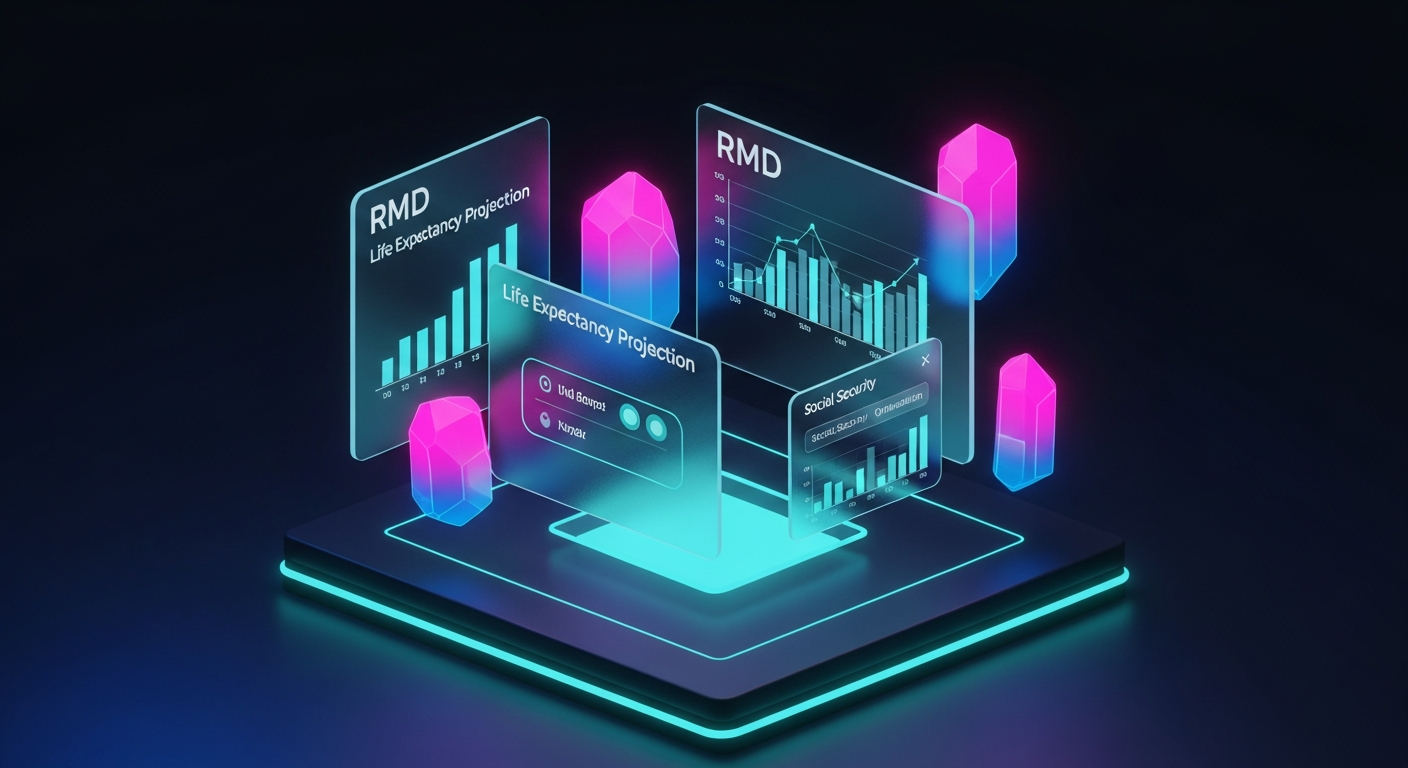
Figure: A visual representation of a modern RMD planning interface — the kind of forward-looking tool that transforms a compliance requirement into a member value-add.
By embracing the digital retirement opportunity, credit unions can fulfill their core mission while building a sustainable, profitable, and deeply differentiated member relationship that will serve both the institution and its members for generations to come.

Figure: A visualization of the digital beneficiary and estate planning experience — turning a complex legal requirement into an engaging, member-friendly journey.
References
- Federal Reserve — Survey of Household Economics and Decisionmaking (SHED), 2024
- Employee Benefit Research Institute — Retirement Confidence Survey, 2025
- Investment Company Institute — IRA Ownership Statistics, 2026
- Cerulli Associates — U.S. Retirement Markets, 2026
- Transamerica Center for Retirement Studies — Annual Retirement Survey, 2025
- SECURE 2.0 Act of 2022 — Setting Every Community Up for Retirement Enhancement
- IRS — IRA Deduction Limits and Contribution Limits
- IRS — Required Minimum Distributions (RMDs)
- TIAA Institute — Financial Literacy Survey, 2025
- Cornerstone Advisors — What's Going On in Banking, 2025
- J.D. Power — U.S. Banking Satisfaction Study, 2025
- NCUA — Regulatory Compliance Resources for IRAs
- CUNA Mutual Group — Retirement Solutions for Credit Unions
- FINRA — Individual Retirement Accounts (IRAs) Guide
- E-SIGN Act — Electronic Signatures in Global and National Commerce Act
- Trust & Will — Digital Estate Planning Platform
- FreeWill — Online Will and Estate Planning
- NerdWallet — Credit Union IRAs: What They Are and How They Work
- Investopedia — Roth IRA: A Beginner's Guide
- Bankrate — The Complete Guide to Credit Union IRAs
- SEC — Investor Resources for Retirement Planning
- Social Security Administration — Retirement Benefits Claiming Guide
- FDIC — Regulation E: Electronic Fund Transfers
- FFIEC — BSA/AML Examination Manual
- IRS — Rollovers of Retirement Plan and IRA Distributions
- IRS Publication 590-A — Contributions to Individual Retirement Arrangements
This article was brought to you by GrafWeb CUSO – Building the future of digital credit unions.