
📑 Table of Contents
- The Importance of Digital Branches in Modern Banking
- 1. Understanding the Digital Branch Paradigm
- 2. UI/UX Foundations: Designing for Trust and Clarity
- 3. Personalization: The Heartbeat of Credit Union Service
- 4. Omnichannel Support: Blending Human and AI Assistance
- 5. Frictionless Onboarding and Account Opening
- 6. ADA Compliance and True Accessibility
- 7. Communicating Security and Stability
- 8. Content Strategy: Financial Education as a Service
- 9. Conclusion: Embracing the Digital Future
- Related Posts
For decades, the cornerstone of the credit union advantage has been the in-branch experience. Members walk through the doors and immediately feel a sense of belonging. They are greeted by name, supported by staff who understand their local community, and guided through financial decisions with genuine care. This profound level of personalized service has bred incredible loyalty, allowing credit unions to thrive even as massive multinational banks have aggressively expanded their footprints. As the industry evolves, the emergence of Digital Branches becomes essential for maintaining this loyalty in a digital-first world. The concept of Digital Branches is changing the way credit unions interact with members.
However, the financial landscape has fundamentally shifted. The modern member—from Gen Z opening their first checking accounts to Baby Boomers managing retirement funds—now expects to interact with their financial institution primarily through digital channels. The physical branch is no longer the default first touchpoint; the website and mobile app have taken its place. This paradigm shift presents both a formidable challenge and a massive opportunity for credit unions: How do you take the warm, personalized, trust-building experience of a physical lobby and seamlessly translate it into pixels on a screen?
Moreover, the evolution of Digital Branches enables easier access to services and resources that empower members. It is crucial for credit unions to embrace the Digital Branches model to remain competitive in the financial services landscape.
The Importance of Digital Branches in Modern Banking
In addition to traditional services, Digital Branches provide a platform for community engagement and financial literacy through online workshops and webinars.
The answer lies in the concept of the Digital Branch. A credit union website can no longer be a static brochure of rates and routing numbers. It must be a dynamic, interactive, and intelligent platform that anticipates member needs, guides them effortlessly toward their financial goals, and fosters the same deep trust that a friendly teller would across a desk. In this comprehensive guide, we will explore the critical strategies, UX/UI methodologies, and technological integrations required to build a true digital branch and effectively utilize Digital Branches for member engagement.
The role of Digital Branches cannot be overstated; they are crucial for driving engagement and satisfaction among members.
Table of Contents
In this guide, we will also emphasize the role of Digital Branches in transforming member experiences and driving engagement through innovative technology.
- 1. Understanding the Digital Branch Paradigm
- 2. UI/UX Foundations: Designing for Trust and Clarity
- 3. Personalization: The Heartbeat of Credit Union Service
- 4. Omnichannel Support: Blending Human and AI Assistance
- 5. Frictionless Onboarding and Account Opening
- 6. ADA Compliance and True Accessibility
- 7. Communicating Security and Stability
- 8. Content Strategy: Financial Education as a Service
- 9. Conclusion: Embracing the Digital Future
To maximize the potential of Digital Branches, credit unions must invest in innovative technologies that facilitate seamless interactions and personalized services.
Creating a vibrant community through Digital Branches is vital for enhancing member loyalty and trust.
The effectiveness of Digital Branches is evident in improved member satisfaction and retention rates.
As we explore the future of Digital Branches, it is essential to recognize their role as a catalyst for transformation in the credit union sector.
1. Understanding the Digital Branch Paradigm
The strategies for implementing successful Digital Branches include leveraging data analytics to tailor services to member needs.
Before diving into specific design tactics, it is crucial to understand what a digital branch actually is. A traditional website is informational; a digital branch is transactional and relational. When a member visits a digital branch, they should be able to perform 99% of the tasks they could do in person, from opening complex joint accounts and applying for HELOCs to seeking customized financial advice and resolving account disputes.

But functionality alone does not make a digital branch. The “branch” aspect implies an environment. Just as a physical branch is designed with comfortable seating, clear signage, and welcoming lighting, a digital branch must be architected with an intuitive user experience (UX) and an inviting user interface (UI). Every click, scroll, and micro-interaction must be engineered to reduce anxiety and build confidence.
Credit unions possess a unique advantage here. Mega-banks often build digital experiences optimized purely for ruthless efficiency—getting the user in and out as fast as possible to reduce server load and support costs. While efficiency is important, credit unions must optimize for connection. The digital branch must feel like an extension of the community the credit union serves.
The Four Pillars of a Digital Branch
- Accessibility and Intuitive Navigation: Users of all technical skill levels and physical abilities must be able to find what they need instantly.
- Frictionless Transactions: Whether checking a balance or applying for a mortgage, the path from intent to completion must be devoid of unnecessary steps.
- Proactive Support: Help must be seamlessly integrated into the journey, preventing user frustration before it occurs.
- Personalized Communication: The platform should remember the member’s context, history, and preferences to offer relevant solutions.
Understanding the nuances of Digital Branches will help credit unions foster better relationships and enhance the overall member experience.
2. UI/UX Foundations: Designing for Trust and Clarity
The visual design and structural layout of your website are the first things a member notices. In psychological terms, this is the “halo effect.” If your digital branch looks outdated, cluttered, or confusing, members will subconsciously assume your financial products, security protocols, and customer service are equally subpar.
Clean, Modern, and Consistent Visual Language
Translating trust begins with professionalism. A digital branch does not need to be boring, but it must be impeccably structured. This involves adopting a modern design system with a consistent visual language. Your credit union’s brand colors, typography, button styles, and iconography must be uniform across every single page and viewport.
White space (or negative space) is not wasted space; it is a critical design tool. Ample white space around text blocks, forms, and calls-to-action (CTAs) reduces cognitive load. When members manage their money, they are often in a heightened state of stress. A cramped, busy interface exacerbates this stress. A clean, spacious interface promotes calm and focus, implicitly signaling that “we have everything organized and under control.”
Information Architecture: Thinking Like a Member
Many credit union websites make the critical mistake of structuring their navigation based on their internal organizational chart (e.g., “Retail Banking,” “Lending Division,” “Wealth Management”). Members do not think this way. They think in terms of their goals: “I want to buy a car,” “I need a checking account,” “I want to save for retirement.”
The information architecture (IA) of a digital branch must be radically user-centric. Mega-menus are highly effective here, grouping products by life events or practical needs. Furthermore, the search function must be front and center. A robust, AI-powered predictive search bar acts as the digital equivalent of the friendly greeter at the front door, instantly directing the member to the exact form or page they need.
Micro-interactions: The Digital Smile
In a physical branch, trust is built through small gestures: a warm smile, a nod of understanding, handing a pen. In the digital branch, these gestures are replaced by micro-interactions. These are small, subtle animations that provide immediate feedback to the user.
When a member clicks a button to submit a loan application, a simple color change or a smooth loading spinner reassures them that the system is working. When they hover over a product card, a slight lift animation indicates it is interactive. When an error is made in a form, an inline, polite message highlighting the specific field (rather than a generic pop-up) guides them back on track. These tiny details collectively create an experience that feels responsive, attentive, and deeply human.
3. Personalization: The Heartbeat of Credit Union Service
The definition of credit union service is “knowing the member.” Your digital branch must reflect this. When an authenticated member logs into your online banking portal—which should be seamlessly integrated with your main website, not a disjointed third-party experience—they should feel recognized.
Dynamic Content and Tailored Dashboards
A static homepage is a missed opportunity. If a member logs in who only holds a basic checking account and is 24 years old, the digital branch should prioritize educational content on building credit and prominent CTAs for first-time auto loans or credit cards. Conversely, if a 55-year-old member with a mortgage logs in, the dashboard should highlight HELOCs, wealth management services, and retirement planning tools.
This level of dynamic content requires tight integration between your website CMS and your core banking processor. By securely leveraging data analytics, you can present the products that genuinely serve the member’s current life stage, transforming your digital branch from a passive brochure into an active financial advisor.
Contextual Next Best Actions
Beyond the dashboard, personalization should follow the member throughout their journey. If they repeatedly visit the mortgage rates page but abandon the calculator, the digital branch should recognize this intent. The next time they log in or visit the site, a subtle, non-intrusive prompt might say, “Still thinking about a new home? Connect with Sarah, our local mortgage expert, for a quick chat.” This bridges the gap between digital analytics and human connection.
4. Omnichannel Support: Blending Human and AI Assistance
No matter how perfect your UX/UI is, members will inevitably have questions or hit roadblocks. How your digital branch handles these moments is the ultimate test of its ability to replicate in-person trust.
The Role of Conversational AI
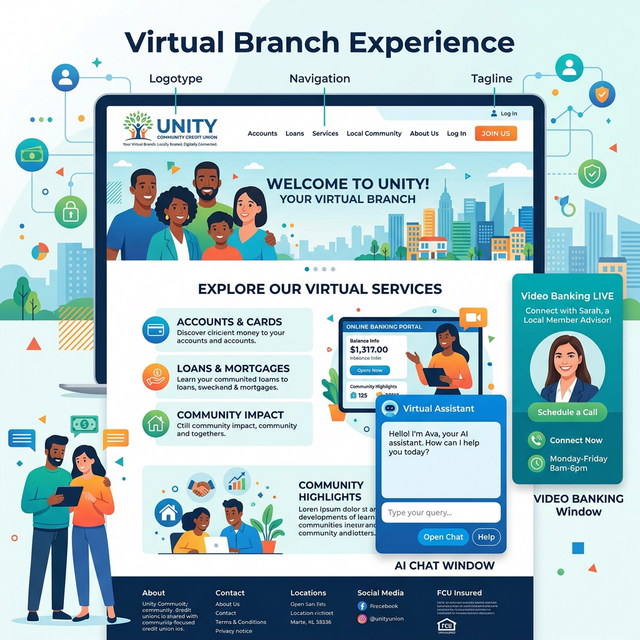
Chatbots of the past were frustrating, rule-based systems that drove members crazy. Today, Conversational AI powered by advanced Large Language Models (LLMs) is a game-changer. An intelligent virtual assistant integrated directly into your digital branch can handle 70-80% of routine inquiries—checking hours, finding routing numbers, or explaining the difference between savings accounts—instantly, 24/7/365.
The key to building trust with AI is transparency and competence. The bot should clearly identify itself as an AI, but it should communicate in the warm, helpful tone of your brand. Furthermore, it must be deeply integrated with your knowledge base so it always provides accurate, up-to-date information.
Seamless Handoffs to Human Experts
The magic of the digital branch happens when the AI recognizes its limitations and seamlessly escalates the conversation to a human representative. This transition must be frictionless. The member should never have to repeat their problem. The human agent should inherit the full chat history and context instantly.
To take this a step further, the digital branch should incorporate Co-Browsing and Video Banking. If a member is struggling with a complex loan application, an option to instantly launch a secure video call and allow the representative to highlight fields on their screen replicates the experience of sitting side-by-side at a desk. This high-touch digital capability is the ultimate expression of credit union service in 2026.
5. Frictionless Onboarding and Account Opening
The most critical moment in a member’s journey is the very beginning. If the process of opening an account or applying for a loan is clunky, slow, or requires printing PDFs, you will suffer catastrophic abandonment rates. The digital branch must offer a consumer-grade onboarding experience.
Mobile-First Application Flows
The majority of your traffic is on mobile devices. Your online application forms must be rigorously optimized for thumbs and small screens. This means utilizing large, touch-friendly inputs, minimizing required typing through auto-complete and address lookups, and utilizing mobile native hardware (like using the camera to scan a driver’s license for secure, instant ID verification).
Progressive Profiling and Save-and-Resume
Ultimately, the success of Digital Branches lies in their ability to adapt to the changing needs of members in a digital landscape.
Long forms are intimidating. Break complex applications (like mortgages) into short, digestible steps with a clear progress indicator. This psychological trick, known as the “endowed progress effect,” motivates users to finish once they perceive they have already made headway.
Equally important is a robust save-and-resume feature. If a member is applying for a loan on their phone during their lunch break but needs to look up a document at home, they must be able to securely pause the application and pick it up exactly where they left off on their laptop later that evening. A digital branch never loses its place.
6. ADA Compliance and True Accessibility
Credit unions exist to serve their communities inclusively. A digital branch that is not accessible to members with visual, auditory, or motor impairments is a fundamental failure of that mission. Beyond the significant legal risks of non-compliance, Web Content Accessibility Guidelines (WCAG) compliance is a moral imperative and a core tenet of building trust.
Engineering for Accessibility from the Ground Up
True accessibility is not a plugin you install at the end; it must be engineered into the core architecture. This involves:
- Semantic HTML: Proper use of heading tags, ARIA labels, and logical document structure so screen readers can interpret the page flawlessly.
- Color Contrast: Ensuring all text stands out sharply against its background, aiding those with visual impairments or color blindness.
- Keyboard Navigation: Every interactive element—from dropdown menus to complex calculators—must be fully operable using only the tab and enter keys, serving members who cannot use a mouse.
When a member with disabilities realizes your digital branch was built with their specific needs in mind, you forge an unbreakable bond of loyalty.
7. Communicating Security and Stability
Trust in a financial institution is fundamentally rooted in a sense of security. While your backend may boast military-grade encryption, if your frontend looks flimsy, members will feel anxious. The digital branch must actively communicate its strength.
Visual Cues of Safety
Incorporate recognized security badges near login fields and transaction buttons. Use clear icons (like locks or shields) to denote secure areas. Beyond explicit badges, the overall professional polish of the UI acts as an implicit indicator of systemic stability. A fast-loading, glitch-free modern interface subtly reassures the user that the underlying technology managing their money is equally robust.
Transparent and Educational Security Policies
Don’t bury your security practices in a dense legal policy document. Have a dedicated, easy-to-read “How We Protect You” page in the digital branch. Explain multi-factor authentication (MFA), fraud monitoring, and data encryption in plain, reassuring language. When members understand how you are protecting them, their trust deepens significantly.
8. Content Strategy: Financial Education as a Service
In a physical branch, members often drop in simply to ask for advice on budgeting, dealing with debt, or planning for a child’s education. The digital branch must replicate this advisory role through a strategic content architecture. Financial education should not be an afterthought; it should be a core product.
With careful attention to user experience, Digital Branches can provide a welcoming and engaging environment for all members.
Resource Centers That Actually Help
Move away from generic, syndicated blog posts. The digital branch should feature a dynamic “Financial Wellness Center” filled with bespoke content tailored to your specific community demographics. This includes:
- Actionable Checklists: “The 30-Day Guide to Buying Your First Home in [Local Area].”
- Interactive Calculators: Not just basic loan calculators, but holistic visual tools that let members model different saving scenarios and visualize the compound impact over time.
- Bite-Sized Video Content: Short, engaging videos featuring your real loan officers and financial advisors answering common questions. This humanizes the digital experience immensely.
When a member learns a crucial financial lesson entirely through your digital ecosystem, they attribute that value directly to the credit union. You become the trusted authority, making them significantly more likely to choose your products when the need arises.
9. Conclusion: Embracing the Digital Future
The transition from a traditional credit union infrastructure to a fully realized digital branch is not purely a technological upgrade; it is a profound cultural shift. It requires reimagining every member interaction through the lens of a screen without losing the empathetic, community-first ethos that defines the credit union movement.
By investing in intuitive UI/UX, personalized data integration, omnichannel support loops, and unwavering accessibility, credit unions can achieve the holy grail of modern banking: digital efficiency infused with human warmth. The digital branch is no longer a “nice-to-have” alternative to the physical location; it is the definitive frontline of member service in the 21st century.
This article was brought to you by GrafWeb CUSO – Building the future of digital credit unions.
As we move forward, the integration of advanced technologies will further enhance the capabilities of Digital Branches.
Digital Branches are not merely a replacement for physical locations; they represent a new approach to delivering financial services that meets the needs of modern consumers.
The future of credit unions will be defined by how effectively they implement and leverage Digital Branches to serve their communities.
Related Posts



Request a proposal from GrafWebCUSO · (201) 632-1771 · [email protected]