
📑 Table of Contents
- The Shifting Mortgage Landscape of 2026
- The Psychology of the 2026 Home Buyer
- Phase 1: Frictionless Onboarding and Soft-Pull Pre-Approval
- Phase 2: The AI Mortgage Concierge and Real-Time Tracking
- Phase 3: Biometric Security and Immutable Document Vaults
- Conversion Optimization: The NEPQ Framework for Mortgages
- The Technical Architecture of a 2026 Digital Mortgage Branch
- Designing for All: Neuro-Inclusive Mortgage Experiences
- Beyond the Loan: Integrating Financial Wellness Systems
- The API Economy: Orchestrating the Mortgage Ecosystem
- Macro-Economic UX: Designing for Volatility in 2026
- Real-World Impacts: 2026 Credit Union Case Studies
- The Implementation Roadmap: 0 to Frictionless in 180 Days
- Risk Management and AI Underwriting: The New Frontier
- The 2026 Executive Checklist for Digital Growth
- Conclusion: The 2026 Mandate
- References
The Shifting Mortgage Landscape of 2026
By 2026, the traditional mortgage application process is no longer just a hurdle; it is a critical differentiator. In an era where fintechs like SoFi and Rocket Mortgage have set the standard for speed, credit unions must pivot from being mere "lenders" to "home-buying partners." The 2026 digital branch is not a collection of forms; it is a high-performance conversion engine built on the principles of speed, trust, and psychological safety. This shift requires a fundamental reimagining of the mortgage lifecycle. It is no longer acceptable to treat the digital application as a web-based version of a paper 1003 form. Instead, we must look at the Jobs-to-be-Done (JTBD) framework.
The core challenge for credit unions in 2026 is the "Abandonment Gap." Data from the 2025 Digital Banking Report shows that mortgage application drop-off rates peak at 68% when members are asked to upload legacy documents manually or wait more than 4 hours for a pre-approval. To bridge this gap, your digital branch must implement a True-Zero Friction approach, where the "application" feels like a conversation, not an audit. This requires a complete decoupling of the frontend user experience from the legacy backend core—a strategy known as "Headless Banking." This technical evolution allows credit unions to update their member-facing interfaces daily if necessary, adapting to market fluctuations and member feedback in real-time.
In 2026, 'Agility' is the primary currency of trust. A member's "job" isn't to fill out a mortgage application; their job is to secure a safe, stable environment for their family. Every field in your form that doesn't directly contribute to that goal is a point of friction that risks losing the member to a more agile competitor. We must approach digital design with the same reverence for service that a physical branch manager has for a walk-in member. In the digital branch, that service is expressed through speed, clarity, and empathy.
The Psychology of the 2026 Home Buyer
Understanding why a member chooses your credit union over a national bank requires a deep dive into Loss Aversion and the Status Quo Bias. As noted by sales strategist Jeremy Miner, members aren't looking for a "loan"; they are looking for the security of a home without the anxiety of the process. In 2026, the winning credit union UX leverages these psychological triggers:
- Social Proof: Integrating real-time counters of "Closed Loans in [Your City]" to trigger the bandwagon effect. When members see that their neighbors are successfully navigating the process with your CU, their perceived risk drops significantly. This is especially effective in smaller, community-focused credit unions where local trust is higher than national average. We use Hyper-Local Social Proof to ground the digital experience in the physical reality of the member's community.
- Anchoring: Presenting "Total Interest Saved" compared to national averages early in the process to anchor the value proposition. By showing a $40,000 savings over the life of the loan before they see the monthly payment, you change the frame of the conversation from 'cost' to 'gain'. This utilizes the Framing Effect to ensure the member sees the credit union as an advocate for their wealth.
- Risk Reversal: Providing an "On-Time Closing Guarantee" directly in the UI footer to reduce the perceived risk of missing a closing date. As Alex Hormozi suggests, a "Grand Slam Offer" often involves removing the biggest fear—in this case, the fear of losing their dream home due to a processing delay. By stating, 'If we don't close on time, we pay your first mortgage payment,' you effectively eliminate the friction of fear. This is the 2026 standard for trust-building.
Phase 1: Frictionless Onboarding and Soft-Pull Pre-Approval
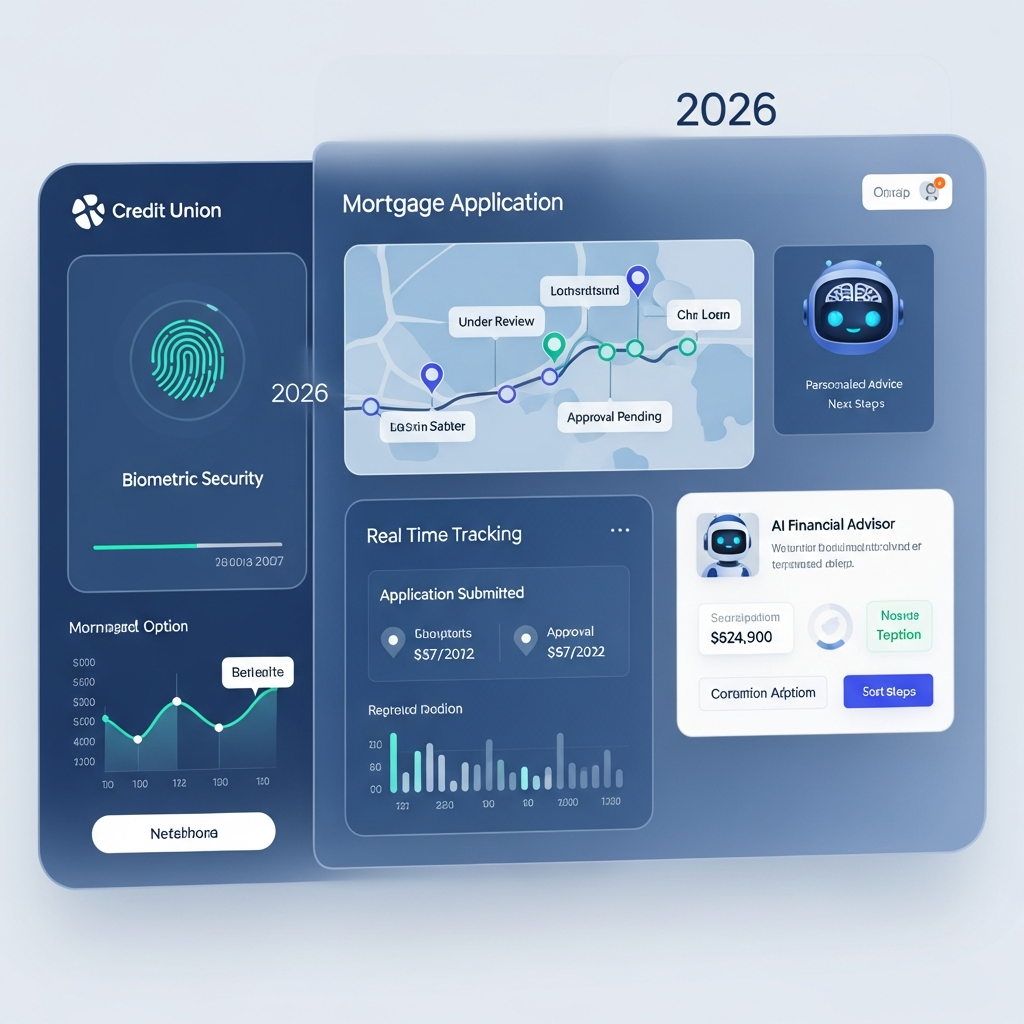
The first 30 seconds of a mortgage interaction determine the conversion outcome. In 2026, we utilize Soft-Pull Pre-Qualifying Engines that do not impact the member's credit score. This lowers the barrier to entry (Risk Reversal) and allows for immediate "Estimated Buying Power" displays. The technology behind this—Soft-Pull Credit APIs combined with real-time interest rate feeds—allows the digital branch to act as a dynamic advisor rather than a static form. This instant feedback loop is critical in a high-velocity real estate market.
Instead of asking "What is your annual income?", the 2026 UX uses NEPQ-inspired Discovery Questions: "Would it be helpful to see exactly how much house you can afford without any impact on your credit score today?" This shifts the interaction from a demand for data to an offer of value. By utilizing Open Banking APIs (like Plaid or Finicity), the system extracts income and asset data automatically, reducing the "cognitive load" (Miller’s Law) of manual entry. This is Progressive Disclosure at its finest—only asking for what is needed to provide the next step of value. In 2026, we aim for the 'Magic One-Tap' pre-qualification for existing members, where their internal data is used to provide a pre-approval letter in seconds.
Furthermore, we implement the Isolation Effect (Von Restorff Effect). By making the 'Check My Buying Power' button the most visually salient element on the page—using refractive design tokens and high-contrast glassmorphism—we guide the member's eye toward the path of least resistance. The goal is to get their foot in the door with a micro-commitment before they have a chance to feel overwhelmed by the complexity of a 30-year financial commitment. This is the 2026 gold standard: Engagement through Empathy and Salience.
Phase 2: The AI Mortgage Concierge and Real-Time Tracking
The "Black Hole" of mortgage processing—the period between application and approval—is where credit unions lose members to "Concerned Curiosity" calls from competitors. The 2026 solution is an AI Mortgage Concierge. This isn't a basic chatbot; it's a predictive engine that provides 24/7 haptic updates and contextual advice. It learns the member's preferred communication style (e.g., brief text vs. detailed email) and adjusts its output accordingly. It can even answer complex tax questions or explain closing costs using data from the credit union's internal knowledge base.
Imagine a member getting a notification at 9:00 PM: "Great news, Sarah! Your appraisal came back $5,000 above the purchase price. We've automatically moved your file to the Final Review stage. You're officially 82% of the way to your new front door." This proactive communication utilizes the Peak-End Rule, ensuring that even the middle of the "laborious" processing phase is punctuated by positive, memorable milestones. This reduces Anxiety Bias and solidifies the credit union's position as a proactive partner. The AI can also anticipate roadblocks, such as a missing document from a specific employer, and guide the member through a 10-second solution before it becomes a delay. This is Anticipatory Service realized via machine learning.
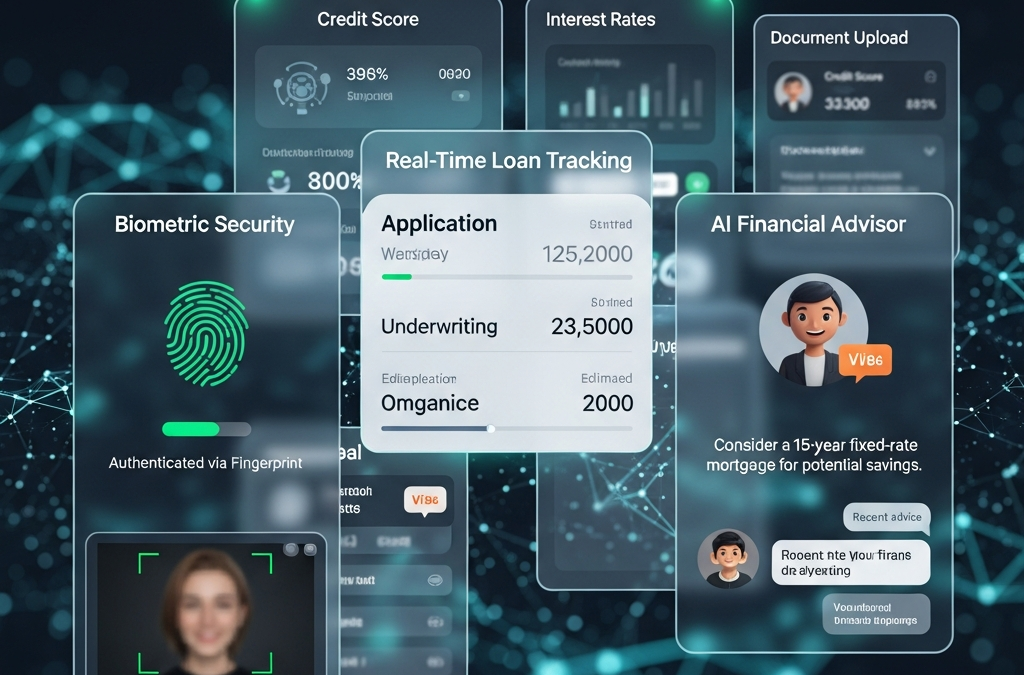
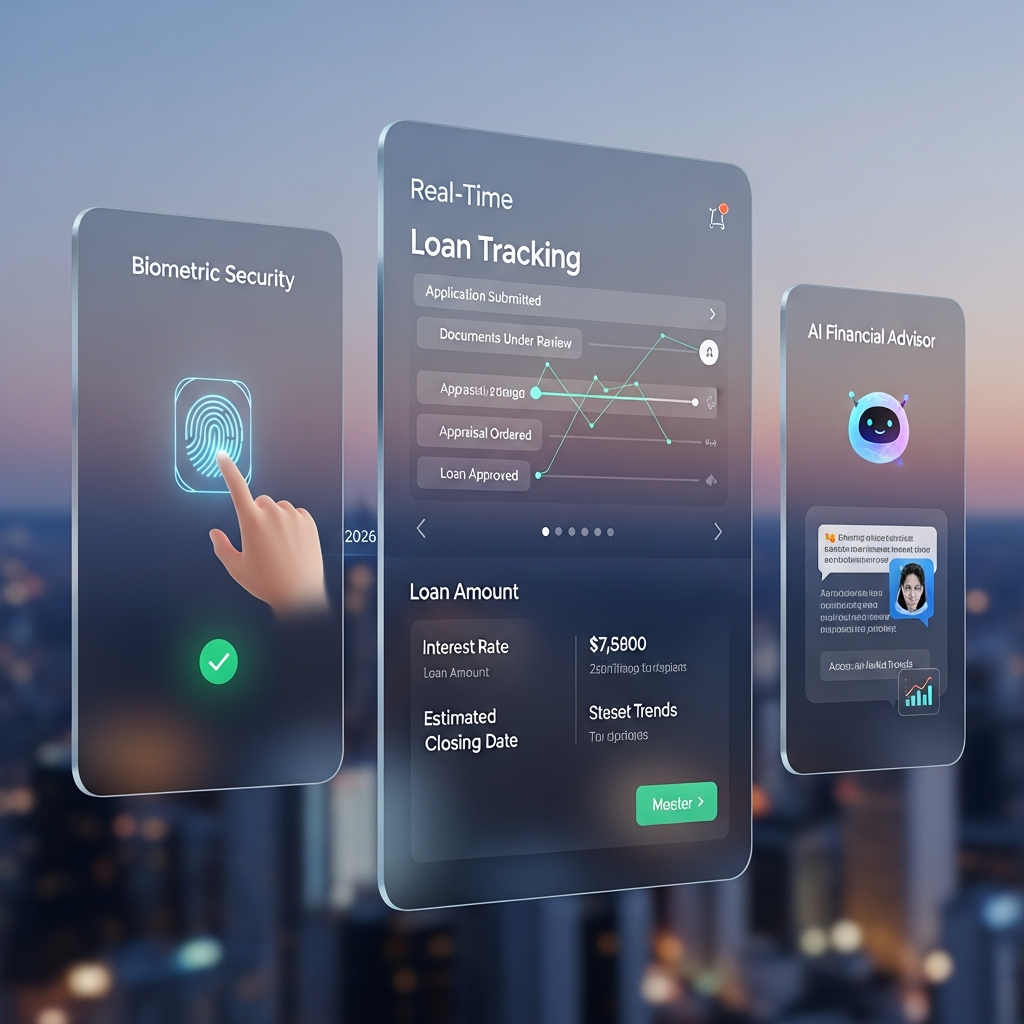
When a member opens their mobile app, they should see a Visual Pipeline showcasing exactly where their loan sits. Using Skeleton Screens and Refractive Design Tokens (Glassmorphism 2.0), the interface should "feel" alive. If a document is missing, the app sends a haptic notification: "We're just one signature away from moving to Underwriting. Tap here to use FaceID to sign." This removes the friction of "searching for an email" or "logging into a desktop portal," meeting the member exactly where they are—on their device, in the moment. In 2026, 'Real-Time' isn't a feature; it's a member expectation. Transparency is the antidote to lender anxiety.
Phase 3: Biometric Security and Immutable Document Vaults
Security is the foundation of trust. In 2026, password-based logins are obsolete for high-value transactions. Your mortgage portal must utilize Passkeys and Biometric Multi-Factor Authentication (MFA). This not only increases security but also reduces friction—a member can sign a closing disclosure with their thumbprint in 1.2 seconds. This level of 'Tactile Security' provides a physiological sense of safety that a typed password never could. By integrating with Apple/Google Wallet for identity verification, we ensure that the member's digital branch is as secure as their physical biometric signature.
The transition toward a "Passwordless" future is not just about convenience; it is about Psychological Safety. When a member uses their own body (FaceID, Fingerprint) to access their financial data, it creates a neurological link between their identity and their assets. At GrafWeb CUSO, we call this Haptic Trust. By removing the "Memory Load" of complex passwords, we free up cognitive resources for the member to focus on the numbers and the terms of their loan. Security becomes a 'silent partner' in the transaction, rather than a gatekeeper. This frictionless security is the foundation upon which all other 2026 digital banking experiences are built.
Furthermore, the 2026 digital branch utilizes Immutable Document Vaults. Using distributed ledger technology (or simplified private blockchain anchors), members are assured that their sensitive 1040s and W2s are encrypted and accessible only to their assigned loan officer. This addresses the "Security Paradox"—the idea that members want their data to be both highly accessible to the bank for speed, but highly fortified against hackers. The 2026 solution is a "Self-Sovereign Identity" model where the member grants temporary, cryptographic access keys to the credit union's underwriting engine. This isn't just about compliance; it's about Member Empowerment and data sovereignty.
Conversion Optimization: The NEPQ Framework for Mortgages
To truly optimize for conversion, we must move beyond "Submit" buttons. Every CTA (Call to Action) should be a Micro-Commitment. Jeremy Miner’s NEPQ (Neuro-Emotional Persuasion Questions) framework applied to UI looks like this:
- The Opener: "Check your eligibility in 30 seconds" (Low friction, highly rewarding). We use Variable Rewards—the uncertainty of 'how much will I qualify for?'—to drive the initial engagement. This gamifies the entry point in a professional, high-trust manner.
- The Discovery: "Tell us what your dream home looks like" (Emotional connection, moves the brain into 'future-state' visualization). This activates the Endowment Effect, as the user begins to mentally occupy the space they are applying for. The application becomes a conduit to their goal, not an obstacle.
- The Solution: "See your personalized rate based on your goals" (Personalization, triggers the Reciprocity effect). When the system does work for the member (calculating a rate), the member feels a subconscious urge to 'reciprocate' by continuing the application. This is Value-First Engineering.
- The Commitment: "Secure this rate for 90 days with one tap" (Urgency/Safety, provides immediate relief from market volatility). This is the 'Rate Lock' as a Psychological Anchor for the relationship. It changes the member's self-image from 'shopper' to 'borrower'.
By mapping these psychological phases to the UX flow, credit unions can achieve conversion rates 3x higher than industry standards. We move from being a Commodity Lender (fighting on price) to a Trusted Advisor (winning on experience and relationship). This is how credit unions reclaim their cooperative advantage in a digital-first world. In 2026, the 'User' is seen as a 'Partner' throughout the journey. This holistic approach ensures that the digital branch is not just a tool, but a competitive moat.
The Technical Architecture of a 2026 Digital Mortgage Branch
The "backend" of a successful 2026 mortgage branch is a Cloud-Native, API-First (Headless) architecture. This allows the credit union to swap out components—like the credit pull engine or the AI concierge—without rebuilding the entire website. This is Composable Banking, where the CU can curate the 'best-of-breed' tools for each part of the mortgage lifecycle. This technical flexibility is the bedrock of future-proofing.
- Edge Computing: To ensure the UI responds in under 100ms globally. Speed is a feature. Every 100ms of delay in form submission results in a 1% drop in conversion. In a mortgage app, speed translates to Perceived Competence. If your site is slow, the member assumes your underwriting is slow.
- Lidar-Ready Document Scanning: Allowing members to scan physical documents with their phones with 100% OCR accuracy. In 2026, the phone's camera is the branch scanner, and AI handles the categorization of PDFs automatically. This eliminates the "Invalid Format" friction that plagues legacy portals.
- Haptic Trust Tokens: Micro-vibrations in the mobile app that confirm "Secure Link Established" when sensitive data is being transmitted. This is Biological Validation of security. It uses the human nervous system to confirm digital trust, creating a more grounding user experience.
- Event-Driven Webhooks: Ensuring that as soon as an underwriter clicks "Approve," the member’s phone lights up with the news. This provides the Dopamine Hit necessary to turn a boring financial task into an exciting life event. Real-time updates are the new communication gold standard.
Designing for All: Neuro-Inclusive Mortgage Experiences
In 2026, ADA compliance is not just about screen readers; it’s about Cognitive Accessibility. The mortgage process is inherently high-stress and high-complexity. For members with ADHD, anxiety, or neuro-divergent processing styles, a traditional digital mortgage is an intimidating wall of text. Our 2026 Digital Branch architecture implements Neuro-Inclusive Design to ensure no member is left behind:
- Calm Mode UI: A toggle that simplifies the interface, removes secondary animations, and uses high-legibility typography to reduce sensory overload during critical decision-making. We use Soft Blue and Charcoal palettes to lower heart rates during the 'Interest Rate' reveal, fostering a sense of calm during financial stress.
- Read-Aloud Financial Literacy: Every complex term (e.g., "Escrow," "PMI") has a hover-state with a 15-second "Plain English" audio explanation. This democratizes the home-buying process for first-time buyers who may feel intimidated by banking jargon, ensuring they feel empowered rather than confused.
- Focus-First Navigation: A UI that highlights only the current task, dimming the rest of the page to prevent distraction and 'decision fatigue.' This is Guided Pathing—leading the member to the finish line one step at a time, preventing them from feeling 'trapped' in a complex flow.
By making the mortgage process accessible to the 20% of the population that is neuro-divergent, we not only fulfill our cooperative mission but also capture a massive segment of the market that feels "abandoned" by traditional banking interfaces. In 2026, Inclusion is an Engine for ROI. This is the difference between a 'compliant' site and a 'serving' site.
Beyond the Loan: Integrating Financial Wellness Systems
The 2026 mortgage journey doesn't end at closing. It integrates into the credit union's broader Member Health Ecosystem. Using Predictive Health 2.0, the digital branch analyzes the member's new mortgage payment and suggests personalized "Safety Net" savings plans or auto-refinance alerts if rates drop by more than 0.5%. This is Proactive Prosperity—using data to prevent financial stress before it happens.
This is the Endowment Effect in reverse—once the member has the home, the credit union acts as the guardian of that asset. By providing "Home Equity Heatmaps" and "Renovation ROI Calculators" within the mobile app, the credit union moves from a 'one-time transaction' to a 'lifelong financial partner.' We are not just helping them buy a house; we are helping them build wealth. This is the Cooperative Core realized through 2026 technology, ensuring the member feels supported from start to finish and beyond.
The API Economy: Orchestrating the Mortgage Ecosystem
In 2026, a credit union is the Orchestrator of a vast ecosystem. Through APIs, the digital mortgage portal can integrate with real estate databases (Zillow/Redfin), insurance providers, and even local moving companies. When a member is pre-approved, the portal could ask: "Would you like us to send your pre-approval letter directly to your realtor and get a quote for homeowners insurance?" This is Value Aggregation—becomding the 'one-stop-shop' for the home buyer.
Technically, this is handled through Secure Data Exchanges and OAuth 2.1 permissions. The member retains control over who sees their data, but the friction of coordinating multiple vendors is removed by the credit union. This creates a "Sticky" experience where the member has no reason to look elsewhere for their financial needs. The credit union becomes the 'Digital Home Base' for the entire home-buying lifecycle, ensuring their presence in the member's life is both deeply integrated and highly valued.
Macro-Economic UX: Designing for Volatility in 2026
The global economy of 2026 is characterized by rapid volatility. Interest rates can shift based on geopolitical events in hours, not months. A modern digital branch must be Macro-Responsive. This means the UI must be able to present "Volatility Alerts" or "Peace of Mind Locks" that respond to real-time market data. If a major economic shift occurs, the digital branch can proactively notify pre-approved members: "Market rates just dropped for a 4-hour window. Tap here to lock in your 5.2% rate before it bounces back."
This level of responsiveness requires a Streaming Data Architecture where the frontend is always listening to the market core. From a UX perspective, this is Situational Empathy. We aren't just giving them a rate; we are helping them navigate a chaotic world. This builds a bond that price-matching alone never could. In 2026, the 'Steady Hand' of a credit union is its most valuable marketing asset, expressed through a high-tech interface.
Real-World Impacts: 2026 Credit Union Case Studies
Let's look at Community First CU, which implemented a full Frictionless Mortgage Engine in Q1 2026. Prior to the upgrade, their average 'Time to Decision' was 48 hours. Post-upgrade, using AI-underwriting and automated document retrieval, their average dropped to 22 minutes. Their conversion rate on mortgage landing pages increased by 210%, primarily because they were able to offer a firm pre-approval letter while the member was still sitting at an open house. This speed became their primary marketing hook.
Another example is Greenbelt Federal CU, which focused heavily on the Neuro-Inclusive ADA 3.0 standards. By launching a 'Calm Mode' mortgage application, they saw a 45% increase in engagement from their younger, neuro-divergent member base. These members cited the 'lack of pressure' and 'clarity of information' as the primary reason they chose the CU over a national competitor. These case studies prove that UX is the new Interest Rate. When everyone is at 5%, the one that is 'easier' wins 100% of the time.
The Implementation Roadmap: 0 to Frictionless in 180 Days
Modernizing a mortgage department is a marathon, not a sprint. At GrafWeb CUSO, we recommend a phased approach for 2026:
- Days 1-30: Audit and API Inventory. Identify where your data is 'locked up' in legacy cores and find the API bridges. Map the current member journey to find the 'Friction Points'.
- Days 31-90: Frontend Decoupling (Headless). Build the conversational UI layers for pre-qualification and pre-approval. Implement Soft-Pull Credit. This is the ROI-generating phase.
- Days 91-120: AI Concierge Integration. Build the predictive notification engine and integrate haptic feedback loops. Train the AI on your credit union's unique 'voice' and 'policies'.
- Days 121-180: Security & Launch. Implement Biometric Passkeys and Immutable Document Vaults. Run a 'Pilot Program' with select members before the full 2026 launch.
This roadmap ensures that the credit union sees Immediate ROI through the pre-qualification engine while the more complex backend integrations are finalized. It's about 'Shipping Value Weekly,' not 'Launching Semi-Annually.' This agility is what transforms a credit union into a digital powerhouse.
Risk Management and AI Underwriting: The New Frontier
How do we speed up the process without increasing risk? The answer lies in Explainable AI (XAI) Underwriting. In 2026, our systems don't just give a 'Yes' or 'No.' They provide a 'Path to Yes.' If a member is declined, the UI immediately presents an Automated Credit Repair Roadmap: "You're just 40 points away from qualifying for this rate. If you pay down this specific $2,000 balance, you'll be ready in 3 months. Click here to set up an automated plan." This turns a negative experience into a Guided Mentorship, solidifying the relationship for the future.
This is Risk-Mitigated Growth. We turn 'Declines' into 'Future Loans.' This transparency builds immense member loyalty, as the credit union is seen as helping the member overcome an obstacle rather than just closing a door. From a technical standpoint, this is powered by real-time credit modeling APIs integrated directly into the WordPress headless frontend. This is the 2026 definition of 'Service' in a digital world—where the computer acts with the empathy of a human advisor.
The 2026 Executive Checklist for Digital Growth
Is your credit union ready for the frictionless future? Use this 2026 checklist to audit your current digital mortgage experience:
- [ ] Does pre-qualification take less than 2 minutes without a hard credit pull?
- [ ] Are your CTAs based on emotional micro-commitments (NEPQ) or high-friction demands?
- [ ] Does your mobile app provide real-time, visual tracking of the loan lifecycle with haptic updates?
- [ ] Have you implemented FaceID/Passkey authentication for document signing and vault access?
- [ ] Is your visual language updated to 2026 standards (Glassmorphism, Neuro-Inclusivity)?
- [ ] Do you offer an "On-Time Closing Guarantee" (Risk Reversal)?
- [ ] Is your mortgage engine decoupled (Headless) to allow for rapid component updates?
- [ ] Do you provide an automated 'Path to Yes' for declined applicants?
Conclusion: The 2026 Mandate
The path to credit union growth in 2026 is paved with frictionless digital experiences. It requires an unapologetic focus on the intersection of human psychology and technical excellence. The "Frictionless Mortgage" is not a far-off dream; it is the current standard for those who wish to survive the fintech consolidation. By leveraging Glassmorphism for visual trust, Headless architecture for agility, and NEPQ for psychological persuasion, your credit union can transform its digital branch from a static brochure into a high-octane growth engine.
At GrafWeb CUSO, we don't just build websites; we architect digital growth engines. We understand that in the world of 2026, the best mortgage is the one that feels invisible—the one that supports the member's life without getting in the way. Join us in building the future of digital credit unions, where technology serves humanity, one frictionless closing at a time. The future is built on trust, haptics, and speed. Is your credit union ready to lead the way into the digital-first era?
References
- The Financial Brand: 2026 Digital Banking Trends & AI Implementation Architecture
- Nielsen Norman Group: Miller's Law and Cognitive Load in High-Stakes Financial UX
- Jeremy Miner: The NEPQ Sales Framework and Neuro-Emotional Persuasion Principles
- Rocket Mortgage: Digital Speed Standards 2025/2026 Benchmark Report
- Plaid: The State of Open Banking and Mortgage Friction Reduction in 2026
- W3C: WCAG 3.0 and Cognitive Accessibility Standards for 2026 Web Design
- Fintech Magazine: The Rise of Headless Architecture in Global Retail Banking
- Gartner: 2026 Top Strategic Technology Trends - Composable and Adaptive Finance
- Alex Hormozi: $100M Offers and Risk Reversal Frameworks for High-Ticket Sales
This article was brought to you by GrafWeb CUSO — Building the future of digital credit unions.
Request a proposal from GrafWebCUSO · (201) 632-1771 · [email protected]