

📋 Table of Contents
- Introduction – the AI revolution in credit union banking
- Current State of Digital Banking for Credit Unions
- AI-Powered Chatbots and Virtual Assistants for Member Service
- Machine Learning for Personalized Financial Product Recommendations
- Predictive Analytics for Loan Risk Assessment
- AI-Driven Fraud Detection and Prevention
- Natural Language Processing for Document Processing
- Computer Vision for Remote Check Deposit Enhancement
- AI in Marketing Automation and Member Engagement
- Implementation Roadmap for Credit Union IT Teams
- Overcoming Barriers: Budget, Talent, and Regulatory Compliance
- Case Studies: Credit Unions Leading the AI Charge
- The Future: Generative AI and Credit Union Innovation
- Conclusion and Next Steps
- References and Further Reading
Introduction – the AI revolution in credit union banking
The year 2026 marks a pivotal moment for credit unions as they strive to meet the evolving expectations of their members. With advancements in artificial intelligence (AI) and machine learning, these financial institutions are poised to enhance member digital experiences like never before.
Artificial intelligence is not just a buzzword; it’s a transformative technology that promises to revolutionize how credit unions interact with their members, streamline operations, and offer personalized financial solutions. This article delves into the multifaceted ways AI can be leveraged by credit unions to stay competitive in an increasingly digital landscape.
From enhancing customer service through chatbots and virtual assistants to improving loan risk assessment through predictive analytics, this guide offers a comprehensive roadmap for credit union IT teams looking to harness the power of AI. We explore specific use cases that have already shown promising results, providing practical insights and strategies for implementation.
Current State of Digital Banking for Credit Unions
In recent years, digital banking has become a cornerstone of financial services, with credit unions adapting to meet the demands of tech-savvy members. As traditional brick-and-mortar branches face declining foot traffic due to increasing online activity, credit unions are compelled to innovate and offer seamless digital experiences.
The current landscape is characterized by robust mobile applications, user-friendly websites, and secure online banking platforms. However, there remains a gap between basic digital services and advanced AI-driven solutions that can significantly elevate member satisfaction and engagement. This transition requires strategic planning and investment in cutting-edge technology to stay ahead of competitors.
Understanding the current state is crucial for credit unions aiming to integrate AI into their operations effectively. By recognizing existing strengths and identifying areas for improvement, institutions can develop a clear vision for leveraging AI technologies that align with their mission and values.
AI-Powered Chatbots and Virtual Assistants for Member Service
In the digital age, efficient customer service is paramount. Credit unions are increasingly turning to AI-powered chatbots and virtual assistants to enhance member experiences 24/7 without compromising on quality or personalization. These tools use natural language processing (NLP) to understand and respond to inquiries accurately.
One of the primary benefits of integrating AI chatbots is cost reduction. By automating routine tasks such as account balance checks, transaction histories, and bill payments, staff can focus on more complex issues requiring human intervention. This shift not only improves operational efficiency but also frees up resources for developing new services.
Additionally, these virtual assistants provide a consistent level of service regardless of time or location. Members appreciate the convenience of receiving immediate responses to their queries via chat, email, or voice commands on mobile devices. Advanced NLP capabilities enable chatbots to understand nuanced requests and offer tailored advice based on individual financial profiles.
Machine Learning for Personalized Financial Product Recommendations
Personalization is key in today’s competitive banking landscape. Credit unions can harness machine learning algorithms to analyze vast amounts of data about member behavior, preferences, and financial history. This analysis allows institutions to recommend products that are most relevant to each individual’s needs, thereby enhancing customer satisfaction.
For example, a credit union might use machine learning models to predict which members would benefit from refinancing their mortgages or taking out personal loans based on current interest rates and financial stability. Such targeted recommendations not only improve the member experience but also drive revenue growth for the institution.
The implementation of these systems involves collecting and cleaning large datasets, selecting appropriate algorithms, and continuously testing and refining models to ensure accuracy and relevance over time. Credit unions must also be transparent about data usage policies to maintain trust among members.
Predictive Analytics for Loan Risk Assessment
Effective loan risk assessment is critical for any financial institution, and credit unions are no exception. Traditional methods often rely on manual evaluations that can be time-consuming and less accurate compared to modern AI-driven solutions. Predictive analytics leverages machine learning algorithms to analyze historical data patterns and predict potential risks accurately.
By using predictive models, credit unions can make faster and more informed decisions regarding loan applications. This process involves training the model on past loan performance metrics such as default rates, delinquency trends, and repayment histories. The result is a system that identifies high-risk applicants early on while providing insights into factors contributing to risk.
Moreover, predictive analytics can help credit unions diversify their portfolios by identifying new markets or customer segments with lower inherent risks. Such strategic decisions contribute to long-term financial health and stability for both the institution and its members.
AI-Driven Fraud Detection and Prevention
Fraud prevention is a critical aspect of digital banking, and AI plays an increasingly important role in safeguarding member accounts. Credit unions can deploy sophisticated machine learning models to detect fraudulent activities in real-time by analyzing transaction patterns and identifying anomalies. This proactive approach minimizes financial losses and enhances trust among members.
The effectiveness of these systems lies in their ability to learn continuously from new data, adapting quickly to evolving fraud tactics. Machine learning algorithms can flag suspicious behavior even before human analysts would typically notice it, providing a robust first line of defense against cyber threats.
Implementing AI-driven fraud detection also involves strict compliance with regulatory standards and privacy laws. Credit unions must ensure that they are transparent about data usage while protecting sensitive information to maintain member confidence in the security of their transactions.
Natural Language Processing for Document Processing
Efficient document processing is essential for maintaining operational efficiency within credit unions. Traditional methods often involve manual input and verification, which can be time-consuming and error-prone. Natural Language Processing (NLP) technologies offer a solution by automating the extraction of key information from documents such as loan applications or account openings.
NLP algorithms are trained to understand complex legal and financial jargon, enabling them to accurately interpret and process unstructured data. This capability significantly reduces turnaround times for document review while ensuring high accuracy rates.
Furthermore, NLP can assist in compliance management by automatically detecting discrepancies or missing information within submitted forms. This proactive approach helps credit unions avoid costly mistakes and ensures that all regulatory requirements are met consistently.
Computer Vision for Remote Check Deposit Enhancement
The rise of mobile banking has made remote deposit capture a popular feature among credit union members. However, ensuring the accuracy and security of check deposits remains a challenge. Computer vision technologies can enhance this process by providing precise image analysis capabilities.
Using machine learning algorithms trained on vast datasets, computer vision systems can accurately read and verify checks deposited through mobile devices or kiosks. This technology eliminates manual intervention while reducing the risk of errors due to poor quality images.
In addition to improving accuracy, these enhancements also offer a more user-friendly experience for members. Credit unions can leverage computer vision to streamline account opening processes and provide real-time feedback on deposit statuses, thereby enhancing member satisfaction.
AI in Marketing Automation and Member Engagement
Engaging with members through personalized marketing campaigns is crucial for credit unions seeking to foster loyalty and drive growth. AI technologies enable institutions to automate these processes while maintaining high levels of personalization. By analyzing member data, machine learning models can predict preferences and tailor communications accordingly.
This approach allows credit unions to send targeted offers via email, social media, or mobile apps at optimal times based on individual behaviors. For instance, a system might identify that a particular member frequently uses the savings feature and automatically sends information about higher-yield accounts.
Moreover, AI-driven chatbots can be employed in marketing automation to provide instant feedback and support during campaigns. These tools engage members directly, answering questions and guiding them through decision-making processes related to financial products or services.
Implementation Roadmap for Credit Union IT Teams
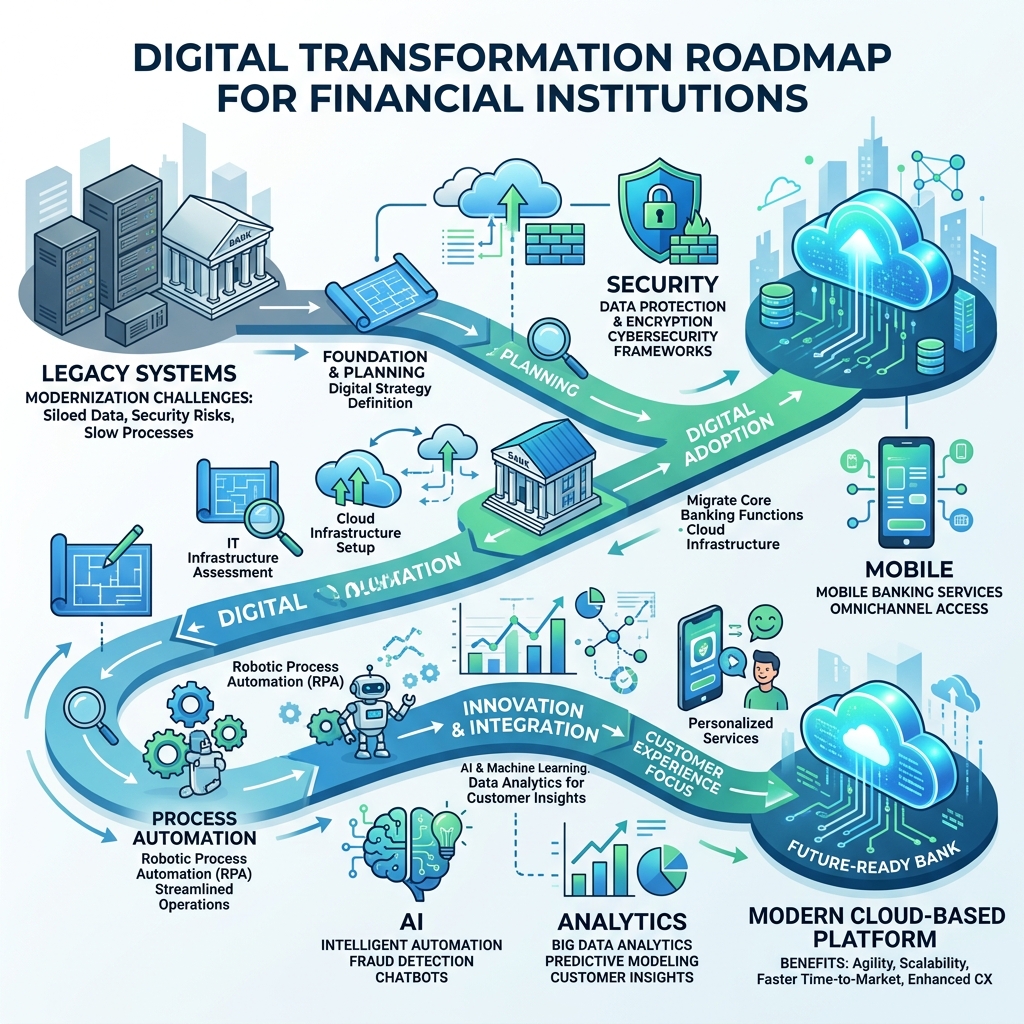
To successfully integrate AI into their operations, credit union IT teams must follow a structured roadmap. This plan typically begins with identifying key areas where AI can add value and then selecting appropriate technologies and vendors. The next step involves collecting relevant data and developing proof-of-concept models to validate the chosen approach.
Once initial testing is complete, credit unions should focus on scaling these solutions across different departments while ensuring seamless integration with existing systems. This phase requires careful planning to minimize disruptions and ensure continuous service delivery.
Ongoing monitoring and optimization are essential components of any successful AI implementation strategy. Regular evaluations help identify areas for improvement and enable credit unions to stay ahead in a rapidly evolving technological landscape.
Overcoming Barriers: Budget, Talent, and Regulatory Compliance
The journey towards AI integration is not without challenges. Credit unions often face hurdles related to budget constraints, talent shortages in technical fields, and navigating complex regulatory environments. Addressing these issues requires a strategic approach.
For budgetary concerns, institutions can explore partnerships with tech firms or leverage grants aimed at supporting financial innovation. Talent acquisition may involve offering competitive compensation packages and training programs to attract skilled professionals. Regulatory compliance demands proactive engagement with legal experts to stay updated on evolving guidelines.
By adopting a holistic strategy that addresses these barriers, credit unions can pave the way for successful AI deployments that deliver tangible benefits to both the institution and its members.
Case Studies: Credit Unions Leading the AI Charge
To illustrate the potential of AI in credit union operations, several institutions have successfully implemented advanced technologies. One such example is the use of chatbots by a mid-sized credit union that reduced call center wait times significantly. Another case involves predictive analytics for loan risk assessment, resulting in improved decision-making and portfolio diversification.
These real-world applications demonstrate how AI can be tailored to meet specific needs while delivering measurable results. Studying these examples provides valuable insights into best practices and common pitfalls, enabling other credit unions to learn from existing successes.
The Future: Generative AI and Credit Union Innovation
As we look towards the future, generative AI holds immense promise for further transforming digital banking experiences. These advanced systems will enable credit unions to create highly personalized content tailored to individual member needs. From customizing educational materials on financial literacy to generating unique marketing campaigns, generative AI offers unprecedented opportunities.
However, this journey is not without its challenges. Ensuring ethical use of data and maintaining transparency with members will be crucial as these technologies become more prevalent. Credit unions must navigate these complexities while continuing to innovate and enhance member satisfaction.
Conclusion and Next Steps
In conclusion, the integration of AI and machine learning presents a transformative opportunity for credit unions aiming to elevate digital banking experiences in 2026. From enhancing customer service through chatbots to improving loan risk assessment via predictive analytics, these technologies hold the key to unlocking new levels of efficiency and personalization.
As we move forward, it is essential that credit unions take a strategic approach to AI implementation, addressing challenges such as budget constraints and regulatory compliance. By doing so, they can position themselves at the forefront of innovation in the financial sector.
References and Further Reading
- NCUA — Letters to Credit Unions and Guidance
- CUNA — Technology and Innovation Priorities
- Filene Research Institute — Credit Union Research Reports
- McKinsey — Financial Services Digital Transformation Insights
- Deloitte — Financial Services Industry Insights
- CUInsight — Credit Union News and Analysis
This article was brought to you by Credit Union Web Solutions.