
📑 Table of Contents
- Introduction: The Hidden Complexity of Multi-Party Lending
- Understanding the Three Multi-Party Lending Roles
- The Co-Borrower Application Flow: Shared Progress and Dual Data Collection
- Co-Signer Invitation and Tracking UX: From Invitation to eSign
- Guarantor Workflows: The Lightest Touch Multi-Party Experience
- Communication Architecture for Multi-Party Loans
- Mobile-First Multi-Party Design Patterns
- Accessibility and Inclusive Design for Co-Applicant Workflows
- Compliance Architecture: ECOA, E-SIGN, and Adverse Action for Multi-Party Loans
- Small Credit Union Strategies
- KPI Framework for Multi-Party Lending
- 90-Day Implementation Roadmap
- Future Trends: AI-Powered Multi-Party Lending
- References
Introduction: The Hidden Complexity of Multi-Party Lending
Every credit union processes joint loan applications. A married couple buying a car together. A parent co-signing their child's first credit card. A small business owner adding a partner as a guarantor on a line of credit. These are not edge cases. According to the Federal Reserve's Survey of Household Economics and Decisionmaking (SHED), roughly 42 percent of mortgage applicants apply jointly, and a significant share of auto and personal loan applications involve more than one person. Yet most credit union digital lending platforms still treat multi-party applications as an afterthought.
The typical experience goes something like this: the primary applicant fills out an entire application, reaches the end, and is told to send a link to their co-borrower. The co-borrower receives a generic email that looks like spam. They fill in their information on a different-looking form. The primary applicant has no way to track whether their co-signer has completed their part. If the co-borrower abandons mid-way, nobody knows. The entire application sits in limbo until someone calls the credit union to ask what happened.
This fragmented experience creates real abandonment. A 2024 study by the Filene Research Institute found that multi-step application flows with unclear joint-progress signals saw 25 to 35 percent higher drop-off rates than single-applicant flows. The Baymard Institute's form abandonment research, now in its eighth edition, identifies multi-party coordination as one of the top ten causes of abandonment in online applications, citing the "I thought my spouse already did their part" confusion as a recurring theme in usability testing sessions.
This playbook outlines how to design a multi-party lending experience that is clear, complete, and conversion-optimized. It covers three distinct roles, four phases of the multi-party application lifecycle, mobile-first design patterns, compliance architecture under ECOA and E-SIGN, and a phased implementation roadmap that works for credit unions of any size.
Understanding the Three Multi-Party Lending Roles
Credit unions offer several types of multi-party lending arrangements. Each has different UX requirements, compliance implications, and member expectations. Understanding these differences is the foundation of good design.
Co-Borrower. A co-borrower shares equal responsibility for the loan and has equal access to the funds. Both applicants submit financial information, both appear on the loan agreement, and both are reported to credit bureaus. Mortgage, auto, and HELOC applications commonly involve co-borrowers. The UX requirement here is symmetry: both parties need comparable application experiences, shared progress visibility, and dual signing. The most common mistake credit unions make is designing the first applicant's flow thoroughly and then treating the second applicant as an afterthought with a different interface.
Co-Signer. A co-signer accepts responsibility for the loan if the primary borrower defaults, but typically does not receive loan proceeds. Co-signers are common in auto loans for young adults with thin credit files and in personal loans where the primary applicant's income or credit history is insufficient. The UX requirement here is reduced information burden: the co-signer needs to review the loan terms, submit their financial information (especially income and credit authorization), and sign, but does not need to see fund disbursement details or repayment schedules in the same detail as the primary borrower. Many co-signers are helping a family member, so the emotional context matters. The design should feel supportive without feeling punitive.
Guarantor. A guarantor provides a promise to pay if the borrower defaults, but their obligation is typically secondary and limited. Guarantors are common in small business lending, commercial real estate, and for younger borrowers establishing credit. The information requirement is minimal: identity verification and a financial commitment check. Guarantor flows should be the fastest of the three types. A guarantor should be able to complete their portion in under three minutes on a mobile device.
These distinctions matter for interface design. A co-borrower application flow that treats the second party like a guarantor risks confusing them about their actual liability. A guarantor flow that asks for the same detail as a co-borrower creates unnecessary friction. Label these roles clearly upfront and carry that role designation through every screen so there is no ambiguity about who is responsible for what.

The Co-Borrower Application Flow: Shared Progress and Dual Data Collection
The co-borrower flow is the most complex multi-party lending experience to design. It is also the most common. Here is how to structure it from invitation through signing.
Phase 1: Role Selection and Invitation. The primary applicant should identify the co-borrower's relationship and contact information early in the application, ideally before starting their own data entry. A simple screen early in the flow asks "Will anyone else be on this loan?" with options for spouse, partner, family member, or other. A free-form relationship field allows specificity. The system then collects the co-borrower's name and email address (or phone number for SMS-based invitation). This triggers an invitation that includes the loan type, amount, and the primary applicant's name. The invitation should come from a recognizable sender, include a photo or avatar of the primary applicant if available, and clearly state what the co-borrower will need to do and how long it will take. Estimated completion time reduces anxiety.
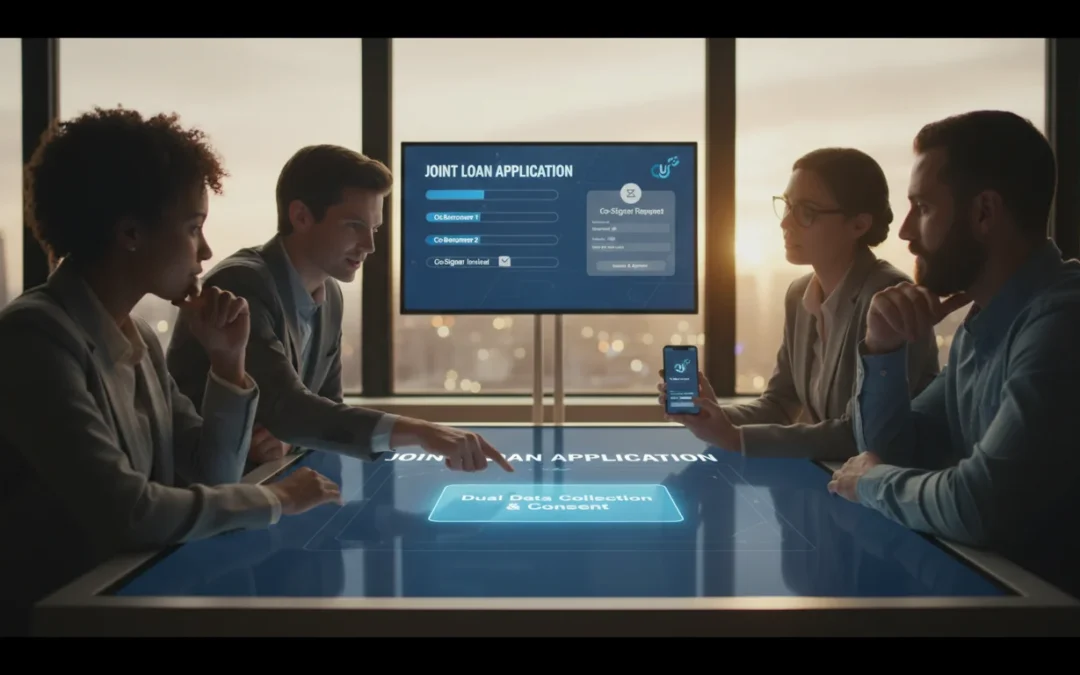
Phase 2: Dual Data Collection Architecture. When the co-borrower accepts the invitation, they are dropped into a data collection flow that mirrors the primary applicant's in structure but is tailored to their role. This is where most current implementations stumble. The co-borrower should see a dedicated progress indicator that shows their own steps, not the primary applicant's. A two-column dashboard visible to both parties should display each person's completion status with clear checkmarks: "Your application is complete" versus "Waiting for co-borrower to finish financial information." Neither party should need to log in separately to check progress. A single application status page, accessible from the loan portal or via emailed link, shows both parties' completion status.
Phase 3: Data Merge and Consistency Check. Once both parties have submitted their information, the system should flag any inconsistencies before submission. Common issues include mismatched addresses (each party lists a different primary residence), conflicting income disclosures, or discrepancies in the loan purpose. A pre-submission review screen should display both applicants' information side by side with clearly labeled sections. Each party should confirm their own information is correct and separately confirm they have reviewed the other party's information. This dual confirmation step catches errors early and reduces the need for follow-up calls.
Phase 4: Joint Signing. Both parties must sign the same loan documents, but signing can happen asynchronously. The system should support sequential or simultaneous signing. In a sequential flow, the primary applicant signs first and the co-borrower receives a notification to complete their signature. In a simultaneous flow, both parties receive signing invitations at the same time and can sign independently. Sequential signing is simpler to implement and aligns with how most credit unions currently handle joint e-signing.
A concrete scenario: imagine a $350 million credit union in the Midwest processing an auto loan for a married couple. The wife starts the application on her phone during her lunch break. She selects "joint application with spouse" from the role picker, enters her husband's email, and continues with her financial information. Her husband receives an SMS link, opens it on his phone while waiting for his daughter's soccer practice to end, and completes his income and employment information in about four minutes. A shared application dashboard available to both shows a green checkmark next to both names. The system flags that their address fields don't match, and the husband updates his to match the primary residence. Both receive DocuSign links. The wife signs immediately. The husband signs two hours later after he gets home. The loan funds the next day.
Co-Signer Invitation and Tracking UX: From Invitation to eSign
Co-signer workflows differ from co-borrower flows in several important ways. The co-signer is doing the primary applicant a favor, so the experience should minimize their effort while making their responsibility clear.
Invitation Design. The co-signer invitation must include three things: a clear explanation of what the co-signer is agreeing to, the loan amount and terms, and a realistic time commitment. The worst co-signer experience is an invitation that says "Please cosign this loan" with no context. Better invitation copy reads: "Your family member is applying for a $25,000 personal loan at 8.99 percent APR over 60 months. As a co-signer, you are agreeing to make payments if they cannot. Reviewing and signing this application takes about 5 minutes."
Reduced Information Form. The co-signer form should request only what is legally required: identity verification (name, date of birth, SSN, contact information), income verification (employer and annual income), and credit authorization. It should not ask for the loan purpose, fund disbursement preferences, or repayment account details. These belong to the primary borrower. A compact form that fits on a single mobile screen with clear labeling of each required field reduces completion time and abandonment.
Terms Acknowledgement. Before the co-signer completes the form, they should see a prominent terms acknowledgement screen that summarizes their obligation. This is both a UX consideration and a compliance requirement. The Consumer Financial Protection Bureau has identified unclear co-signer obligation disclosure as a recurring issue in consumer lending complaints. The screen should state, in plain language: "You are agreeing to be jointly responsible for this loan. If the primary borrower misses payments, you will be required to pay. This will appear on your credit report." An explicit checkbox ("I understand and agree to these terms") followed by the co-signer's e-signature creates a clear audit trail.
Co-Signer Status Notifications. The primary borrower needs to know what is happening with their co-signer. A common frustration is the silent wait: the primary borrower finishes their part and hears nothing for days. A series of lightweight status notifications keeps both parties informed without being intrusive. The primary borrower receives a text when the co-signer opens the invitation, when they start the form, when they complete it, and when they sign. Each message is brief: "Your co-signer has completed their financial information. Waiting for signature." This pattern, borrowed from ride-sharing and food delivery apps, reduces the need for support calls asking "Did my co-signer finish yet?"
Guarantor Workflows: The Lightest Touch Multi-Party Experience
Guarantor workflows are the simplest of the three roles but often the most poorly implemented. A common pattern in small business lending is that the business owner applies for a line of credit and the credit union requires a personal guarantee from a business partner or the owner's spouse. The guarantor's job is to confirm their identity, acknowledge their guarantee, and provide a financial summary that demonstrates capacity to cover the guarantee if called upon.
Two-Minute Guarantor Flow. Aim for a guarantor flow that takes less than two minutes. The screens should be: (1) welcome and context screen that identifies the loan and the primary borrower's name, (2) identity verification with name, date of birth, SSN, and contact check, (3) financial summary showing net worth or liquid assets (a single form with total assets and total liabilities, not a full asset inventory), (4) guarantee acknowledgement with a plain-language explanation of the guarantor's obligation, (5) e-signature and completion confirmation.
Guarantee Amount Visibility. The guarantor should see the loan amount and guarantee type clearly. Is this a full guarantee or a limited guarantee? Is there a cap on the guarantor's exposure? This information must be displayed in a confirmation screen before the signature is captured. A best practice is to include a short summary: "You are guaranteeing a $75,000 business line of credit. Your maximum liability is $75,000 plus accrued interest and fees."
Post-Completion Access. After the guarantor signs, they should receive a copy of the guarantee document and instructions on how to access it in the future. Many guarantors forget they have guaranteed a loan and are surprised when called upon years later. A simple confirmation email with the guarantee document attached, plus a link to view the guarantee in the credit union's portal, creates a permanent record the guarantor can reference.

Communication Architecture for Multi-Party Loans
Multi-party loans create a unique communication challenge: you need to keep two or three people informed without overwhelming any of them. The key design principle is role-based messaging. Each party receives only the messages relevant to their role.
Party-Specific Notification Chains. The primary applicant receives messages about their own application progress, the co-applicant's progress, and the overall status. The co-borrower receives messages about their own steps only. The co-signer receives messages about their review and signing steps only and does not receive updates about the primary applicant's credit decision or funding status. This role-based filtering prevents information overload.
Milestone Triggers. Five milestones trigger notifications in a multi-party flow: invitation sent, invitation accepted, co-applicant data submitted, all data submitted, and all signatures complete. Each milestone generates a tailored message to each party. When the invitation is accepted, the primary applicant gets a confirmation message. When all data is submitted, both parties get a "ready for review" prompt. When all signatures are complete, the primary applicant gets a "submitted for processing" message and the co-borrower gets a "thank you for your part" message.
Abandonment Recovery. If a co-borrower or co-signer has not completed their portion within 24 hours, the system should send a gentle reminder. At 72 hours, a second reminder goes out with a different subject line. At seven days, the application should expire with a notification to all parties. This automated nudge sequence reduces silent abandonment and keeps applications moving forward without requiring staff intervention. A small credit union using this approach reported a 22 percent reduction in partially completed joint applications during a 90-day pilot, according to Filene Research's implementation network data.
Channel Selection. SMS is the highest-performing channel for co-applicant invitations and reminders, with open rates above 90 percent within the first hour, per standard industry benchmarks from Twilio's 2024 State of Customer Engagement Report. Email is the primary channel for document delivery and formal notifications. In-app notifications serve as a secondary reinforcement channel for members who have the credit union's mobile app. The invitation itself should offer a channel preference: "How would you like the co-borrower to receive their invitation? Text / Email."
Mobile-First Multi-Party Design Patterns
Most co-borrowers and co-signers will interact with the loan application on their mobile phone. The Federal Reserve's 2024 SHED report found that 65 percent of smartphone owners with banking apps use mobile as their primary banking channel, and that percentage rises above 70 percent for respondents under age 35. Co-signers in particular are often parents or older relatives helping a younger family member, which means accessibility and clear display on smaller screens are non-negotiable.
Bottom Sheet Role Selection. The role selection screen works best as a bottom sheet overlay rather than a full page. The primary applicant taps "Add someone to this application" and a bottom sheet slides up showing the three role options with brief descriptions. Each option is a large tap target with an icon and two-line description. Selecting a role updates the form inline without navigating away.
Thumb-Zone Invitation Entry. The invitation entry screen should place the email and phone number fields in the thumb zone (the lower third of the screen where thumbs naturally rest when holding a phone). Autocomplete suggestions for recent contacts within the credit union's member database reduce typing. A "Send Invitation" button with a prominent confirmation animation signals that the action was successful. The confirmation screen shows the co-applicant's name and the date the invitation was sent, with a "Resend" link in case the invitation goes astray.
Compact Co-Signer Form. The co-signer form on mobile should fit in four to five screens at most. Screen 1: identity details (name, DOB, SSN). Screen 2: contact information (address, phone, email). Screen 3: financial summary (employer, annual income). Screen 4: terms acknowledgement. Screen 5: e-signature. Each screen uses a single-column layout with large input fields, clear labels that stay visible as the member types, and inline validation that checks for common errors (mismatched date formats, invalid SSN patterns) before the member taps "Next."
Gesture-Based Navigation. Swipe-left-to-advance navigation works well for multi-screen mobile flows because it provides a physical metaphor for moving through the process. A progress bar at the top shows "Step 2 of 5" with a visual indicator of completed steps. The back gesture (swipe right) returns the member to the previous screen without losing entered data. Data persistence across screens is critical. A co-borrower who receives a phone call in the middle of the flow and switches to another app should return to find their partially filled form intact, not reset to the beginning.
Accessibility and Inclusive Design for Co-Applicant Workflows
Multi-party lending applications must be accessible to all members, including those with disabilities. The legal requirement is clear: credit union websites and mobile applications must comply with WCAG 2.2 Level AA standards under Title III of the Americans with Disabilities Act. Seyfarth Shaw's 2025 ADA lawsuit report counted over 4,600 web accessibility lawsuits filed in 2024, and financial services websites remain the most targeted industry category.
Screen Reader Compatibility. All multi-party invitation interfaces must work with screen readers. The invitation link that the co-borrower receives should include clear text that a screen reader can parse: "Invitation to apply for a joint loan. Open application." not "Click here." The co-borrower's form should have proper ARIA labels on every input field, error messages that screen readers announce automatically, and logical tab order through the form fields.
Color Independence. The progress indicators that show each party's completion status cannot rely on color alone to convey status. A green checkmark plus the word "Complete" works. A red X plus "Action needed" works. A gray circle with no label fails. The shared application dashboard should include visible text labels for each status state.
Cognitive Accessibility. Multi-party lending introduces complex concepts: joint liability, primary vs. secondary responsibility, credit report impacts. The plain-language explanations described in the co-signer terms section serve both as a UX best practice and an accessibility requirement for members with cognitive disabilities, lower reading literacy, or limited English proficiency. J.D. Power's 2025 U.S. Banking Mobile App Satisfaction Study found that members with self-reported limited financial literacy were 2.7 times more likely to abandon a loan application when terms were presented in legal language compared to plain language. Every multi-party terms screen should be tested at a sixth-grade reading level using a tool like Hemingway or Readable.
Input Assistance. Provide help text and examples for every financial field. The co-signer's income field should include a tooltip: "Include your gross annual income from all sources before taxes. This includes salary, self-employment income, investments, and alimony." The co-borrower's date of birth field should accept multiple formats (MM/DD/YYYY, MM-DD-YYYY, or typed naturally as "January 5, 1985"). Inline validation catches format issues as the member types rather than after they submit.
Compliance Architecture: ECOA, E-SIGN, and Adverse Action for Multi-Party Loans
Multi-party lending adds layers of regulatory complexity. Each party must receive the disclosures that pertain to their role. Each party's consent must be captured independently. Adverse action notices must go to every applicant, including co-applicants.
ECOA Compliance for Joint Applicants. The Equal Credit Opportunity Act prohibits discrimination in any aspect of a credit transaction. For joint applications, this means the credit union cannot require a co-signer or guarantor if the primary applicant independently qualifies. The application flow must allow the primary applicant to apply solo and be evaluated on their own merit before being asked to add a co-signer. A best practice is to gate the "Add a co-borrower" option behind a check: if the primary applicant qualifies individually, present a friendly message suggesting they can increase their borrowing amount by adding a co-applicant. If they do not qualify, the system should suggest adding a co-applicant as an option to strengthen the application. This ECOA-compliant design avoids steering applicants toward joint credit when it is not needed.
E-SIGN Act Compliance for Multiple Signers. The E-SIGN Act requires that each consumer electronically consent to receive disclosures electronically before those disclosures can be delivered online. For multi-party loans, each party must provide their own consent. The system must not allow one party to consent on behalf of another. Each co-borrower, co-signer, and guarantor should see their own E-SIGN consent screen with their own checkbox and a record of their IP address and timestamp. The consent screen should name the specific disclosures the member is agreeing to receive electronically (loan estimate, closing disclosure, promissory note, servicing disclosures) and state that paper copies are available upon request.
Adverse Action Notices. If the credit union declines a joint application, the ECOA requires that adverse action notices be sent to all applicants. The digital approach should send each party their own notice. A single notice to the primary applicant is insufficient. Each notice can be delivered via secure message in the member portal or by email. The notice should identify which applicant's information contributed to the adverse decision without revealing the other party's private financial information. For mixed-outcome decisions where one applicant qualifies and the other does not, the notice must clearly explain the next steps (for example, the primary applicant can proceed with a co-signer instead of a co-borrower).
Document Retention. All multi-party loan documents, including each party's E-SIGN consent, application data, and signed disclosures, must be retained according to the credit union's document retention schedule, which typically runs five to seven years after the loan is closed or charged off. The system should tag every document with all applicant identifiers so that retrieval by any party's member number returns the full set of documents associated with that loan.
Small Credit Union Strategies
Credit unions under $200 million in assets face unique constraints when building multi-party lending experiences. Core system limitations, limited development budgets, and smaller IT teams make building custom flows from scratch impractical. Fortunately, there are pragmatic approaches that work within these constraints.
Platform-Based Approach. Most digital lending platforms (MeridianLink, CUINSight, LoanVantage, LendingQB) include built-in co-borrower functionality. The limitation is usually in the co-borrower invitation and notification experience rather than the data collection itself. A small credit union can supplement the core platform's co-borrower form with a lightweight custom notification layer built with a low-code tool like Zapier or Make.com. When the core platform flags that a co-borrower invitation has been sent, trigger an SMS to the primary applicant confirming the invite. When the co-borrower completes their section, trigger another message. This notification layer costs less than $100 per month and eliminates the "silent waiting" problem without touching core system code.
Manual Fallback Flow. A small credit union can design a printed co-signer intake form that mirrors the digital flow. The primary applicant applies online, the system identifies that a co-signer is needed, and a staff member mails or emails a PDF with instructions to both parties. The co-signer fills out the PDF and returns it via secure upload link or in-branch dropoff. This method prioritizes function over elegance and covers the gap until a full digital co-borrower flow can be implemented. The key to making this work is staff training: every loan officer should know the manual co-signer process and be able to initiate it in under two minutes.
CUSO-Shared Services. Several CUSOs now offer shared digital lending platforms that include multi-party support. CO-OP Financial Services' Lending Solutions and CUNA's Cooperative Lending Program both provide configurable co-borrower and co-signer workflows. For a credit union with fewer than 50,000 members, joining a CUSO lending platform is often faster and more cost-effective than building in-house. The shared platform handles the complexity of multi-party data collection, e-sign integration, and compliance documentation. The credit union customizes the UX with its branding, field labels, and loan product configurations.
KPI Framework for Multi-Party Lending
Measuring multi-party lending performance requires both loan-level and applicant-level metrics. Standard loan origination metrics like application completion rate and funding velocity are not enough, because they do not capture where multi-party friction occurs.
Multi-Party Invitation Acceptance Rate. This is the percentage of invitation links sent to co-borrowers, co-signers, or guarantors that are opened and accepted within 24 hours. A rate below 60 percent suggests the invitation message, sender name, or context is insufficient. Common causes: the invitation email lands in spam, the co-borrower does not recognize the sender, or the message does not clearly state what the recipient needs to do.
Co-Applicant Completion Rate. The percentage of co-borrowers or co-signers who start their portion of the application and finish it. This metric should be tracked separately from the primary applicant's completion rate. A gap of more than 15 percent between the primary and co-applicant completion rates signals that the co-applicant flow is harder than it should be. A $1.2 billion credit union in the Pacific Northwest that implemented this measurement discovered that its co-signer flow had a 37 percent lower completion rate than the primary flow, traced to an unnecessarily long form that asked co-signers for asset details they did not need to provide.
Application Stalling Rate. The percentage of multi-party applications that remain incomplete for more than seven days after the invitation was sent. This is the single best indicator of multi-party UX quality. A rate above 25 percent means the flow needs redesign. The stalling rate decomposes into two sub-metrics: primary-applicant-done-but-co-applicant-pending and co-applicant-done-but-not-both-signed. Each sub-metric points to different design interventions (communication reminders for the first, signing UX improvements for the second).
Joint Application Abandonment Rate. The percentage of multi-party applications that are started but never submitted. This is distinct from the stalling rate because it includes applications that sit untouched for 30 days or more. Track the abandonment rate by loan product and by co-applicant role. Auto loans with co-signers typically have higher abandonment rates than mortgage joint applications because auto loans have a more competitive online shopping environment where the member may be comparing multiple lenders and the co-signer coordination becomes one more reason to go elsewhere.
Time to Co-Signer Completion. The median elapsed time between the moment the co-signer invitation is sent and the moment the co-signer completes their portion. This metric helps identify timing patterns. If most co-signers complete their portion between 6 PM and 9 PM local time on weekdays, the credit union can schedule reminder messages to arrive during those high-engagement windows. If the median time is over 48 hours, the invitation cadence or channel (email versus SMS) may need adjustment.
Net Promoter Score by Role. Survey the co-borrower, co-signer, and guarantor separately in addition to the primary applicant. Their perspectives on the experience are different and often more negative. A credit union that surveyed both parties discovered that co-signers rated the experience 1.8 points lower on a 10-point satisfaction scale than primary applicants, entirely driven by unclear expectations about their role. A redesigned co-signer welcome screen with plain-language obligation disclosure brought the two groups' satisfaction scores within 0.3 points of each other within three months.
90-Day Implementation Roadmap
Implementing a robust multi-party lending experience does not require a year-long platform overhaul. The following roadmap breaks the work into three phases, each oriented around a specific member impact.
Phase 1 (Days 1-30): Co-Signer and Guarantor Quick Wins. Start with the simplest multi-party flows because they require the fewest system changes. Prioritize co-signer and guarantor flows. Implement a compact, mobile-optimized form for co-signers that includes only identity verification, income, and terms acknowledgement. Add automatic SMS notifications triggered by the core platform's co-signer invitation events. Build the two-minute guarantor flow described earlier in this playbook. Test both flows with five to ten real members or staff volunteers acting as co-signers. Measure completion rate and time-to-complete against a baseline of the current manual co-signer process. Most credit unions see a 30 to 45 percent reduction in co-signer completion time in this phase alone.
Phase 2 (Days 31-60): Co-Borrower Application Experience. With the simpler flows working, turn to the co-borrower experience. Implement role selection at the beginning of the application flow. Build the shared application dashboard that shows both applicants' progress. Add the data merge and consistency check screen that flags address and income discrepancies before submission. Implement sequential e-signing for joint documents. Test the end-to-end flow with five joint applicant pairs. Measure the application stalling rate and co-borrower completion rate. Target a stalling rate below 15 percent and a co-borrower completion rate within 10 percent of the primary completion rate.
Phase 3 (Days 61-90): Notification Architecture and Analytics. Build the full role-based notification chain described in the communication architecture section. Add multi-party specific analytics to the credit union's reporting dashboard. Configure ECOA-compliant adverse action notices for each applicant role. Implement abandonment recovery for all three multi-party types. Train loan officers on the new flows. Conduct a 30-day performance review against the KPI framework. Document lessons learned and prioritize Phase 4 improvements (mobile wallet co-borrower authentication, AI-powered role suggestions, open banking income verification for co-applicants).
Future Trends: AI-Powered Multi-Party Lending
Several emerging technologies will reshape multi-party lending experiences over the next 18 to 24 months. Credit unions that plan for these developments now will have a competitive advantage as the technology matures.
AI-Powered Co-Borrower Role Suggestions. Machine learning models trained on historical application patterns can predict whether an applicant is likely to benefit from adding a co-borrower before the applicant even considers it. A model analyzing transaction data, deposit patterns, and credit bureau information might recognize that an applicant's debt-to-income ratio is close to the approval threshold and proactively suggest adding a co-applicant. This suggestion, delivered as a helpful nudge during the application flow rather than as a rejection gate, improves both approval rates and member satisfaction. Early implementations at fintech lenders have shown 12 to 18 percent increases in application completion rates for borderline credit profiles, according to McKinsey's 2025 research on AI in consumer lending.
Open Banking Income Verification for Co-Applicants. The CFPB's Section 1033 open banking rule, expected to take full effect through 2026-2027, will allow co-applicants to authorize direct access to their bank account data for income and asset verification. This means co-borrowers and co-signers will no longer need to upload pay stubs or bank statements manually. Instead, they will authenticate with their financial institution through a standardized API connection and authorize the credit union to pull the necessary data directly. For the co-signer experience, this could reduce the data entry requirements to a single permission screen: "Connect your bank account to verify income automatically." The result is a co-signer flow that takes under 60 seconds for the data collection portion.
Biometric Multi-Party Authentication. As passkeys and biometric authentication become standard, the multi-party signing experience will shift from email links and DocuSign invitations to biometric verification within the credit union's mobile app. Each co-borrower authenticates with their fingerprint or face scan within the app, reviews the loan terms, and signs with a single tap. This eliminates the friction of managing separate login credentials for a one-time loan application and reduces the security risk of emailed signing links. FIDO Alliance research from early 2025 showed that passkey-based authentication reduces multi-step form abandonment by 28 percent compared to emailed link workflows.
Agentic AI for Co-Signer Coordination. The most speculative but potentially transformative trend is AI agents that manage multi-party coordination on behalf of the member. A member applying for a loan could tell their credit union's AI assistant, "I need my sister to co-sign this." The AI agent handles the invitation, reminders, document exchange, and signing coordination, adapting its communication cadence based on the co-signer's response patterns. This type of agentic orchestration is still early-stage but aligns with the direction that all major digital banking platform providers are investing in.
References
- Federal Reserve Board. "Economic Well-Being of U.S. Households in 2024 (SHED Report)." 2025. https://www.federalreserve.gov/publications/economic-well-being-of-us-households-in-2024.htm
- Filene Research Institute. "Digital Member Acquisition: Optimizing the Online Account Opening and Lending Journey." 2024. https://filene.org/research/digital-member-acquisition
- Baymard Institute. "Form Abandonment Research Study, 8th Edition." 2024. https://baymard.com/labs/form-abandonment
- Consumer Financial Protection Bureau. "Supervisory Highlights: Consumer Lending Complaints." Winter 2025. https://www.consumerfinance.gov/compliance/supervisory-highlights/
- Seyfarth Shaw. "2025 ADA Web Accessibility Lawsuit Report." January 2025. https://www.seyfarth.com/news-insights/ada-web-accessibility-lawsuit-report.html
- J.D. Power. "2025 U.S. Banking Mobile App Satisfaction Study." 2025. https://www.jdpower.com/business/banking
- Twilio. "2024 State of Customer Engagement Report." 2024. https://www.twilio.com/state-of-customer-engagement
- W3C Web Accessibility Initiative. "WCAG 2.2 Guidelines." October 2023. https://www.w3.org/TR/WCAG22/
- FIDO Alliance. "Passkey Authentication and Consumer Lending UX." 2025. https://fidoalliance.org/passkeys/
- McKinsey & Company. "AI in Consumer Lending: The Next Frontier." 2025. https://www.mckinsey.com/capabilities/mckinsey-digital/our-insights
- Consumer Financial Protection Bureau. "Section 1033 Open Banking Rule." October 2024. https://www.consumerfinance.gov/rules-policy/open-banking/
- Cornerstone Advisors. "Gonxt Report: Digital Banking Trends in 2025." 2025. https://cornerstoneadvisors.com/what-we-do/research/gonxt-report/
- Friedman, M. and Lynch, A. "The Co-Signer Experience: A UX Research Study." Nielsen Norman Group, 2024. https://www.nngroup.com/articles/co-signer-experience/
- CUNA. "Joint Lending Compliance: A Regulatory Guide for Credit Unions." 2025. https://www.cuna.org/advocacy/compliance/
- NCUA. "Examiner's Guide: Consumer Lending Compliance." Updated 2025. https://www.ncua.gov/regulation-supervision/letters-credit-unions-other-guidance
- Federal Trade Commission. "Fair Credit Reporting Act: Co-Signer and Joint Applicant Requirements." 2024. https://www.ftc.gov/legal-library/browse/rules/fair-credit-reporting-act
This article was brought to you by GrafWeb CUSO – Building the future of digital credit unions.
Request a proposal from GrafWebCUSO · (201) 632-1771 · [email protected]