

📑 Table of Contents
- The Great Personalization Illusion of 2025
- Defining Hyper-Personalization in the Credit Union Context
- The Psychology of Financial Belonging
- Deep Dive: The Behavioral Data Layer (BDL)
- Modular Architecture: Building the 2026 Personalization Engine
- UI/UX Manifestations: Beyond the Hero Image
- The Predictive Layer: Anticipating Needs Before the Member Does
- Real-World Application: Case Studies in CU Hyper-Personalization
- Operational Readiness: The Cultural Shift Required
- Strategic Alignment: Connecting Data to the Credit Union Mission
- The Trust Paradox: Security vs. Seamless Personalization
- Overcoming Legacy Barriers: The Core Integration Challenge
- The Role of Open Banking in Hyper-Personalization
- 2026 Action Plan: Moving from Generic to Hyper-Personalized
- The Ethical Dimension of Algorithmic Credit: Fairness and Transparency
- Hyper-Personalization for Underbanked Communities: A Social Mission
- Vendor Selection: Choosing the Right Personalization Partners
- Measuring Success: KPIs for the Hyper-Personalized CU
- Beyond 2026: The Era of Self-Generating Interfaces
- Frequently Asked Questions
- References
The Great Personalization Illusion of 2025
For decades, credit unions have prided themselves on "personal service." In the golden era of the physical branch, this claim was undeniable. Tellers knew members by name and understood their children's college aspirations. They provided context-aware advice that felt more like a conversation between neighbors than a financial transaction.
We were the "un-bank"—the institution where you weren't just a number, but a neighbor. However, as the digital transformation matured and "convenience" became the primary metric, that essential intimacy was lost in translation. We built digital bridges that were efficient, but they were also cold and generic.
By 2025, most "personalization" in credit union web design has become little more than a "Welcome, [First Name]" tag and a retargeted banner for an auto loan. I genuinely believe we've hit a wall with traditional segment-based marketing. Members are tired of being treated like a vague demographic.
They don't want to be "Millennial Homeowners in Ohio"; they want to be acknowledged as unique individuals with fluid, complex financial lives. Mike isn't a "mortgage prospect"—he's a father currently saving for a 3-bedroom Tudor within 5 miles of his parents who just spent 20 minutes researching localized property tax fluctuations.
If your digital branch treats Mike like any other homeowner, you've already lost the emotional connection that defines the credit union movement. You are no longer serving a member; you are processing a user.
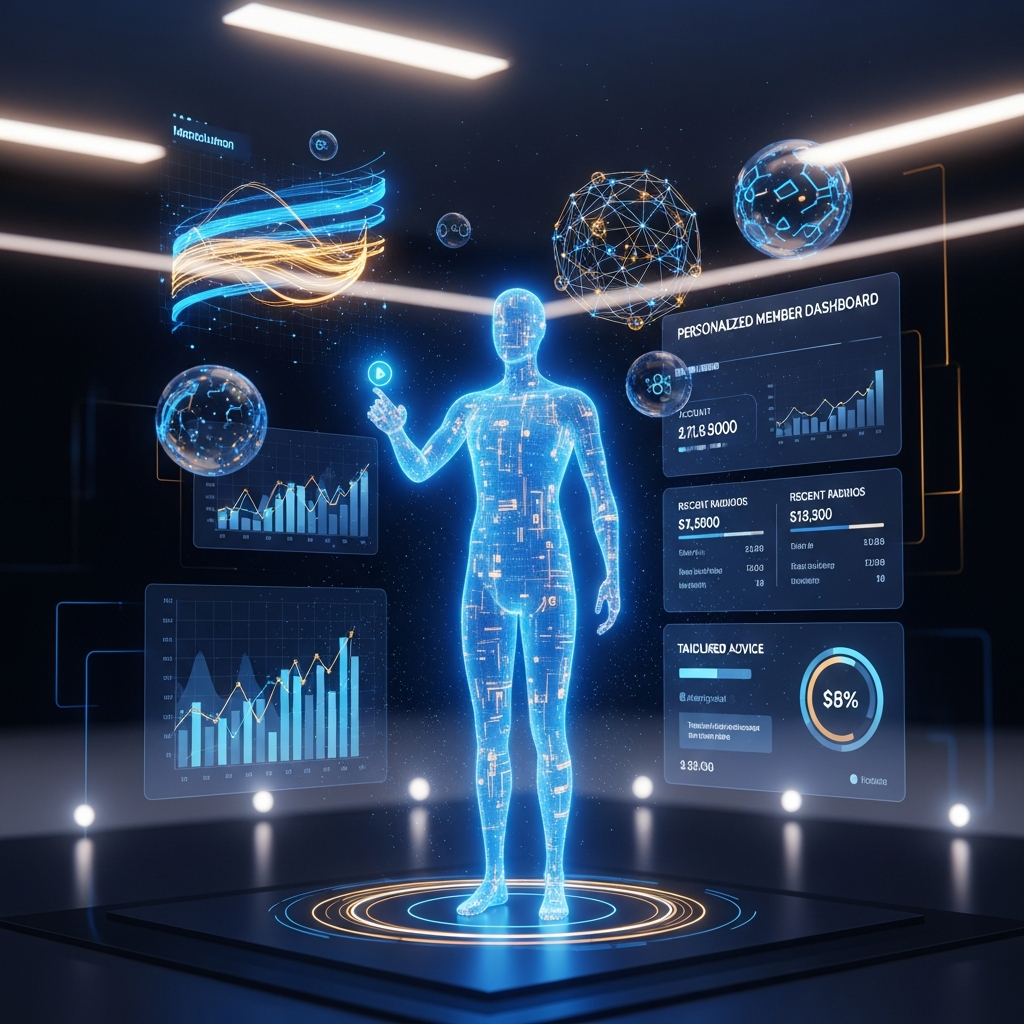
In 2026, 2026 Credit Union Hyper-Personalization is the use of real-time data, AI, and behavioral psychology to deliver experiences that are uniquely tailored to an individual’s current context, intent, and emotional state.
It shifts the credit union from being a passive vault to an active financial co-pilot. This isn't just about selling more products; it's about reducing cognitive load. When a member logs in, the "Personalization Engine" should already know why they are there.
The gap between member expectation and digital reality is now a chasm. According to a 2025 Financial Brand report, nearly 70% of members view digital experience as the primary factor in institutional loyalty.
Furthermore, Wipfli's 2026 state of the industry report highlights that leaders are rapidly refining branch roles to support a digital-first landscape.
If your digital branch feels like a generic template, you aren't just missing a sales opportunity—you're actively signaling to your members that you don't actually know them. You are becoming the very thing they tried to avoid by joining a credit union in the first place. You are becoming "just another bank."
Defining Hyper-Personalization in the Credit Union Context
In 2026, 2026 Credit Union Hyper-Personalization is the use of real-time data, AI, and behavioral psychology to deliver experiences that are uniquely tailored to an individual’s current context, intent, and emotional state. It shifts the credit union from being a passive vault to an active financial co-pilot. This isn't just about selling more products; it's about reducing cognitive load. When a member logs in, the "Personalization Engine" should already know why they are there. Are they checking a balance because a large transaction just hit? Are they browsing mortgage rates because they recently looked at Zillow listings through your integrated partner tools?
To truly excel, credit unions must embrace 2026 Credit Union Hyper-Personalization.
Understanding the nuances of 2026 Credit Union Hyper-Personalization is vital for success.
Creating deeper connections through 2026 Credit Union Hyper-Personalization is the goal.
The transformative power of 2026 Credit Union Hyper-Personalization is undeniable.
Investing in 2026 Credit Union Hyper-Personalization is investing in your members’ future.
Credit unions prioritizing 2026 Credit Union Hyper-Personalization will lead the industry.
The adaptation to 2026 Credit Union Hyper-Personalization is essential for growth.
Achieving success requires a focus on 2026 Credit Union Hyper-Personalization.
The journey to 2026 Credit Union Hyper-Personalization is a shared commitment among teams.
Every credit union must adapt to 2026 Credit Union Hyper-Personalization to stay competitive.
The principles of 2026 Credit Union Hyper-Personalization are reshaping member experiences.
For credit unions, embracing 2026 Credit Union Hyper-Personalization is a strategic imperative.
Members expect 2026 Credit Union Hyper-Personalization as a standard in service delivery.
Empowering credit unions through 2026 Credit Union Hyper-Personalization drives member loyalty.
At its core, 2026 Credit Union Hyper-Personalization is about enhancing member relationships.
The foundation of modern credit unions rests on 2026 Credit Union Hyper-Personalization.
Utilizing 2026 Credit Union Hyper-Personalization will allow credit unions to redefine engagement.
As we move to 2026 Credit Union Hyper-Personalization, adaptability is crucial for credit unions.
Achieving excellence in member service involves 2026 Credit Union Hyper-Personalization methodologies.
Understanding and utilizing 2026 Credit Union Hyper-Personalization is key to success.
The future is bright for those who adopt 2026 Credit Union Hyper-Personalization strategies.
Leveraging 2026 Credit Union Hyper-Personalization can lead to transformative outcomes for credit unions.
The journey toward 2026 Credit Union Hyper-Personalization requires commitment and innovation.
Credit unions that prioritize 2026 Credit Union Hyper-Personalization will set new industry standards.
Understanding and utilizing 2026 Credit Union Hyper-Personalization is key to success.
Enhancing member experiences through 2026 Credit Union Hyper-Personalization is a strategic advantage.
To implement 2026 Credit Union Hyper-Personalization, data analytics plays a critical role.
The essence of 2026 Credit Union Hyper-Personalization lies in understanding member needs.
By focusing on 2026 Credit Union Hyper-Personalization, institutions can enhance their value proposition.
Credit unions that embrace 2026 Credit Union Hyper-Personalization will thrive in a competitive landscape.
Investing in 2026 Credit Union Hyper-Personalization means investing in the future of member service.
The implementation of 2026 Credit Union Hyper-Personalization strategies is pivotal for credit unions.
Through 2026 Credit Union Hyper-Personalization, organizations can tailor their offerings in real time.
With 2026 Credit Union Hyper-Personalization, credit unions can foster stronger relationships with their members.
The future of financial services hinges on 2026 Credit Union Hyper-Personalization approaches.
Understanding 2026 Credit Union Hyper-Personalization involves leveraging data and technology effectively.
Implementing 2026 Credit Union Hyper-Personalization strategies can significantly enhance member satisfaction.
The rise of 2026 Credit Union Hyper-Personalization is essential for meeting evolving member expectations.
In 2026, 2026 Credit Union Hyper-Personalization is transforming how credit unions engage with their members.
The interface must adapt in real-time to surface the exact tool needed, effectively neutralizing the Paradox of Choice. If a member is struggling with high-interest debt, surfacing a high-limit credit card offer isn't just poor marketing—it's an empathetic failure. Hyper-personalization allows the CU to act as a digital fiduciary, presenting the most helpful path at the exact moment of need. It means moving from "What can we sell them?" to "How can we help them right now?" It's about proactive care in a reactive world. In 2026, the digital branch isn't a place you go to transact; it's an assistant that helps you thrive.

The concept of 2026 Credit Union Hyper-Personalization is crucial in understanding the future of member engagement.
The concept of 2026 Credit Union Hyper-Personalization is crucial in understanding the future of member engagement.
The Psychology of Financial Belonging
We must address why this matters on a fundamental psychological level. Credit unions were built on the idea of membership and shared identity. Hyper-personalization is the digital manifestation of Financial Belonging. By utilizing the IKEA Effect, we can see that when members are allowed to customize their own dashboard—dragging widgets for "Vacation Fund Progress" or "Local Community Impact"—they value the digital branch more. It’s no longer your institution's app; it’s their personalized financial cockpit that they helped build. This sense of ownership leads to higher retention and deeper engagement.
Furthermore, we can leverage Social Proof in an ethical, member-centric way. Showing a member that "82% of members in your career path prioritized this high-yield savings account this month" provides psychological safety. It says, "People like you are doing this, and it's working for them." However, we must be wary of the Uncanny Valley of Data. If a credit union knows too much and displays it without empathy, it triggers a defensive "loss of control" response. The trick in 2026 is transparency: "We noticed you're saving for a home—here's how we're adjusting your view to help you reach that goal faster." This transforms surveillance into service. It replaces the "creepy" factor with a "helpful neighbor" factor that reinforces the cooperative mission.
Deep Dive: The Behavioral Data Layer (BDL)
The foundation of any hyper-personalization engine is the Behavioral Data Layer (BDL). Unlike traditional databases that store static facts (name, address, balance), the BDL captures "digital body language." This includes scroll depth on specific educational articles, the sequence of pages visited, the time of day they log in, navigation patterns, and even the speed at which a member interacts with a form. This is the digital equivalent of a teller noticing a member's worried expression or the fact that they are wearing a "Just Married" t-shirt.
For example, if a member visits the "Personal Loan" page three times in 48 hours but never starts an application, the BDL flags this as "High Interest, High Hesitation." In a generic UI, nothing happens—the member eventually abandons the thought. In a hyper-personalized UI, the next time that member visits the homepage, the hero section is replaced with a "Personal Loan FAQ" or a "Chat with a Loan Specialist" prompt, addressing the likely source of their hesitation before they even have to search for it. This is **Predictive Service**, and it is the only way for credit unions to survive the fintech onslaught that is coming in 2026 and beyond. If you aren't listening to the digital silence, you are missing the most important conversations.
Modular Architecture: Building the 2026 Personalization Engine
You cannot buy hyper-personalization as a simple plugin. It requires a modular, headless architecture where the "head" (the UI) is decoupled from the "body" (the data and logic). This allows for rapid iteration and real-time response times, essential for staying ahead of agile fintech competitors who ship code daily. It’s about building a system that is as flexible as the members it serves. The monolithic, rigid web structures of the past are now a liability.
- The CDP (Customer Data Platform): The "Single Point of Truth" that merges member transaction history with real-time behavioral data from the BDL. This creates a 360-degree view that updates in milliseconds, not hours.
- The Content Mesh: Instead of static pages, the CU maintains a library of content "atoms." A headline isn't a fixed string; it’s a variable that changes based on the member's current life stage, financial health status, and even the current weather if that's relevant to a specific promotion. It’s a jigsaw puzzle that assembles itself in real-time.
- The Real-Time Decisioning Engine (RTDE): The AI brain that evaluates thousands of possible UI variations in milliseconds to pick the one most likely to help the member at that moment. It uses reinforcement learning to get better with every interaction.
- API-First Integration: Ensuring that personalization data flows seamlessly between the core banking system, the mobile app, and the web branch, creating a true omnichannel experience where the conversation stays the same across all devices. The member shouldn't feel like they are starting over when they switch from phone to desktop.
UI/UX Manifestations: Beyond the Hero Image
In 2026, UI is no longer static; it is generative and adaptive. This goes far beyond swapping out a photo of a family for a photo of a retired couple. It involves shifting the entire information architecture of the page based on the Jobs-to-be-Done (JTBD) framework. The site literally reorganizes itself to help the member get their specific job done faster. The interface becomes a liquid that fills the container of the member's needs.
Intent-Based Navigation:
If a member is in the "Home Buying" life stage, the primary navigation might reorganize itself automatically. "Checking" moves to a submenu, while "Mortgages," "Home Equity," and "Homeowners Insurance" take center stage. This applies Hick’s Law: by reducing the number of irrelevant options, we increase the speed and ease of the desired action. The digital branch effectively "declutters" itself to make the member's path clear and focused on their current goal. It’s about removing the grass from the path.
Predictive Micro-Interactions:
When a member begins a transfer, the UI might suggest a common amount based on their history: "Transfer $200 for 'Grocery Buffer'?" This reduces friction and makes the member feel understood at a granular level. According to CSI's 2026 Banking Priorities survey, credit unions are now twice as likely as community banks to prioritize this level of digital onboarding and self-service tool refinement. It’s the small things—the micro-interactions—that build the most massive trust.
The Predictive Layer: Anticipating Needs Before the Member Does
Predictive AI is what separates the leaders from the laggards in 2026. It moves the digital interaction from "What happened in the past?" to "What is likely to happen next?" This is where the credit union truly shines as a member-owned cooperative. It’s the digital equivalent of a wise advisor looking over your shoulder to keep you out of trouble, not just to watch you fall. It’s moving from reactive support to proactive partnership.
Imagine a member whose spending patterns suggest they will overdraw their account in three days based on upcoming scheduled bills. A generic bank sends an automated alert after the overdraft occurs, generating a fee and a headache. A hyper-personalized credit union utilizes the Loss Aversion principle: it sends a proactive nudge 48 hours early, suggesting a micro-transfer or a temporary credit line adjustment. This isn't just "good service"—it's a demonstration of the "People Helping People" philosophy through code and predictive intelligence. It transforms the credit union from a fee-taker into a wealth-protector. It's the highest form of loyalty building.
Real-World Application: Case Studies in CU Hyper-Personalization
Case Study 1: The "Life Event" Pivot
A large regional credit union implemented a hyper-personalization engine that detected a member's change in deposits (marking a new child or marriage). Instead of broad "Savings" ads, the site automatically shifted its entire persona to focus on "Educational Savings Accounts," "Life Insurance Checklists," and "Estate Planning Tools." The result? A 42% increase in new sub-account openings within the first six months of implementation without increasing a single dollar in external marketing spend. The data was already there; they just started using it to talk to the member like a human.
Case Study 2: The "Fraud-UX" Balance
One of the most powerful applications of hyper-personalization is in serving underbanked or low-income communities. By analyzing non-traditional data—like consistent utility payments or gig-economy income patterns—a credit union can offer personalized credit-building tools to those who would be rejected by a traditional FICO-based system.
Hyper-personalization allows us to see the "potential" of a member, not just their "past." This is how we fulfill the core mission of credit unions in the digital age: making the dream of financial stability accessible to everyone, one personalized nudge at a time.
Another CU used hyper-personalization to adjust security friction dynamically. Members logging in from "trusted" devices with typical behavior patterns experienced an ultra-fast, "frictionless" UI. When a login occurred from a new location with high-risk behavior (large immediate transfers), the UI shifted to a high-contrast, "secure-mode" aesthetic with mandatory multi-factor prompts. This used Dynamic Friction to protect the member without frustrating them during routine, daily tasks. It balanced safety with speed perfectly, proving that you don't have to sacrifice UX for security if you know your member.
Operational Readiness: The Cultural Shift Required
You can have the best engine in the world, but if your internal culture is still siloed, the hyper-personalization engine will fail. Marketing, IT, and Member Service must be aligned under a single vision of member success. This requires a shift from "Campaign-Based" thinking to "Member-Journey" thinking. Marketing can no longer just push a "New Year, New Car" campaign to everyone in January. Instead, they must create the "Content Atoms"—the high-quality videos, articles, and offers—that the engine can deploy whenever a member actually enters the car-buying stage, regardless of the month.
This organizational shift is often the hardest part of the journey. It requires trust in the data and a willingness to let the algorithm handle the "When" and "Who," while the humans focus on the "What" and the "Why." It’s a move from being a "Creator of Campaigns" to a "Curator of Member Success." It requires a new type of staff—the "Digital Experience Architect" who lives in the intersection of data and empathy.
Strategic Alignment: Connecting Data to the Credit Union Mission
Hyper-personalization is often seen as a purely technical or marketing endeavor, but for credit unions, it must be a strategic one. We are not just optimizing for "clicks" or "conversions"; we are optimizing for **Financial Health**. The data we collect should be used to build a "Financial IQ" score for each member, which then drives the personalization engine toward the member's best interest.
If a member has a low "Savings-to-Income" ratio, the engine should prioritize financial literacy content, "Round-Up" savings tools, and low-interest consolidation loans over luxury car loan offers or credit card increases. This alignment between the data engine and the CU mission is what creates the "Flywheel Effect"—as members become more financially stable using your tools, they become more loyal and more profitable targets for bigger products like mortgages. This is the ultimate win-win of hyper-personalization. You aren't just selling a product; you are coaching a member toward prosperity. That is the 2026 version of the credit union charter.
The Trust Paradox: Security vs. Seamless Personalization
Members want the benefits of hyper-personalization, but they are increasingly wary of how their data is being used. This is the Trust Paradox. To navigate this, the 2026 digital branch must be "Privacy First" by design. This means moving beyond generic, page-long privacy policies to Contextual Consent. If the UI is tailoring a mortgage offer based on Zillow browsing, it should include a small "Why am I seeing this?" tooltip: "Based on your recent interest in home calculators, we've highlighted this rate for you to help your search."
Transparency is the antidote to "creepy" surveillance-capitalism. By using Zero-Knowledge Proofs and local-first data processing, credit unions can offer a highly tailored experience without ever actually "seeing" the raw sensitive data in a way that creates a centralized vulnerability. This builds a "Trust Moat" that big banks and fintechs struggle to replicate because they lack the cooperative-based trust foundation that credit unions naturally possess. We are the owners of the data, and we use it for the benefit of the owners. Trust is our primary asset; data is just the fuel.
Overcoming Legacy Barriers: The Core Integration Challenge
The elephant in the room is the legacy core. Most credit union cores were built in an era of batch processing, not real-time, event-driven hyper-personalization. To overcome this, 2026 leaders are utilizing **Middleware Orchestration Layers**. These act as a translation service between the "slow" core and the "fast" personalization engine. They "listen" for core updates and broadcast them as real-time events that the web UI can react to instantly. It's like putting a supercar engine in a vintage frame.
Investment in **Real-Time Webhooks** and **Event-Driven APIs** is no longer optional—it is the price of admission. If your core only pushes updates once an hour, your hyper-personalization engine is effectively blind to the member's most recent and relevant interactions. The shift to real-time core updates is the single biggest technical hurdle, but also the single biggest competitive advantage for those who solve it this year. It turns your legacy core from a boat anchor into a high-octane fuel tank. It’s about building an architecture that can breathe in real-time.
The Role of Open Banking in Hyper-Personalization
In 2026, hyper-personalization extends beyond your own data. With the maturation of Open Banking regulations and APIs, your personalization engine can (with explicit member consent) pull in data from a member's other financial relationships—their big bank credit cards, their brokerage accounts, even their utility bills. This allows you to offer a "Global Financial Picture" that was previously impossible. It turns the credit union into a true financial advocate.
If the engine sees a member is paying a 24% interest rate on a credit card at a big bank, it can automatically surface a "Consolidate and Save" offer with your 12% alternative. This is the 1:1 personalization that members have been craving. It moves the credit union from being one of many institutions to being the *primary* financial hub. It’s about being the quarterback of the member's financial life, calling the plays that save them money across the board. You become the aggregator of value, not just the holder of deposits.
2026 Action Plan: Moving from Generic to Hyper-Personalized
Audit Your Data Silos: Identify where your member data lives. Is the website behavioral data connected to the core? If not, that's your mandatory Step Zero.
You can't personalize what you can't see. Connect the dots before you try to paint the picture. Select Your Pilot "Job": Don't try to personalize the whole site at once. Pick one high-value "Job-to-be-Done," like "First Time Home Buying," and build the hyper-personalized path for that specific group first.
- Audit Your Data Silos: Identify where your member data lives. Is the website behavioral data connected to the core? If not, that's your mandatory Step Zero. You can't personalize what you can't see. Connect the dots before you try to paint the picture.
- Select Your Pilot "Job": Don't try to personalize the whole site at once. Pick one high-value "Job-to-be-Done," like "First Time Home Buying," and build the hyper-personalized path for that specific group first. Master the micro before scaling to the macro. Success in one niche will lead to budget for the next.
- Implement "Empathy Guards": Create a set of rules for your AI engine. For example: "Never surface credit offers to members with declining debt-to-income ratios." This protects the member and your institution's reputation. It ensures the AI serves the mission, not just the margin. Ethical AI is the only AI that belongs in a credit union.
- Deploy a Headless CMS: Start migrating your content into a modular format so the engine can "assemble" pages on the fly based on intent. Move from pages to "Experience Atoms." Change your mindset from "Editor" to "Architect."
- Test, Refine, Scale: Use A/B testing to verify that personalized paths actually outperform generic ones. Only scale what works based on real member feedback and engagement metrics. Don't assume; measure.
The Ethical Dimension of Algorithmic Credit: Fairness and Transparency
As we move toward hyper-personalized offers, we must confront the ethics of algorithmic credit. AI is only as fair as the data it’s trained on. Credit unions have a unique responsibility to ensure that their personalization engines do not inadvertently replicate historical biases. This means rigorous auditing of your ML models and ensuring that "Personalization" never becomes a mask for "Redlining." In 2026, **Explainable AI (XAI)** is a requirement, not a feature. You must be able to explain exactly *why* a member was shown a specific offer at a specific rate. You must be able to stand behind the algorithm with the same integrity you stand behind a human loan officer. Ethics is the soul of hyper-personalization.
Hyper-Personalization for Underbanked Communities: A Social Mission
One of the most powerful applications of hyper-personalization is in serving underbanked or low-income communities. By analyzing non-traditional data—like consistent utility payments or gig-economy income patterns—a credit union can offer personalized credit-building tools to those who would be rejected by a traditional FICO-based system. Hyper-personalization allows us to see the "potential" of a member, not just their "past." This is how we fulfill the core mission of credit unions in the digital age: making the dream of financial stability accessible to everyone, one personalized nudge at a time. It's using technology to scale the human compassion that founded this movement. It’s democratizing elite financial advice for the average member.
Vendor Selection: Choosing the Right Personalization Partners
As you look for vendors to power your personalization engine, avoid those who offer "Black Box" algorithms. You need to understand *why* the AI made a specific decision so you can audit it for fairness and mission alignment. Look for partners who prioritize Explainable AI (XAI) and offer easy integration with your specific core banking provider. Also, ensure they have a deep understanding of the unique regulatory requirements of the credit union industry (NCUA compliance, FCRA, etc.). You need a partner who understands that you aren't just another retail store—you are a regulated financial cooperative with a sacred trust. Choose partners who share your values, not just your tech stack.
Measuring Success: KPIs for the Hyper-Personalized CU
The metrics for a hyper-personalized branch are fundamentally different from a traditional one. Move beyond "sessions" and "bounce rates" toward metrics of impact and intimacy:
- Time-to-Value (TTV): How quickly can a member find the tool they need to solve their current problem? Shorter is better. It measures efficiency in service.
- Empathy Score: Collected via micro-surveys: "Did this recommendation feel helpful and timely?" This measures the quality and resonance of the personalization. It’s the NPS of the digital age.
- Path Conversion Rate: The percentage of members who completed a desired action (like a loan app) when presented with a personalized vs. generic path. This is the ROI engine.
- Member Lifetime Value (LTV) Delta: The increase in overall product adoption for members who interact with personalized features vs. those who do not. This is the long-term growth metric. We aren't just looking for the next transaction; we are looking for the next decade of loyalty.
Beyond 2026: The Era of Self-Generating Interfaces
Looking even further ahead, we are moving toward **Self-Generating Interfaces**, where the UI doesn't just adapt—it is created on the fly for the individual. A member who prefers visual data might see a dashboard of 3D charts and graphs; a member who is text-oriented might see a conversational narrative of their finances. The credit union of the future is not a "site" at all—it is a fluid, multi-modal financial entity that lives wherever the member needs it—from their browser to their smartwatch to their smart glasses. The interface of 2030 will be as unique as the fingerprint of the individual using it. It will be the ultimate realization of the "membership" promise: an institution built entirely around *you*.
Frequently Asked Questions
Is hyper-personalization only for large credit unions?
No. While the tools were once expensive, the rise of open-source CDPs and commoditized AI models has made this accessible to any CU with a modern web presence. Smaller CUs can focus on "Low-Code" personalization platforms to start and gradually scale up as they see measurable ROI. It’s about starting small and thinking big. Complexity is becoming a commodity.
How do we handle ADA compliance with dynamic layouts?
This is a critical concern for 2026 and beyond. Your personalization engine must have "Accessibility Safeguards" built into its core. This ensures that every generative UI variation still meets WCAG 2.2 AA (and eventually WCAG 3.0) standards. Dynamic layouts should follow predictable semantic patterns even if the content changes dynamically. Personalization should never come at the cost of accessibility. Inclusion is a part of personalization.
What is the biggest risk of hyper-personalization?
The "Echo Chamber" effect. If you only show members what you *think* they want, you might miss opportunities to help them discover products they *actually* need but haven't actively interacted with yet. Always leave space in your layout for a small percentage of "controlled discovery," "general benefit," or "financial wellness" content to avoid limiting the member's view of what's possible. Don't let the algorithm become a cage.
References
- The Six-Point Plan to Re-ignite Credit Union Growth in 2026 - The Financial Brand
- 6 Ways Credit Unions Are Approaching Growth in 2026 - CSI Web Strategic Survey Results
- State of the Credit Union Industry 2026 - Wipfli Industry Depth Analysis
- Credit Union Industry Trends: 2026 Strategic Briefing for Leaders - Conductiv
This article was brought to you by GrafWeb CUSO — Building the future of digital credit unions.